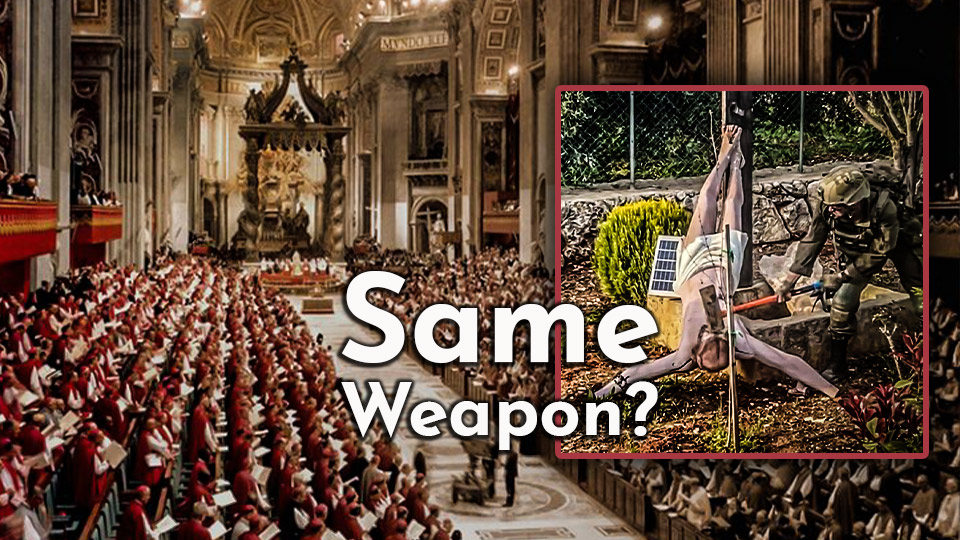
A shocking act of desecration in the Middle East becomes a lens for examining the Vatican II controversy and the transformation of Catholic teaching in the modern age. It seems that the sledgehammer used by the Israeli solider to smash the crucifix was the same one used at Vatican II to smash Catholicism.
“You have heard that it hath been said, Thou shalt love thy neighbour, and hate thy enemy. But I say to you, Love your enemies: do good to them that hate you: and pray for them that persecute and calumniate you.” (Matthew 5: 43-44)
As has been widely reported and denounced, an Israeli Defense Forces soldier was recently photographed in Lebanon using a sledgehammer to smash the head of Our Lord on the cross. As horrifying as the action is in the eyes of Christians, it is undoubtedly the case that many Jews were also distressed by the spectacle of such intense hatred for the Christian religion. Indeed, most Jews would surely view this action with contempt, realizing that it is not only deplorable in itself but also something that would tend to feed anti-Semitism. It is worth considering the anti-Christian hatred behind the sledgehammer of the Israeli soldier, especially because it was the same spirit that animated the sledgehammer used against Catholicism at Vatican II.
It is worth considering the anti-Christian hatred behind the sledgehammer of the Israeli soldier, especially because it was the same spirit that animated the sledgehammer used against Catholicism at Vatican II.
For an eloquent introduction to at least some of the root causes of such anti-Christian hatred among some Jews, we can consider the words of Albert Memmi (1920 – 2020), a Jewish man from Tunisia who had relocated to France, from his 1962 book, a Portrait of a Jew:
“Do Christians realize what the name of Jesus, their God, can mean to a Jew? . . . To all Jews, even if they are atheists, the name of Jesus is the symbol of a threat, of that great threat that has hung over their heads for centuries and which may, any moment, burst forth in catastrophes of which they know neither the cause nor the prevention. That name is part of the accusation, absurd and frenzied, but so efficiently cruel, that makes social life barely livable. That name has, in fact, come to be one of the signs, one of the names of the immense apparatus that surrounds the Jew, condemns him and excludes him. I hope my Christian friends will forgive me. That they may better understand, let me say that to the Jews, their God is, in a way, the Devil, if, as they say, the Devil is the symbol and essence of all evil on earth, iniquitous and all-powerful, incomprehensible and bent on crushing helpless human beings.”
There is something refreshingly honest in this, even though it is offensive to Christians. Of course, not all Jews feel this way, but it certainly resonates with what Saul felt towards Christians before Our Lord set him on the path of becoming St. Paul. We wish Memmi would not have thought this way, but we can understand it.
Another passage from Memmi’s book provides a somewhat extreme manifestation of the dislike that he and certain other Jews felt towards Christ:
“One day in Tunis, an idiot Jew (we always had a certain number of them who haunted cemeteries and community gatherings) seeing a Christian funeral pass, was suddenly seized with an uncontrollable rage. Knife in hand, he flung himself on the funeral procession which scattered terror-stricken in all directions. But the idiot, paying no attention to the crowd screaming in terror, rushed straight to the acolyte . . . grabbed the cross out of his hands, flung it on the ground and trampled it furiously. I did not understand his action until later. Anxiety expresses itself as best it can; the idiot reacted in his own way to our common malaise before that world of crosses, priests and churches, those concentrated symbols of the hostility, the strangeness of the world that surrounds us and assails us the moment we leave the narrow confines of the ghetto. It is, in short, impossible not to notice that breach which the religion of non-Jews introduces into the life of the Jew, that separation of the Jew’s daily life from that of his non-Jewish fellow-citizens, no matter how independent their thought of or their loyalty to traditional dogmas.”
Although only the “idiot” interrupted the Christian funeral and trampled the cross, Memmi saw that many Jews experienced the type of anxiety about Christianity that spurred the outburst.
When we see such persistent displays of anti-Christian hatred, we must assume that it has been indoctrinated on a wide scale.
This appears to be essential context for understanding the photograph of the Israeli soldier smashing the head of Jesus with a sledgehammer in Lebanon. The Israeli Defense Forces condemned the soldier’s actions, but . . . one cannot but recognize the stunning similarity to the scene of the idiot from Albert Memmi’s book. When we see such persistent displays of anti-Christian hatred, we must assume that it has been indoctrinated on a wide scale.
For a closer look at how this could happen, we can consider a book by a famous Jewish historian, Professor Jules Isaac (1877 – 1963). His Jésus et Israël, first published in 1948, was translated into English with this foreword in 1971:
“To state that this book was written over twenty years ago is to run the risk of having the prospective reader set it aside unread. Yet it is brought out today in the United States precisely because the time seems ripe for a wide reading public’s interest. Vatican Council II has awakened many Christians to the necessity of revising their attitude regarding the Jews. However, it is doubtful whether the conciliar statement on the Jews would have taken shape at all had not Jules Isaac, eighteen years prior to the Council’s voting, compelled European Christians to come face to face with the responsibility of the centuries-old Christian teaching in the development of a mentality that made the Holocaust of six million Jews possible.”
There are some important concepts in this brief introduction:
- Jules Isaac and his book were vital to the making of Vatican II’s Nostra Aetate.
- The book sought to awaken Christians to the “necessity of revising their attitude regarding the Jews.”
- Isaac wanted Christians to accept responsibility for the Holocaust.
Already with these few words, we have a very definite accusation that Christianity caused the Holocaust and an accompanying assertion that Christians must therefore collectively accept responsibility and reshape their religious beliefs. There is an unmistakable premise that the Jews occupy a moral high ground and have a right, if not duty, to chastise and reform the murderous Christians.
There is an immense difference between objecting to the teachings of another religion and demanding that the other religion change its teachings to fit our own religion.
Turning to the text of the book, we find that Isaac’s primary focus was to dispute the historical accuracy of the various New Testament claims about the Jews. Isaac’s strongest words were understandably directed against the following passage from the Gospel of St. Matthew:
“And the governor answering, said to them: Whether will you of the two to be released unto you? But they said, Barabbas. Pilate saith to them: What shall I do then with Jesus that is called Christ? They say all: Let him be crucified. The governor said to them: Why, what evil hath he done? But they cried out the more, saying: Let him be crucified. And Pilate seeing that he prevailed nothing, but that rather a tumult was made; taking water washed his hands before the people, saying: I am innocent of the blood of this just man; look you to it. And the whole people answering, said: His blood be upon us and our children.” (Matthew 27: 21-25)
Although Christians believe that these words were divinely inspired and without error, we can obviously understand why a Jewish person might object to them. For our part, we could similarly object to the reality that non-Christian religions believe and teach that Jesus was not who He said He was — and, by logical extension, that Our Lord was a madman or a liar. There is, however, an immense difference between objecting to the teachings of another religion and demanding that the other religion change its teachings to fit our own religion.
Here, though, is what Isaac wrote about the concept of deicide derived from St. Matthew’s words above:
“‘Deicide.’ At what moment did the defamatory epithet appear, the brilliant find — itself murderous — which would be made into an indelible brand, generating frenzies and crimes (homicide, genocide)? It is impossible to say exactly. But we can discern in the roiled stream of Judeo-Christian polemics the current whence it issued. The contents of the Gospels, begun in the mid-first century, carry visible marks of these polemics; this is particularly true of the first Gospel, Matthew’s, and the fourth, John’s.”
Isaac chose not to hide his contempt for Christianity here — and he placed the primary blame on St. Matthew and St. John. As a historian who saw fit to write a book denouncing Christianity, he most certainly understood that by denouncing the Gospels as full of malicious lies, he was attacking the entire Christian religion. But if the entire Christian religion is a malicious lie, as Isaac sought to prove, then Christ was also a madman or a liar.
Anyone who would modify Christianity to fit anti-Christian demands would effectively work to abolish the religion already by grafting anti-Christian beliefs onto the religion given to us by God.
Isaac did not stop there, for he needed to accuse Christians of perpetuating murderous beliefs:
“The next Christian accusation brought against Israel, the accusation of deicide, an accusation of murder which is itself murderous, is the most serious, the most poisonous: it is also the most iniquitous.”
Isaac was damning the entire Christian religion as murderous and iniquitous. Naturally, then, he insisted that Christians reform their teaching:
“Anti-Judaism will retain its virulence as long as the Christian Churches and peoples do not recognize their initial responsibility, as long as they do not have the heart to wipe it out. Latent anti-Semitism exists everywhere, and the contrary would be surprising: for the perennial source of this latent anti-Semitism is none other than Christian religious teaching in all its forms, the traditional and tendentious interpretation of Scripture, the interpretation of which I am absolutely convinced is contrary to the truth and love of him who was the Jew Jesus. The Jewish problem is not only a temporal problem; it is first and fundamentally a spiritual problem, whose resolution can be found only in a profound spiritual and religious renewal.”
It is a wonder why he did not let his hatred of Christianity run its logical course and demand the abolition of the religion altogether. In practice, though, anyone who would modify Christianity to fit anti-Christian demands would effectively work to abolish the religion already by grafting anti-Christian beliefs onto the religion given to us by God.
And so we have to ask — is this hatred of Christianity and Christians taught today? If so, is there any mystery as to why the Israeli soldier smashed the head of Our Lord with a sledgehammer? We should not follow Isaac in demanding that other religions change how they view and teach their religion, but we can nonetheless observe that teaching hatred of Christ and Christians invariably inspires hatred of Christ and Christians.
If he had lived to see it, surely Professor Isaac would have delighted in this neutering of Catholicism and uncrowning of Christ the King.
But, for Catholics, there is a more disturbing question: why did Isaac get to help change Catholic teaching not only through his influence of Nostra Aetate but also by influencing the beliefs of Cardinal Augustin Bea, who was among the handful of most important figures at the Council? John XXIII charged Bea with directing the Council’s efforts to promote ecumenical relations with other Christians and to produce the document on the Jewish people (which was broadened to include all non-Christian religions). Somehow, though, all of Bea’s efforts worked to diminish the Catholic religion. As discussed in a previous article, Bea had his hands on most of the destructive “reforms” associated with Vatican II, but we can see his general orientation (away from Catholicism) from two statements from his The Church and the Jewish People:
- “The aim of the Church is to promote unity among men and nations in every field of activity. Nevertheless, since she herself is pre-eminently a religious society, it is natural that her chief endeavor should be to foster harmony and collaboration with other religions and therefore to pay particular attention to what she has in common with them.” (p. 41)
- “The method used by [Nostra Aetate] is to seek in each of the various religions its specific contribution to the solution of man’s unending questioning and to the religious needs of the human heart.” (p. 43)
Gone is the idea — so offensive and dangerous to Isaac — that the Catholic religion was correct and all souls needed to belong to it. Instead, the Catholic Church (according to Bea) had the role of uniting all men by promoting harmony among various religions. If he had lived to see it, surely Professor Isaac would have delighted in this neutering of Catholicism and uncrowning of Christ the King.
And yet that is not where the story ends.
Staggeringly, this reminds us of Archbishop Marcel Lefebvre’s words about Bea in his They Have Uncrowned Him:
“‘Freemasons, what do you want? What do you ask of us?’ Such is the question Cardinal Bea went to ask the B’nai B’rith before the beginning of the Council. The interview was announced by all the newspapers of New York, where it took place. And the Freemasons answered that what they wanted was ‘religious liberty!’ — that is to say, all the religions put on the same footing. The Church must no longer be called the only true religion, the sole path of salvation, the only one accepted by the State.” (p. 214)
How is it that the desires of Jules Isaac and the Jewish B’nai B’rith have been so perfectly realized in what has transpired over the past sixty years?
Bea’s secretary, Fr. Stjepan Schmidt, wrote of the cardinal’s legacy in his biography, Augustin Bea: The Cardinal of Unity:
“A French bishop wrote: ‘For history Cardinal Bea will doubtless be seen as the man chosen by providence who put all his efforts into reconciling the Catholic Church with Judaism, and who set a definitive goal for this movement within the church.’ I do not think I am wrong in thinking the most important influence on Cardinal Bea in his performance of this historic task was his relationship with Pope John XXIII. It was the pope who sent Professor Jules Isaac to him in June 1960, asking him to see what could be done.” (p. 535)
Today, sixty-five years later, we see “what could be done,” as the Mystical Body of Christ has been disfigured to fit the anti-Christian desires of those who despised Catholicism.
Going back to the passage from the Gospel of St. Matthew that Isaac found so odious, who are the “children” of those who persecuted Our Lord if not those who persecute Him today for the same reasons? Jesus, true God and true man, was hated then by some Jews for asserting His divinity. Those who hate Him today manifest their hatred by attempting to rob Him of His divinity — asserting that He was only a man, and a delusional one at that — and doing what they can to disfigure the Mystical Body of Christ. In this light, the words of the Jews — “His blood be upon us and our children” — were more of a prophecy than a curse.
And yet that is not where the story ends. Saul might have echoed these words as he persecuted Jesus and His followers. But, when touched by God’s grace, that blood of Our Savior was upon him in another way, by washing him from his sins and setting him on the path of becoming St. Paul. If, as Jesus commanded us, we must love those who hate us today, we should pray that they too will follow the path of St. Paul. May God grant the Israeli solider and all those like him the grace to become a great saints. Immaculate Heart of Mary, pray for us!