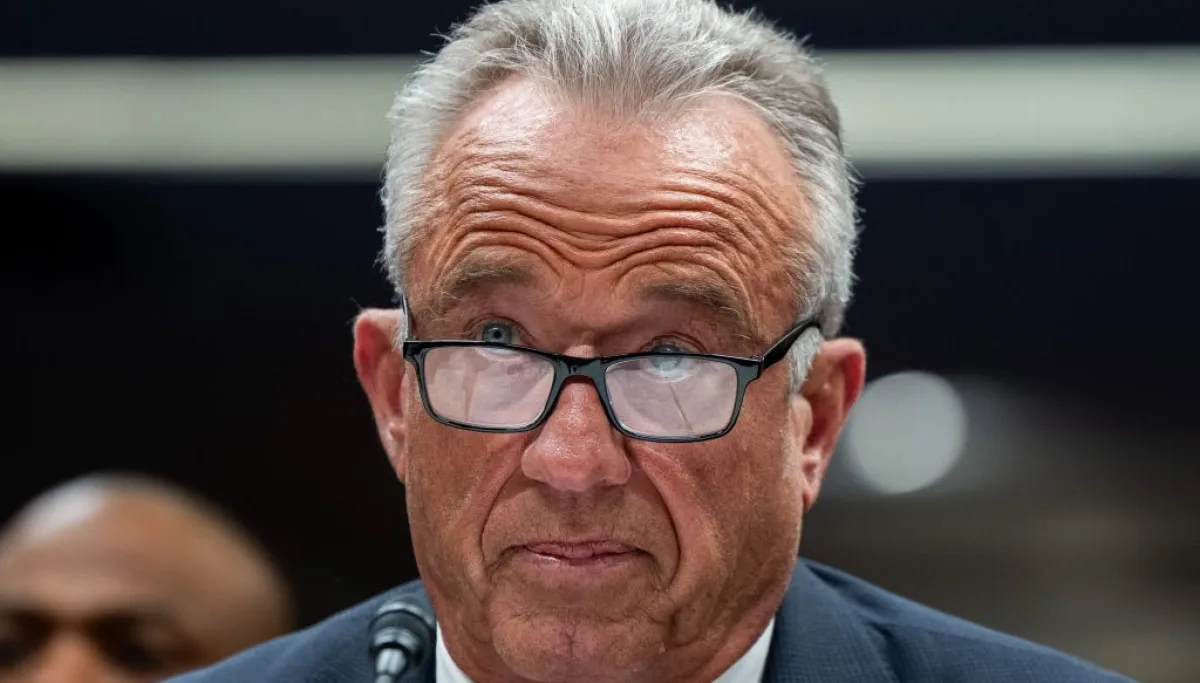
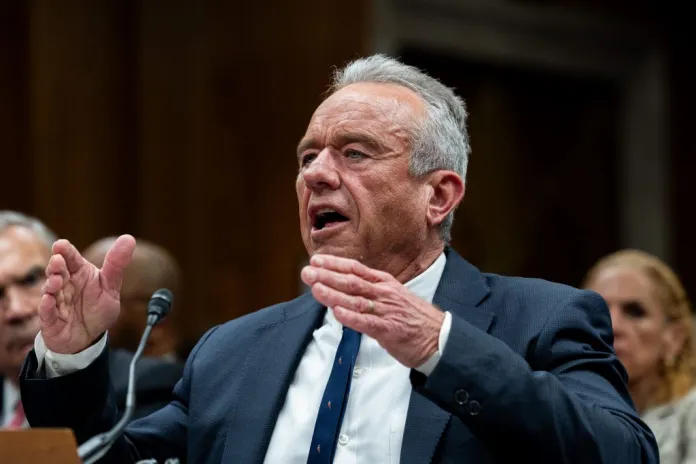
Health and Human Services Secretary Robert F. Kennedy Jr. fielded tough questions on a host of issues from Democrats and Republicans on Tuesday during two congressional budget hearings.
The White House requested a budget cut for HHS of roughly 12.5%, or nearly $16 billion, as well as the consolidation of several sub-agencies into the new Administration for a Healthy America.
The week of hearings, his first appearance before Congress since last fall, has been a test for Kennedy and the strength of his Make America Healthy Again agenda ahead of the midterm elections.
MAHA-MAGA TENSIONS GROW AHEAD OF MIDTERM ELECTIONS
The discussions on Tuesday touched on a variety of issues under HHS’s jurisdiction, ranging from vaccines and Medicare Advantage to the National Institutes of Health.
Here are the highlights from both hearings:
Defense of controversial vaccine policy
On multiple occasions during the hearings, Kennedy insisted that he is not anti-vaccine but rather wants to ensure all vaccines have placebo-controlled clinical trials to test for safety.
“I’m not anti-vax. I’ve never been anti-vax,” Kennedy said before the House. “I’m putting a billion dollars into vaccine research right now at the NIH and [National Cancer Institute]. If I was anti-vax, I wouldn’t be doing that.”
Kennedy also referenced HHS’s work on a universal flu vaccine and cancer vaccines as evidence that he does not “believe all vaccines are bad.”
The secretary, also during the House hearing, denied multiple times that he and his team had been counseled by White House advisers to tone down their rhetoric and policy making on vaccine reform, a key portion of the MAHA agenda, until after the midterm elections.
Kennedy also denied any knowledge of polling conducted by the Trumpworld research group Fabrizio Ward that found the vast majority of Americans support access to vaccines for children, including polio and measles vaccines.
When asked if White House chief of staff Susie Wiles told Kennedy not to talk about vaccines ahead of the elections this November, Kennedy said “no.”
White House health adviser Calley Means gave a similar response when asked about public opinion polling on vaccines during a Politico Health Summit last Thursday, held concurrently with Kennedy’s hearings before the House Ways and Means Committee and the House Appropriations Committee.
Means, a close ally of Kennedy, said HHS is “not backing down” on vaccines.
“I think that these are just ongoing conversations about where to prioritize, on what’s leading to a problem in American healthcare, and we’re not apologizing for what’s happened on vaccines,” Means said.
Funding cuts and grant changes for NIH
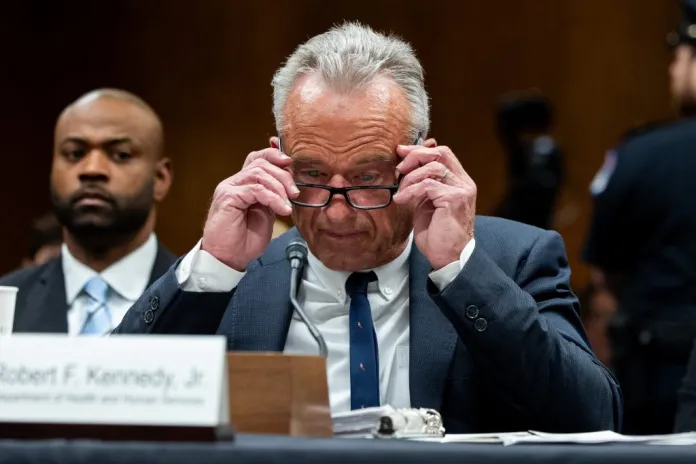
Republicans and Democrats on the Senate Appropriations Committee expressed bipartisan agreement on the importance of NIH funding for basic biomedical research.
Last year, Congress rebuffed the White House’s 2026 budget request to reduce the NIH’s research budget by 40%, instead increasing funding for the agency by $415 million over 2025 levels.
Sen. Shelley Moore Capito (R-WV) said in her opening statement that the Trump administration’s budget for research is “much more reasonable” than last year but still disagreed with the proposed $5 billion cut to NIH research.
Capito said U.S. leadership in medical science “depends on the medical research across the country supported by the NIH.”
Sen. Susan Collins (R-ME) pressed Kennedy on how the Trump administration’s general prohibition of diversity, equity, and inclusion language has affected research in women’s health at NIH and other agencies.
“The administration’s emphasis on canceling diversity-related grants has resulted in less research aimed at women’s health. It is well established that disparities in women’s health exist,” Collins said.
Kennedy said that his department is still conducting general research on key health issues that disproportionately affect women, such as Alzheimer’s disease and autoimmune diseases, but Collins said women-specific research is still necessary.
“I still think we have a problem if grants are being scanned for the word women and then … are not funded,” Collins said.
Healthcare spending or war in Iran
Democrats during both hearings had heated exchanges with Kennedy regarding reductions in healthcare spending compared to the costs of Trump’s war in Iran.
Rep. Frank Pallone (D-NJ), the leading Democrat on the Energy and Commerce Committee, referenced a statement made by Trump earlier this month that there is not enough taxpayer money to spend on projects such as universal healthcare or child care because of the costs of defense and conducting war.
“Do you know what Trump’s reckless, illegal war with Iran is costing us right now? Do you have any idea?” Pallone asked, later citing an American Enterprise Institute study that estimated the war in Iran has so far cost more than $25 billion.
Kennedy, however, evaded the question, saying instead that Pallone used to be a champion for families who believed their children had suffered side effects from vaccines.
The secretary also did not respond to questions about whether the administration would seek further reductions in spending for healthcare entitlement programs in another budget reconciliation bill this summer to fund the Iran war, as several media outlets have speculated.
Sen. Patty Murray (D-WA) also asked Kennedy about funding the Iran war instead of healthcare and education.
Murray said it is going to be difficult to write an appropriations bill this year because “the president is requesting a trillion and a half in new funding for defense, which cuts our non-defense incredibly.”
Kennedy responded by blaming Democrats for the war.
“The Democratic Party for the last 20 years has said Iran cannot have a nuclear weapon, and they’ve kicked that down the road,” Kennedy said.
Support for pro-vaccine CDC nominee
Rep. Raul Ruiz (D-CA), an emergency medicine physician by training, grilled Kennedy on whether he supports Trump’s nominee to lead the Centers for Disease Control and Prevention after long-term turmoil in the agency’s leadership.
Kennedy fired the first Senate-confirmed CDC director, Susan Monarez, last August after a public disagreement about vaccine policy. Monarez told the Senate in an oversight hearing after her firing that she was dismissed because she refused to rubber-stamp Kennedy’s request to reduce the childhood vaccine schedule.
Trump’s new CDC pick, Dr. Erica Schwartz, is a veteran of the first Trump administration and served most of her career in the U.S. Public Health Service Commissioned Corps. Schwartz was in charge of ordering viral tests during the COVID-19 pandemic.
Kennedy told Ruiz that he had spoken to Schwartz multiple times since she was nominated for the CDC position, but that he did not speak directly with Trump about the appointment. Instead, Kennedy said, his senior counsel adviser, Chris Klomp, spoke with the president.
Ruiz highlighted a quote from Schwartz’s time in the first Trump administration in which she said disease prevention through vaccines allows public health officials to “change lives before illness ever begins.”
The congressman said Schwartz’s support for vaccines “runs contrary to [Kennedy’s] dangerous anti-vaccine crusade.”
Industry pressure prompts Medicare Advantage change
During an exchange with Rep. Alexandria Ocasio-Cortez (D-NY), Kennedy said the Trump administration reversed the course of Medicare Advantage reimbursement rates following pushback from the insurance industry.
Medicare Advantage, or privatized health insurance plans that follow Medicare rules for seniors, has been criticized by both Democrats and Republicans in recent years as costing more taxpayer money than traditional fee-for-service Medicare administered by the federal government.
In January, Medicare administrator Dr. Mehmet Oz announced that HHS would be keeping the reimbursement rate for Medicare Advantage plans in 2027 effectively the same as this year. This triggered an intense lobbying campaign from insurance companies and other entities in the healthcare economy.
But earlier this month, the Trump administration reversed course and raised reimbursement rates, upping the amount of Medicare Advantage spending by $13 billion for 2027.
Ocasio-Cortez pressed Kennedy on this decision after the pair agreed that health insurance companies are “fleecing the public.”
DR. OZ ANNOUNCES MEDICAID FRAUD AUDIT FOR ALL 50 STATES
“We got a huge blowback,” Kennedy said, “not only from the industry, but providers and everybody else who said, ‘We are going to experience closures. We’re going to experience places where you cannot get insurance. It is going to leave all these patients high and dry.’”
Kennedy said that his job is to “balance the impact on patients if there are no options in those areas.”