Israel and Lebanon, with a heavy push from the Trump administration, are working toward a historic agreement that could end Hezbollah’s decadeslong stranglehold on the latter country.
The two countries are not directly at war with each other, even though representatives agreed to a 10-day ceasefire that commenced on Thursday, two days after the ambassadors from each country met in Washington, D.C. to hold direct talks for the first time in decades. Hezbollah did not agree to the ceasefire and may not follow it, nor was the group represented in those talks at the State Department.
Israel and the Lebanese government seemingly find themselves on the same side, along with the United States, all of whom want to remove Hezbollah’s influence and military capabilities to ensure Israel and Lebanon can coexist without the U.S.-designated terrorist group on its doorstep for the first time in more than 40 years.
“We all stand before a new stage,” Lebanese President Joseph Aoun said in a televised address on Friday. “It is the stage of transition from working to halt the gunfire to working on permanent agreements that preserve the rights of our people, the unity of our land, and the sovereignty of our homeland.”
He has said the ceasefire agreement was a necessary prelude to more far-reaching negotiations, while also seemingly trying to distance his government from the Iranian regime, adding, “We are no longer a card in anyone’s pocket, nor a field for anyone’s wars.”
The State Department released a statement on Thursday that the Israeli and Lebanese governments signed off on that said they request the U.S. “facilitate further direct negotiations between the two countries with the objective of resolving all remaining issues, including demarcation of the international land boundary, with a view to concluding a comprehensive agreement that ensures lasting security, stability, and peace between the two countries.”
Andrew Tabler, a former State Department and National Security Council Middle East official, told the Washington Examiner, “There’s been a long hiatus here [with] direct talks, and hopefully, I think it’s a real accomplishment for the administration to get the two parties to talk directly.”
“It’ll allow for the potential of pulling the rug out from under Hezbollah, whether that ends up being the case, I think, depends on how the ceasefire goes in the short term, and then, how the talks proceed, and what they can include and are they able to, particularly the Lebanese government, enforce,” Tabler, who now works at the Washington Institute for Near East Policy, added.
Hezbollah broke the ceasefire that had been in place on March 2, which it said was in response to the U.S. and Israel beginning their war against Iran. Israeli forces have killed more than 2,200 people, a tally that does not distinguish between Hezbollah fighters and civilians, and Hezbollah rocket fire into Israel has killed 14 people since the restarting of hostilities.
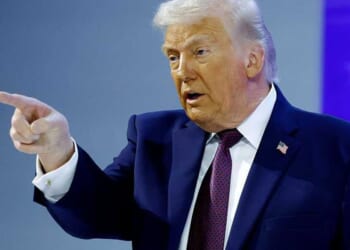
On Friday, a day after the ceasefire went into effect, President Donald Trump declared the U.S. had “PROHIBITED” Israel from “bombing Lebanon.”
In the past, Hezbollah had been too powerful politically and militarily, especially with the help of its Iranian backers, who for a long time could easily travel to and from Lebanon through Syria before the collapse of the Assad regime. Israel’s military has decimated Hezbollah over the last couple of years, including assassinating Hezbollah Secretary-General Hassan Nasrallah, among several other senior leaders.
“Hezbollah is down, but it’s not out, and it’s not out because it still has this influence over Lebanon that’s weakening, but it’s still there,” Fadi Nicholas Nassar, a senior fellow at the Middle East Institute, told the Washington Examiner. “So here’s what you do: On the one hand, you start to empower the Lebanese stake. You empower the Lebanese armed forces. You empower its formal institutions. You give support like we’re hearing from President Trump.”
Israeli Prime Minister Benjamin Netanyahu acknowledged on Friday that “the dismantling of Hezbollah … will not be achieved tomorrow. It requires sustained effort, patience, and endurance, and it requires wise navigation of the diplomatic field,” adding, “The road to peace is still long, but we have begun it.”
“At his request, we will give an opportunity to promote an integrated political and military solution with the Lebanese government,” Netanyahu said of Trump, even though they “have not yet finished the job” of destroying Hezbollah’s “remaining rocket threat and the drone threat.”
TRUMP AND IRAN ANNOUNCE STRAIT OF HORMUZ ‘COMPLETELY OPEN’ FOR REST OF ISRAEL-LEBANON CEASEFIRE
Trump said he spoke with both Netanyahu and Aoun on Thursday and would invite both to the White House for “meaningful talks” at an undetermined time.
Hezbollah still has capabilities in southern Lebanon, even though it has been badly diminished during the war, and it’s unclear whether the Lebanese government will be able to disarm Hezbollah as Israel has been seeking to do for years, but there appears to be momentum behind them.