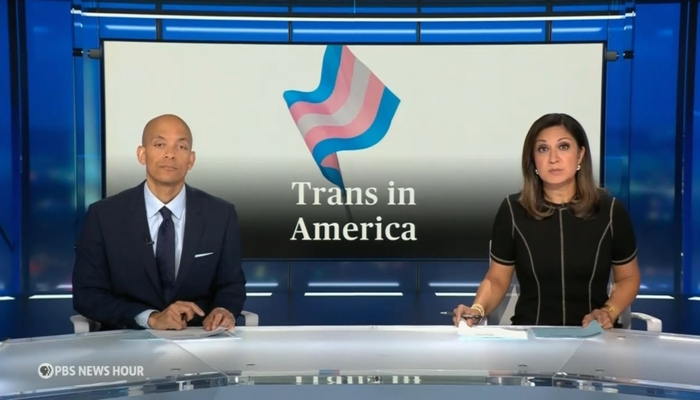
The PBS News Hour doubled down on its advocacy for transgender surgery for minors on Thursday evening, reacting with condescension and alarm to President Trump’s move to restrict so-called “gender-affirming medical care for minors.” This time PBS paired up with its (former) taxpayer-funded outlet National Public Radio.
Co-anchor Amna Nawaz: The Trump administration today took its most significant moves yet in a wide-ranging effort to restrict gender-affirming medical care for minors.
Co-anchor Geoff Bennett: The Department of Health and Human Services unveiled a series of actions meant to effectively ban transition-related medical treatments nationwide for those under the age of 18.
Reporter Stephanie Sy followed a clip from Health and Human Services Secretary Robert F. Kennedy Jr. stating “Sex-rejecting procedures are neither safe nor effective treatment for children with gender dysphoria.”
Sy: We will delve into those controversial assertions in a moment, but we should say that, before these policies are enacted, there’s a lengthy rulemaking process that has to take place and groups such as the ACLU are already threatening lawsuits….
Her NPR guest, a health policy reporter, was no less appalled.
Selena Simmons-Duffin, NPR: Yes, I mean, children’s hospitals have been pioneers in this treatment for transgender young people, which can include puberty blockers, hormone therapy. Very rarely, it can include surgery. But part of the reason why children’s hospitals are attractive to parents, children who are considering this treatment, is because they’re interdisciplinary and they have really high-quality teams, that you can talk to therapists, you can talk to psychiatrists, you can really get that full spectrum of care. And I think that if these rules are enacted, this care will no longer happen at hospitals across the country….
Simmons-Duffin does not bring journalistic skepticism to her transgender coverage, only cheerleading. She had previously handed over the NPR microphone to President Biden’s transgender Assistant Secretary of Health and Human Services Secretary Rachel Levine in 2022, when Levine was engaged in a road trip to, in the words of NPR anchor Mary Louise Kelly, “urge medical students to fight political attacks against trans young people and their families.”
Sy provided a classic example of condescending liberal gatekeeping with a side of denial of basic biological fact. Does someone have to be a doctor to tell the difference between a man and a woman?
Sy: For all the talk of gold-standard science at the announcement today, there were a few nonscientists who made declarative statements dismissing gender dysphoria altogether. I want to play what Jim O’Neill, deputy secretary at HHS, who has no medical degree, had to say.
Jim O’Neill, U.S. Health and Human Services Deputy Secretary: Men are men. Men can never become women. Women are women. Women can never become men. At the root of the evils we face, such as the blurring of the lines between sexes and radical social agendas, is a hatred for nature as God designed it.
Simmons-Duffin avoided the actual issue of minors receiving so-called gender-affirming care while criticizing O’Neill.
Simmons-Duffin: ….I think you can really hear ideology at play in those statements from Jim O’Neill. I mean, he did not say that evidence doesn’t support the use of threat treatments among the pediatric patients because they have these side effects, et cetera, et cetera. No, he was saying men cannot become women, women cannot become men. He’s speaking about adults. And that is kind of the foundation of understanding what it means to be transgender….
Simmons-Duffin cited the American Academy of Pediatrics as one of the brave groups “composed of doctors that actually see these patients and engage with this care don’t agree and really roundly reject this characterization….”
As we’ve noted here before, the institutional credibility of the Democratic hacks at AAP has been on a well-deserved decline since it recommended masking up toddlers, requiring student athletes to compete in masks, and flushing down the memory hole its own previous insistence that seeing faces is critical for early childhood development.