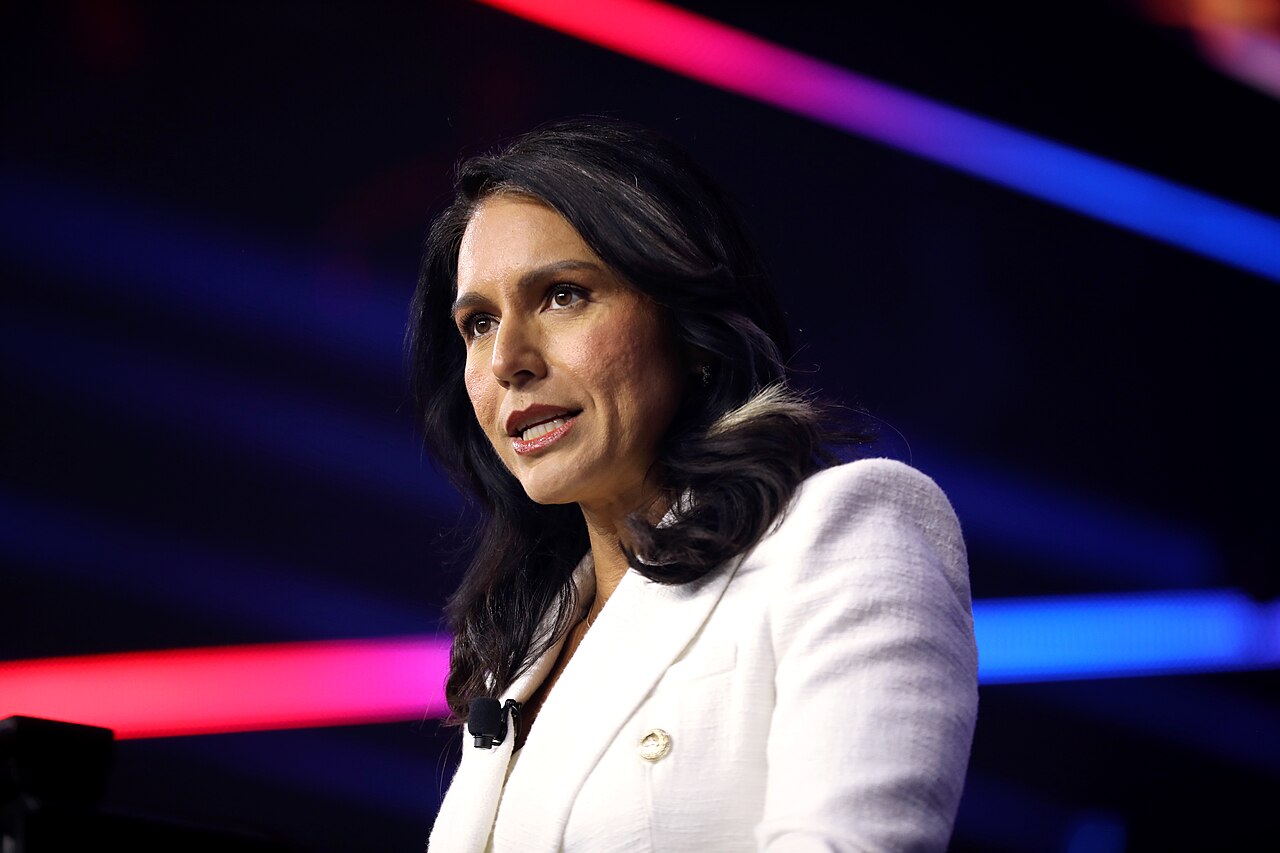
Tulsi Gabbard, the director of national intelligence, is under attack again. A so-called “whistleblower” filed a complaint against her alleging wrongdoing so sensitive that its details supposedly could not be disclosed. The complaint was reviewed and closed because it lacked credibility. That determination was made by Tamara Johnson, a career official who served as the acting inspector general of the intelligence community during the Biden administration. That should have been the end of the story.
Instead, the secrecy surrounding the complaint has been repackaged as proof that something terrible must have occurred. The absence of evidence is now being marketed as evidence itself.
Enter The Wall Street Journal. In a breathless piece published this week, the WSJ reported on the existence of this “sensitive” complaint while strongly implying that its classification alone suggests guilt. To heighten the drama, the article likens the episode to a John le Carré novel. At that point, the piece collapses into accidental self-parody.
In le Carré’s most famous and definitive work, Tinker, Tailor, Soldier, Spy, the entire plot revolves around a compromised source feeding supposedly ultra-sensitive intelligence into the system, sending British intelligence on a manhunt for a threat that does not exist. The secrecy is not proof of truth. It is the mechanism of the deception. The “sensitive” intelligence is the hoax.
So yes, the comparison is apt. Just not in the way The Wall Street Journal intended.
By invoking le Carré, the authors inadvertently describe their own method with remarkable precision. Invent or exaggerate something supposedly sensitive. Elevate the classification itself into the story, and let the audience infer guilt from secrecy alone. This is not journalism. It is narrative laundering, where insinuation substitutes for evidence and secrecy substitutes for proof.
The WSJ never establishes that Gabbard did anything wrong. It does not even claim to know what she supposedly did. The “scoop” is simply that a classified complaint exists. Worse still, the only fact that actually matters is quietly buried deep in the article: The complaint was closed because it was not credible. Judging by the outrage the piece generated across left-wing media, most readers never reached that part.
There is no scandal here. What exists instead is a familiar and well-worn playbook.
The Anatomy of a Hoax
The mechanics are simple and have been deployed repeatedly over the last decade.
First, make an allegation against a political target. The allegation does not need to be supported by evidence. It does not even need to be coherent.
Second, wrap the allegation in extreme classification. Make it “super sensitive,” bury it in a restricted annex, or otherwise render it inaccessible.
Third, leak the existence of the allegation and let the secrecy do the work. The absence of detail generates intrigue, classification becomes a proxy for gravity, and that gravity is then presented as proof.
This is exactly what CIA Director John Brennan, DNI James Clapper, and FBI Director James Comey did with the Obama-ordered Intelligence Community Assessment in 2017. The objective of that assessment was to saddle the incoming president, Donald Trump, with the Russia-collusion narrative. The method was to launder the fraudulent Steele dossier, which alleged collusion between Trump and Russia, into something that appeared official.
In a manner uncannily reminiscent of a le Carré plot, Brennan, Clapper, and Comey solved the problem of how to launder a known fabrication into an intelligence product by embedding it in a highly classified annex of the ICA. The mere fact of its inclusion was then leaked to the media, with CNN breaking the story just days before Trump was sworn in, ensuring his presidency would be immediately engulfed by a manufactured scandal. That is how a lie that the FBI already knew to be false acquired the appearance of gravity solely because it was secret.
The Ukraine impeachment followed the same template. A so-called “whistleblower” complaint about a phone call President Trump had made was treated as inherently damning, not because it was substantiated, but because it was designated as sensitive. When President Trump released the actual transcript of the phone call to strip away the manufactured secrecy surrounding the complaint, it quickly became clear that no misconduct had occurred. By that stage, however, the false narrative was already entrenched, driven not by facts but by the earlier insinuation that something bad must have happened. Incredibly, the Ukraine whistleblower was represented by the same lawyer now behind the Gabbard complaint, laying bare the recycled playbook at work.
The same dynamic played out with the Steele dossier. When BuzzFeed released the full document, anyone could see it was riddled with ridiculous claims, falsehoods, contradictions, and embarrassing errors. Jake Tapper at CNN emailed BuzzFeed’s editor furiously complaining, preferring the public remain ignorant of the actual contents while the “sensitive” innuendo did its work. But it was too late. The Russia-collusion narrative had already embedded itself in the national consciousness.
The current attack on Gabbard follows this same template almost perfectly. A politically motivated individual files a baseless complaint. The complaint is wrapped in classification. That classification is then used to imply obstruction, delay, and wrongdoing even after the complaint is deemed not credible.
Gabbard’s Accountability Efforts
Tulsi Gabbard is not a random official caught in bureaucratic crossfire. She is one of the very few senior figures in this administration who has actively pursued accountability against the institutions that manufactured these earlier hoaxes.
It is no coincidence that The Wall Street Journal’s attack arrived just days after Gabbard was present at the FBI raid on the Fulton County election office. At President Trump’s direction, and in her role overseeing election security, she was on site as materials tied to the contested 2020 Georgia election were seized pursuant to a warrant. That fact alone speaks volumes about whom the president trusts. But it also explains the reaction. Democrats and their media allies do not want a proven fighter with real authority anywhere near investigations into their own conduct.
Earlier, in July 2025, Gabbard exposed Barack Obama’s central role in orchestrating the Russia-collusion hoax by releasing documents showing not only Obama’s involvement but also that U.S. intelligence agencies did not believe Russia preferred Trump. If anything, the evidence pointed in the opposite direction.
Contrast this with the Department of Justice’s recent handling of a complaint against D.C. Chief Judge James Boasberg. The story of Boasberg’s egregious anti-Trump bias was first reported by The Federalist. Instead of submitting documentary evidence, DOJ cited a Fox News clip. The complaint was promptly dismissed. The episode was performative, complete with public fanfare from Attorney General Pam Bondi, and ultimately ended in embarrassment.
Gabbard’s work is the opposite of performative. That dedication has unsurprisingly earned her powerful enemies, and she now faces these attacks largely on her own. Other officials who pursued similar accountability have been sidelined: Lindsey Halligan, who secured indictments against James Comey and Letitia James, is no longer U.S. attorney for the Eastern District of Virginia after her temporary appointment expired, and Ed Martin, who led anti-weaponization efforts at DOJ, has reportedly been removed from that role.
The real story is not the “scoop” or the supposed scandal. It is the relentless recycling of the same weaponized secrecy playbook and the media’s grotesque complicity each time, deployed to suppress anyone pursuing real accountability. Gabbard’s work cuts through that pattern, and the intensity of the backlash against her only underscores the point.