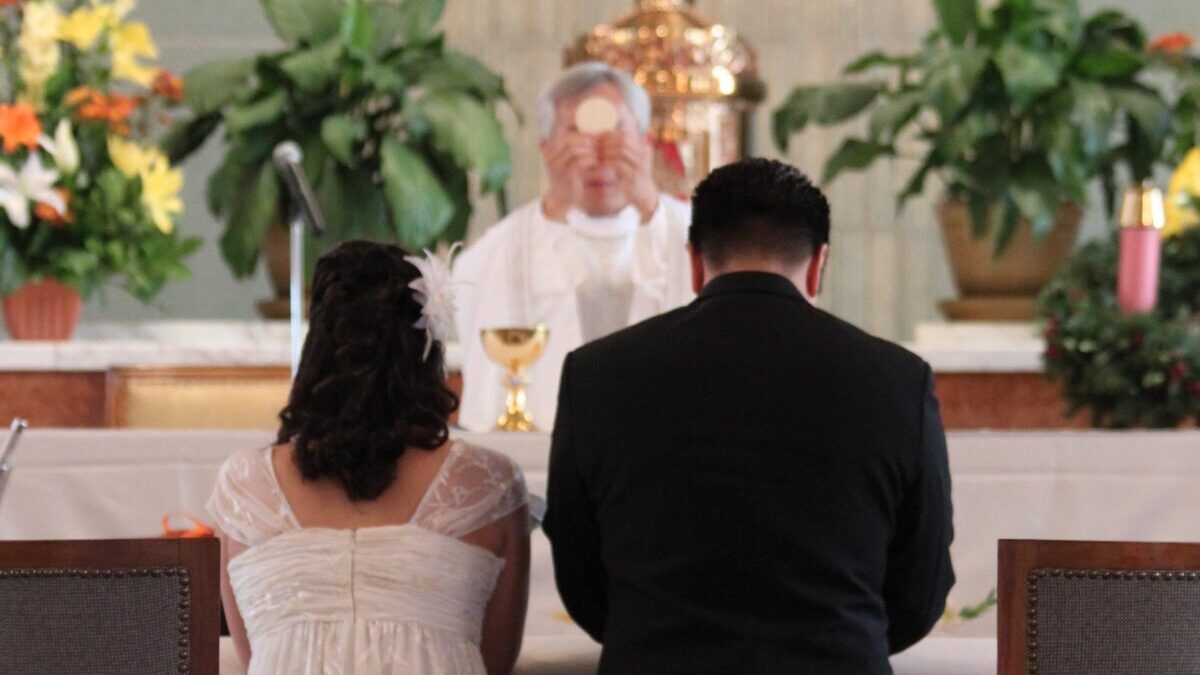
Catholic teaching holds that marriage is for life. Yet 28 percent of U.S. Catholics divorce. To remarry in the church, and avoid what Catholicism considers adultery, they must secure annulments from tribunals holding their marriages invalid at the time of the wedding. With a success rate of nearly 100 percent, annulments have come to be viewed as entitlements.
By contrast, Catholic spouses striving to honor their vows find little support from a church that seems to have adopted a U.S. divorce culture mentality. Pope Leo alluded to this crisis during his recent address to the Roman Rota, which hears annulment appeals and regularly overturns decisions by U.S. tribunals.
“I think the prevalence of affirmatives has certainly added to people’s concepts that annulments is purely a process rather than a real trial,” said Father Andrew Larkin, a priest and defender of the marriage bond in Savannah’s tribunal. “But I think the divorce factor is huge. I think one of the things that is probably quite prevalent because of divorce culture is that most people have an erred view of marriage not being for the lifetime …. No-fault has come to define marriage and take away that indissolubility to the point now that it’s touching upon invalidity.”
Indeed, the view that marriage is not for life is specifically embedded in our nation’s no-fault divorce laws, which recognize an automatic right of divorce to any spouse who unilaterally claims the marriage is irrevocably broken. These laws are clearly unconstitutional. But most tribunals require entry of a no-fault divorce judgment before they will accept an annulment petition. In turn, they rely on these one-sided judgments as proof of irreconcilability, despite research establishing that most marriages are low conflict with good chances for reconciliation.
Many priests also support parishioners in their efforts to secure divorces and annulments.
“I see a lot where it’s kind of like, ‘I’m on your side so let’s get you that annulment so now you’ll be able to be free,’” Father Larkin said, adding his serious concerns about spillover into tribunal efforts to protect valid marriages.
Priest and Arizona tribunal judge Father Nathanael Block receives “letters from priests saying this person deserves an annulment because they’re good people.” But annulment isn’t a right, he reiterated.
This entitlement mentality gets reinforced throughout Catholic culture too. For example, a spokesperson for Catholic Match, who reportedly has had multiple marriages, says the first step for dating after divorce is to “get your annulment.” Politicians admitting to infidelity secure annulments and even, in Newt Gingrich’s case, appointments as ambassador to the Holy See for their reported affair partner.
Annulments for Psychological Defects
Like civil law, canon law rightly permits marriages to be held invalid for defects like bigamy, marriage below legal age, consanguinity, and coercion. But around 95 percent of U.S. marriages that are annulled are held invalid for “defective consent,” a vague term that implies some sort of psychological or emotional deficiency related to judgment or reasoning. By contrast, not one annulment was granted for defective consent in 140 other countries, with an additional 37 granting only one or a handful.
Catholic author John Clark believes that many canon lawyers bewitched by pop psychology “psychobabble” have become judicial activists, relying on the vague definition of what constitutes “defective consent.” This is evidenced by the explosion in annulments.
He’s concerned too about the vetting of tribunal priests, noting the little-publicized scandal of a Catholic priest who resigned from a Delaware tribunal only after a reporter uncovered his story. Although the priest had left the Catholic Church, married another priest, and become an Episcopalian, he nevertheless continued to serve on the tribunal for 20 years. He’s now an Episcopal priest. How could this man possibly defend Catholic marriage?
Spouses Fight for Their Marriages
A Catholic I’ll call Mary, who spoke on condition of anonymity, is attempting to uphold her marriage in an ongoing annulment proceeding she described as shrouded in secrecy. “There is zero support from the tribunal for spouses like me,” she said, convinced the tribunal will ultimately find that her husband had a psychological defect at the time of their wedding that will be “magically” “healed in time for him to marry the other woman in the Catholic Church.”
Clark’s research confirms this pattern.
He married at 21, has been married for 33 years, and has nine children. Still, he firmly believes tribunals “would invalidate my marriage based on youth.” Indeed, long-term marriages are regularly annulled.
David Schoenberger’s wife of 18 years divorced him, secured an annulment, and remarried. He told me he pleaded for help from priests, tribunal judges, even his bishop, to no avail. Sadly, these stories are legion.
Church Needs to Act
In his address, Pope Leo stressed the importance of promoting reconciliation including, where possible, that tribunals uphold the validity of marriages. In reality, in the U.S. that doesn’t often happen.
Of the 194 U.S. Catholic dioceses, so far only Atlanta has officially supported the growing number of Catholic martyrs, called “standers,” who are defending the validity of their marriages.
For two decades, stander Bai MacFarlane has provided resources to Catholics who want to contest their divorces and annulments. “The Church is failing when we are told that annulment is like the 8th sacrament that provides healing after a failed marriage,” she said.
Roman Rota judge Cormac Burke said “not all failed marriages are entitled to be declared null, but it is fairly evident that if we can reduce the number of failures, we are going to have less petitions for nullity.” But this requires action.
The breakdown of marriage and family is often identified as the most important issue of our times. And the church has acknowledged the harm of no-fault divorce.
Yet efforts to engage U.S. church leadership on divorce reform have been met with silence. Church marriage ministries and programs to help couples experiencing marriage difficulties are rare. The Catholic marriage rate has plummeted. Priests rarely talk about marriage from the pulpit. Marriage preparation, required before Catholic couples marry, is a hodgepodge.
Father Larkin is hopeful, however, given the young priests he deals with who seem eager to properly prepare couples for marriage. He says U.S. bishops are now also focusing on marriage prep. And he’s impressed by the young couples he counsels. They are fearful of divorce, having experienced it with their own parents, and seem committed to shoring up their relationships.
Meanwhile, gray divorce among their elders continues to rise. “I think as things get worse, people have a real awakening,” Father Larkin added.
More than two decades ago, Pope John Paul II told the Roman Rota, “one cannot give in to the divorce mentality.” That’s already happened in the U.S. Let’s hope it’s not too late.