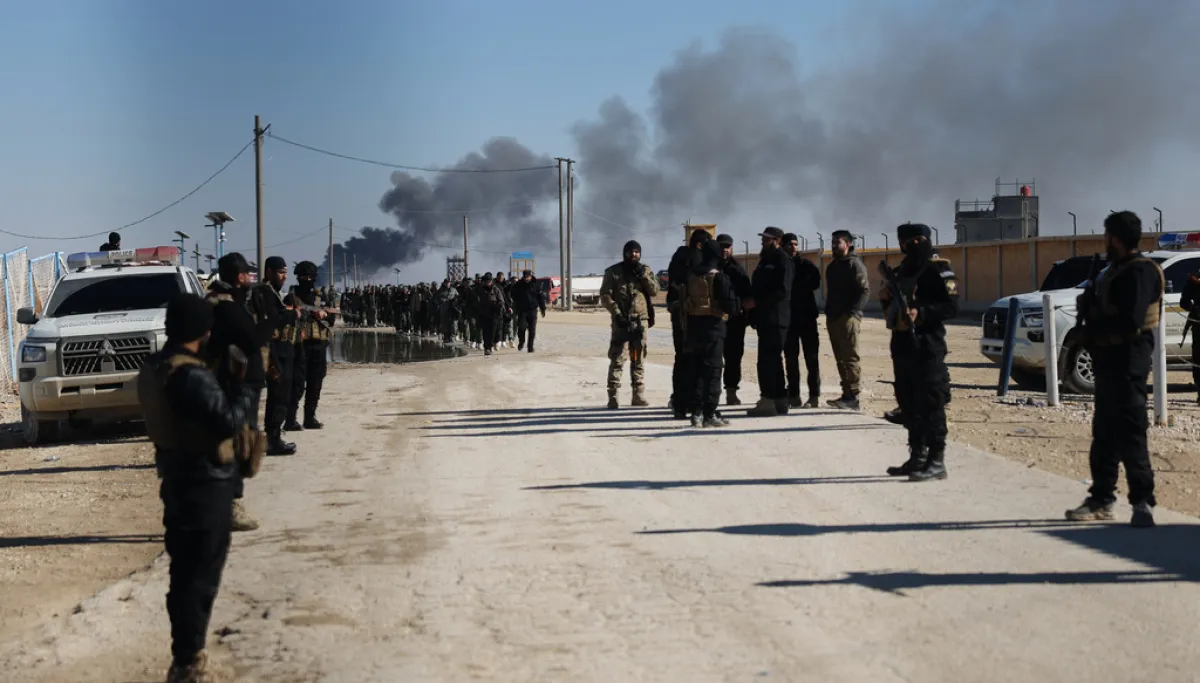
The United States launched a military operation to transfer thousands of ISIS prisoners from Syria to Iraq as fighting continues between the Kurdish Syrian Democratic Forces and Damascus.
U.S. Central Command announced the beginning of the operation on Wednesday, by which point it had already transported 150 Islamic State Group prisoners from northeast Syria to a “secure location” in Iraq. It is estimated that up to 7,000 ISIS prisoners could be transferred to Iraq.
“We are closely coordinating with regional partners, including the Iraqi government, and we sincerely appreciate their role in ensuring the enduring defeat of ISIS,” CENTCOM commander Adm. Brad Cooper said. “Facilitating the orderly and secure transfer of ISIS detainees is critical to preventing a breakout that would pose a direct threat to the United States and regional security.”
Fears revolving around over 50,000 ISIS prisoners held in Kurdish captivity in SDF-controlled territory reached a fever pitch over the past week, when Damascus launched an offensive against the SDF redoubt in northeast Syria. Several battles took place around some of the roughly 27 detention centers holding ISIS prisoners. Many ISIS fighters were able to take advantage of the chaos and break out, while others were simply released.
The figure of 7,000 ISIS prisoners that could be transferred to Iraq would be nearly the entirety of the 8,950 male ISIS members believed to be held in northeast Syria, according to the State Department.
Alongside the male former combatants are 43,250 “non-combatants, including approximately 25,000 children under 12 years old,” according to the State Department. Many of the women and children include wives of ISIS fighters and others who have been indoctrinated into the ideology. The alleged ISIS detainees hail from around 60 countries.
The transfer of ISIS detainees to the more secure Iraq is intended to prevent them from breaking out during government-Kurd fighting, but also could reflect Washington’s hesitance to trust Damascus with the high-value detainees. The Syrian military is made up primarily of former jihadists, many of them foreign, who took up arms in Syria for the purpose of establishing a caliphate. Videos posted on social media showed ISIS detainees rejoicing and greeting the government soldiers with cheers.
Syrian President Ahmed al Sharaa himself was first sent to Syria personally by former ISIS Caliph Abu Bakr al Baghdadi for the explicit purpose of establishing the terrorist group’s Syrian branch. The two split only due to leadership disputes, not any moral misgivings from Sharaa. He would go on to lead al Qaeda’s Syrian branch, the al Nusra Front, which he later rebranded into Hay’at Tahrir al Sham — the group that ultimately toppled the government of former Syrian President Bashar al Assad.
Syria’s military has entire units made up of foreign jihadists who haven’t renounced terrorism. In June, U.S. special envoy Tom Barrack announced that Washington had given Damascus its blessing to incorporate about 3,500 foreign jihadist fighters into the regular Syrian army as the 84th Syrian army division, Reuters reported. Barrack assented to the government’s argument that the fighters, mainly Uyghurs from China and surrounding countries, could be better monitored as part of a state project, rather than excluded and sent into the arms of ISIS or other jihadist groups.
Syrian government forces are already infamous for the litany of war crimes they’ve committed, massacring defenseless Alawite and Druze civilians during fighting last year. War crimes against Kurds, including the executions and beheading of Kurdish prisoners of war, have already been reported.
The legions of ISIS prisoners in Kurdish areas were assessed as posing a “huge regional threat” by analyst Kamaran Palani of the London School of Economics Middle East Centre, speaking with Al Jazeera.
“These families, based on my fieldwork and research, as well as their members and ISIS prisoners in Raqqa and residents remaining still in al-Hol, they would be very happy to be integrated into the Syrian state, because this is the kind of state that’s familiar to them, and they have got groups that they can access and partner with … And this is going to be a huge regional threat beyond Syria,” Palani said.
ISIS FIGHTERS REPORTEDLY ESCAPE FROM KURDISH PRISONS AMID FIGHTING WITH GOVERNMENT
“And we are not talking about a few hundred ISIS prisoners; we are talking about thousands of them,” he said. “And we are also talking about thousands of family members belonging to these armed groups.”
Holding the most dangerous of these prisoners in the more secure Iraq would keep them under closer surveillance and prevent jihadist units of the Syrian military from releasing or integrating them.