Order Michael Finch’s new book, A Time to Stand: HERE. Prof. Jason Hill calls it “an aesthetic and political tour de force.”
The Islamic Republic of Iran is escalating its activities, now evidently with China’s help. “US commandos raided ship headed to Iran from China with military-related items — report,” AFP, December 13, 2025:
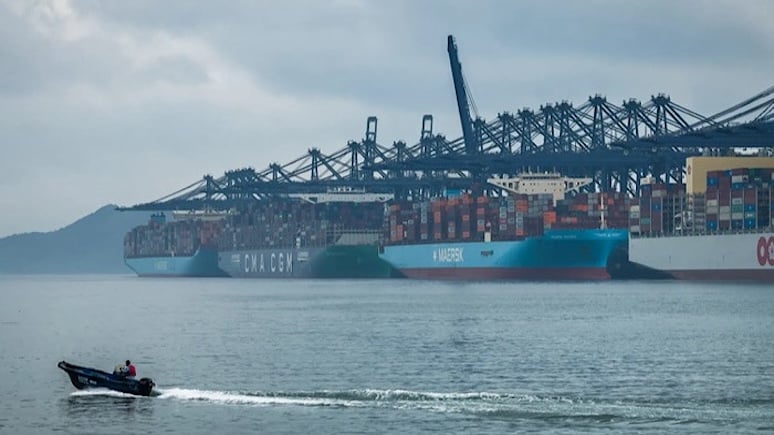
A US special operations team in the Indian Ocean raided a ship headed to Iran from China last month and seized military-related articles, the Wall Street Journal reported on Friday, citing US officials.
The cargo consisted of components potentially useful for Iran’s conventional weapons, one official said, adding the shipment had been destroyed.
US forces boarded the ship several hundred miles off the coast of Sri Lanka, according to the newspaper, which added the vessel was later allowed to proceed….. The report cited an American official as saying US intelligence indicated the shipment was headed for Iranian companies known to be intermediaries for the country’s missile development efforts.
The action was part of a campaign by the US Defense Department to cut off Iran’s covert arms supply networks….
China’s military support to Iran attracts less attention than that of Russia, but is far more crucial to Iran’s efforts to rehabilitate its strategic programs. This interdiction is no small thing, and another indication that the Iran challenge persists. https://t.co/HF5VVkKK8e
— Afshon Ostovar (@AOstovar) December 12, 2025
In mid-November, the US Treasury announced it was “targeting 32 individuals and entities based in Iran, the United Arab Emirates (UAE), Türkiye, China, Hong Kong, India, Germany, and Ukraine that operate multiple procurement networks supporting Iran’s ballistic missile and unmanned aerial vehicle (UAV) production.”
Under Secretary of the Treasury for Terrorism and Financial Intelligence John K. Hurley stated: “Across the globe, Iran exploits financial systems to launder funds, procure components for its nuclear and conventional weapons programs, and support its terrorist proxies”. Hurley also stated that the Trump administration was “putting maximum pressure on Iran to end its nuclear threat.”
Professor Hongda Fan, director of the China–Middle East Center at Shaoxing University, commented on the impact that sanctions are having upon Iran, saying that Chinese investment in Iran is difficult due to the sanctions, but possible with determination. In an interview, he admitted that “sanctions are the biggest obstacle to China’s powerful companies and enterprises doing business with Iran.”
Yet China is committed to longterm relations with Iran, promising “to continue to support Iran in safeguarding sovereignty and dignity.” The groundwork was already in place. In 2021, Iran signed onto China’s Belt and Road Initiative, described as a “roadmap for massive Chinese investments” of up to $400 billion USD. The exchange for Iranian infrastructure and energy was for a steady supply of Iranian oil.
Last week, Iran hosted a trilateral meeting with China and Saudi Arabia. Recall that in March 2023, the Beijing Agreement, which China brokered, restored diplomatic relations between Saudi Arabia and Iran after a seven-year break. Iran International reported a unity against the state of Israel during the trilateral meeting:
The three sides called for an immediate halt to Israeli actions against Palestine, Lebanon, and Syria, and condemned violations of Iran’s national sovereignty and territorial integrity. The statement also said the parties look forward to expanding cooperation in various fields, including economics and politics.
Iran, China and Saudi Arabia also agreed to “expand cooperation across political and economic fields and stressed the need for dialogue among regional countries to support security, stability, peace, and economic development.” Based on their condemnation of Israel, the notions of “security, stability and peace” do not align with the Western idea of these three, and should be regarded with caution.
There has been much going on behind the scenes, to which the Western media isn’t paying attention. Iran has been courting its regional neighbors with tremendous ardor. Last month, senior officials from Turkey and Saudi Arabia visited Iran for high-level talks.
In July, Iran’s foreign minister, Abbas Araghchi, in a meeting with Chinese Foreign Minister Wang Yi, “thanked China for its valuable support to Iran,” prompting CNN’s headline: “China was on the sidelines of the Iran-Israel war.”
China’s foreign ministry “strongly condemned” the U.S. attacks on Iran, accusing the U.S. of seriously violating “the purposes and principles of the UN Charter and international law, and have exacerbated tensions in the Middle East.”
Iran has clearly not abandoned its nuclear ambitions, but has changed its strategy for survival. It has turned to China, in a realignment away from Moscow. According to the Jerusalem Institute For Strategy and Security, Iran is disappointed in Russia, for specific reasons: “Russia’s inaction in the face of Israeli strikes in Iran and Syria; its lack of commitment to securing the future of the Assad regime; its disregard for Iranian interests in the agreement between the United States, Azerbaijan, and Armenia to establish the ‘Zangezur Corridor’; and Moscow’s de facto recognition of the United Arab Emirates’ sovereignty over three disputed islands in the Persian Gulf.”
Amid the urgency following American airstrikes, the geopolitical gravity appears to be slowly shifting eastward, but still not in a way that has meant the complete abandonment of Russia. In September, Iranian President Masoud Pezeshkian visited Beijing with success in securing “the expansion of economic and security agreements with China.”
The Iran-China relationship is a cause for concern, but is also unpredictable, since according to analysts across the board, China does not want Iran to acquire nuclear weapons.
The incident of American commandos raiding the ship that was heading from China to Iran was “part of a campaign by the US Defense Department to cut off Iran’s covert arms supply networks.”
Nonetheless, in the global arena, the red-green alliance is growing stronger and expanding strategically, which isn’t good news for American interests. Iran is not isolated; instead, it is actively looking for ways to skirt American sanctions, as it develops a stronger partnership with China while retaining a strategic partnership with Russia, driven by a shared anti-Western sentiment and needs.
Most worrying also is the ongoing damage of which Iran is capable. The regime has vowed to continue to “resolutely support” Hezbollah against Israel, with no apparent condemnation from its regional partners or China. It has also been calling for jihad attacks against Jews across Europe since October 7, and more broadly against Europe and the United States. In sum: “kidnappings, espionage and foreign influence operations, cyber attacks, sanctions evasion, and illicit procurement of sensitive technology to support Iran’s military capability and nuclear program” remain serious threats. Australia is now probing a possible Iran regime connection in the Bondi Beach jihad attack in Sydney on Sunday.
With a left-leaning mainstream media that is obsessed with castigating Trump, and focused on identity politics and wokeness, the West increasingly stands at a grave disadvantage; let alone the state of Israel, with its enemies, Iran and China, growing ever friendlier toward each other.