Renowned economist and social commentator Thomas Sowell made this astute observation about poverty and education:
If you want to see the poor remain poor, generation after generation, just keep the standards low in their schools and make excuses for their academic shortcomings and personal misbehavior. But please don’t congratulate yourself on your compassion.
Unfortunately, too many urban school systems have taken this as a mission statement rather than a warning, especially Baltimore City Public School System (BCPSS) in my former hometown.
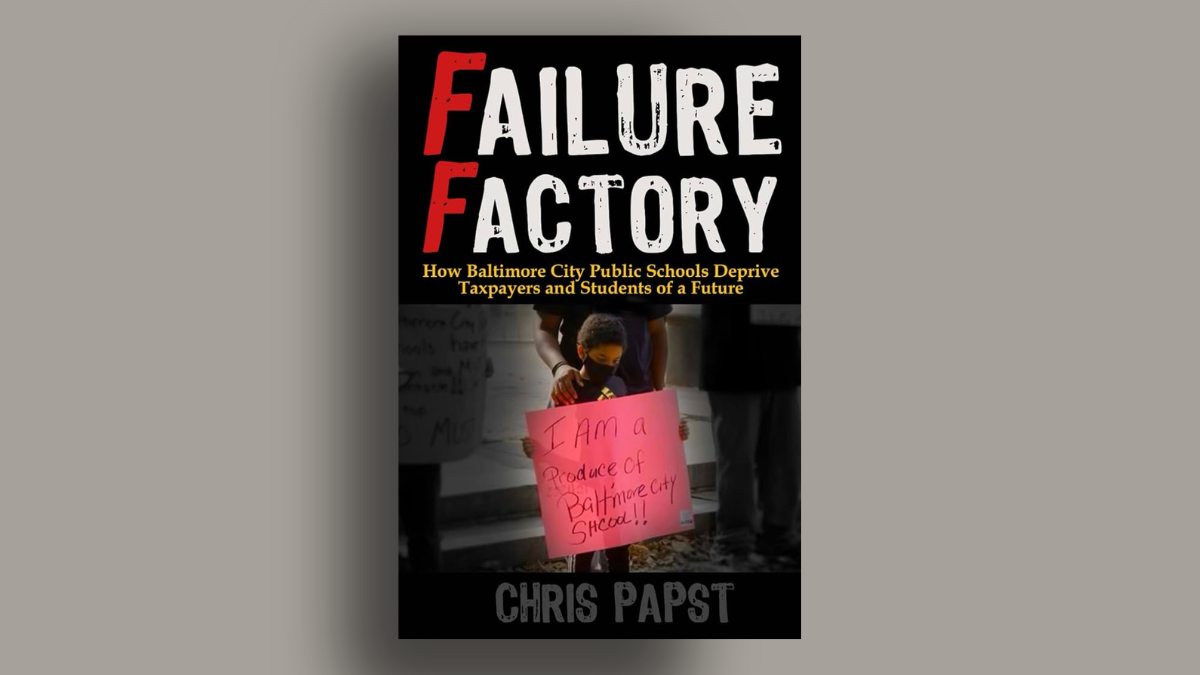
Failure Factory: How Baltimore City Public Schools Deprive Taxpayers and Students of a Future written by Chris Papst, the lead investigative reporter for Project Baltimore, records the 8-year effort to expose just how dysfunctional BCPSS has become. They’re not only failing to educate, but also bilking the taxpayers out of millions. Learning is far from the minds of those in charge. Students become nothing but data points, and data leads to dollars.
Launched in 2017 on Baltimore’s Fox 45 WBFF, Project Baltimore’s mission is “asking tough questions about why schools in Maryland are performing so poorly despite having among the nation’s highest funding.” Failure Factory records the answers, and those answers are shocking.
The prologue is a 2019 excerpt from the transcript of one of the first court cases filed by the television station, Fox45/Project Baltimore vs. Baltimore City Board of School Commissioners. Project Baltimore made repeated public record requests for information from the school system regarding reported grade changes. The central office, known as North Ave., ignored or rejected requests for information from Mr. Papst, specifically the emails related to the reported grade changes.
In 2017 Gregory Gray, a parent of a middle schooler at Calverton Elementary/Middle School, was concerned that his son was being passed on to the next grade level though he had done little or none of the work, so he reached out to Mr. Papst. Project Baltimore’s investigation into this uncovered a systemic pattern of grade changes and attendance manipulation not only at Calverton, but across Baltimore’s schools.
One anonymous source from North Ave. confirmed, “It’s common. It happens in most schools.” As a former BCPSS teacher, I can confirm this. And when I did not change the grade, the school’s administration would. (N.B. In the interest of disclosure, Mr. Papst interviewed me on Project Baltimore five times over a period of four years while I was still a Baltimore City teacher. A handful of quotes from those interviews are in this book.)
As Mr. Papst dug deeper, he uncovered corruption, manipulation of data, and out and out fraud across BCPSS to a degree that is astounding. The first half of the book focuses on individual students, individual schools, and his ongoing battle with North Ave., who stonewalled his attempts for information every step of the way. It would take years before the information was released by North Ave.
The second half of the book expands the investigation into just how deep this corruption goes in Baltimore City and across the state of Maryland. The amount of money involved, money, often tied to fraudulent data, is in the millions. Additionally, the lack of oversight from those doling out money is criminal.
Without learning just how dysfunctional our big city public schools are, we cannot begin to stop failing our children. There’s little doubt an investigation into big city schools everywhere in this country would uncover a similar story. But this is not just about big cities, small cities and small towns in America are facing at least some of the same problems.
Chris Papst’s exposition is clear and uncluttered, just as one might expect from an investigative reporter, but it is not without heart. The students and parents’ struggles he shared bring to life the sense of hopelessness in some of the most vulnerable. He does not sugarcoat the students’ responsibilities in their failure either. Papst interweaves these more personal stories with hard-hitting evidence, bringing the receipts that open wide the dysfunction of the system which was supposed to teach these students.
Some may argue that he is ignoring the many successes that also take place in Baltimore and there are indeed many, but this is a triage situation. There is no time to talk niceties; the vast majority of Baltimore’s students need immediate help.
Hopefully, Mr. Papst will draw enough attention to just how utterly dysfunctional this school system is to make change happen, though I won’t hold my breath. I have little doubt that the same book could be written about every big urban school system in this nation. This should be a warning to smaller school systems; this dysfunction is headed your way.
I recommend this book to anyone who also wonders why our schools have become so unsuccessful. Parents, politicians, teachers, board members, and anyone connected to our schools will see just what the battle is. It will not be solved by a new curriculum or more teacher training, and it certainly will not be solved by more money.
Mr. Papst and Project Baltimore have exposed what BCPSS has tried to keep hidden. In doing so this offers hope to future students, in Baltimore and across the country, that their schools will not just be Failure Factories.
Dana R. Casey is a veteran high school English teacher, a mother, an artist, a home chef, a carpenter, and a writer. She is working towards the return of an America which includes civil discourse, a diversity of ideas, and individual freedom balanced by personal responsibility. Her work has appeared on Conservative Teachers of America, D. C. Clothesline, Freedom Outpost, and Candid Discourse.