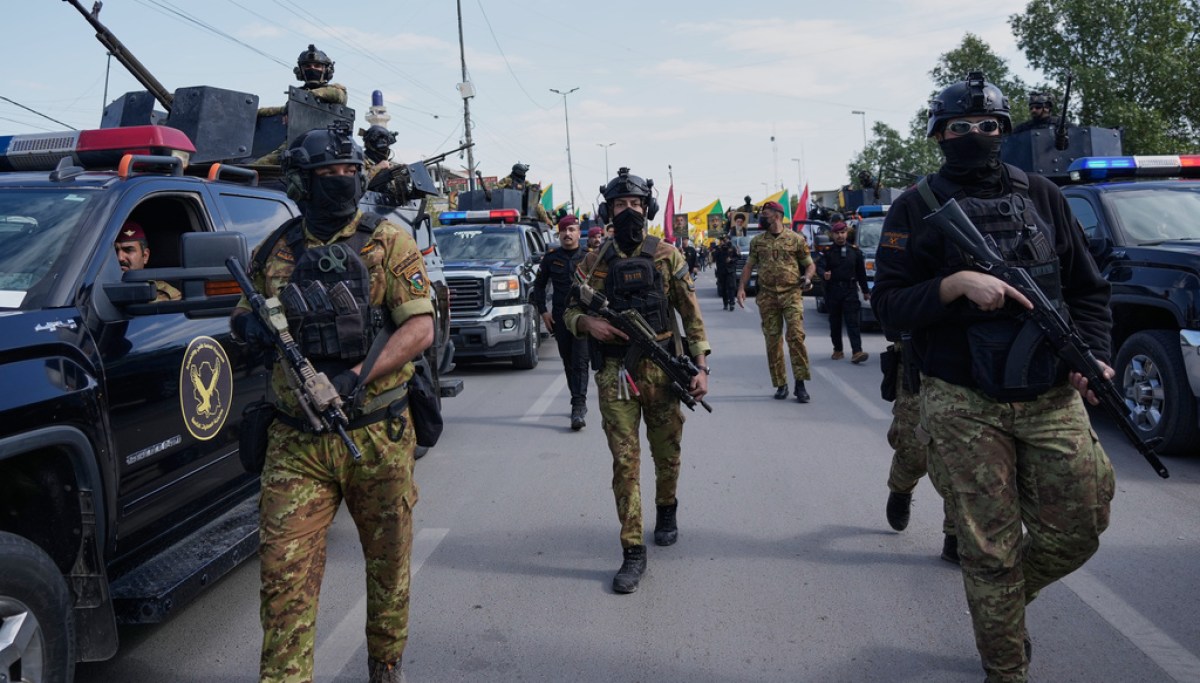
In Washington, D.C., policy circles, Iraq’s Popular Mobilization Forces are often described as a legitimate national force that emerged in 2014 to fight the Islamic State. Many policymakers view the PMF as a formal component of Iraq’s security apparatus, an institution that gained legitimacy through religious authority, parliamentary legislation, and its role in defeating ISIS.
This narrative is dangerously misleading.
In reality, the PMF was shaped under the direct influence of Qassem Soleimani, the commander of Iran’s Islamic Revolutionary Guard Corps’s Quds Force. Its purpose extended far beyond the battlefield against ISIS. The organization was designed to consolidate the power of Iraq’s Shia political establishment while simultaneously expanding Iranian strategic influence inside the Iraqi state.
FRIEND OR FOE? HOW IRAN’S INFLUENCE OVER IRAQ SHOULD SHAPE US DIPLOMATIC APPROACH
Structurally and ideologically, the PMF closely resembles Iran’s Islamic Revolutionary Guard Corps. In many respects, it functions as a parallel security structure embedded within Iraq’s system but aligned with Tehran’s strategic agenda.
Despite mounting evidence of its destabilizing role, three persistent myths about the PMF continue to shape Washington’s understanding of the organization.
Myth 1: The PMF was created by Sistani’s fatwa
The most common claim is that the PMF was created in response to a religious fatwa issued by Grand Ayatollah Ali al Sistani in 2014 after the collapse of Iraqi security forces in Mosul.
This interpretation misrepresents what Sistani actually said.
Sistani issued a call for collective defense, urging Iraqis to volunteer to protect their country. He did not call for the creation of militias or for the establishment of independent armed groups outside the Iraqi state.
Volunteers responding to the fatwa could have joined the Iraqi army, police, or other official security institutions. The fatwa itself did not authorize the creation of separate militia structures such as the PMF.
In fact, Sistani later emphasized repeatedly that all weapons in Iraq should ultimately remain under the authority of the state.
Myth 2: Parliamentary recognition made the PMF legitimate
Another argument often heard in Washington is that the PMF became legitimate after Iraq’s parliament passed legislation formally recognizing the organization.
This argument ignores a fundamental constitutional issue.
Article 9 of the Iraqi constitution explicitly prohibits the formation of militias outside the official armed forces. Article 13 further states that no law may contradict the constitution.
Even if parliament passed legislation recognizing the PMF, such a law cannot override the constitution itself. By constitutional standards, the PMF’s existence remains deeply controversial and legally problematic.
Myth 3: The PMF is just another branch of Iraq’s security forces
The Iraqi government and several Shia political factions frequently argue that the PMF functions like any other branch of Iraq’s security apparatus.
In practice, however, the PMF operates as an umbrella structure for numerous Iranian-backed militias, including groups that have repeatedly targeted U.S. forces and international partners.
These attacks are often claimed by shadowy organizations that appear suddenly under new names — groups such as People of the Cave, which analysts widely recognize as front organizations for established militias like Kataib Hezbollah.
When such attacks occur, the Iraqi government often condemns them. Yet when the United States retaliates against those same militias, Baghdad frequently reframes the strikes as attacks against the PMF, which it describes as part of Iraq’s official security forces.
This rhetorical maneuver allows Iraqi authorities to denounce American responses as violations of sovereignty while avoiding responsibility for militia activities conducted under the PMF umbrella.
Despite repeated promises to Washington to take action against Iran-backed militias responsible for attacks on U.S. forces, American interests, and targets in the Kurdistan region, Prime Minister Mohammed Shia al Sudani has delivered little in terms of concrete action. Not a single militia member responsible for these attacks has been eliminated or even arrested. In practice, Sudani’s assurances appear to have served primarily as a means of buying time with Washington, while his government continues to fund, harbor, and politically shield the very militias carrying out these operations.
Washington’s strategic miscalculation
Confusion surrounding the PMF was reinforced by a strategic miscalculation during the Obama administration.
During the early years of the campaign against ISIS, elements of the PMF were indirectly incorporated into the broader anti-ISIS effort. This decision unintentionally granted the organization international legitimacy.
At times, U.S. officials even visited wounded PMF fighters in hospitals, reinforcing the perception that the group was a legitimate partner in the fight against ISIS.
That perception continues to influence policy debates in Washington today.
Constitutional contrast with the Peshmerga
PMF factions have attempted to exploit Sistani’s later calls for all weapons to remain under state authority by claiming that the PMF itself represents part of the Iraqi state.
Using this logic, some political actors have even argued that other armed forces, including the Kurdistan region’s Peshmerga, or internal security forces, should be dissolved or subordinated to Baghdad. However, Article 121 of the Iraqi constitution explicitly recognizes the Peshmerga as the regional guard forces within Iraq’s federal system.
The contrast is stark: The Peshmerga have constitutional recognition, while the PMF exists in tension with constitutional provisions prohibiting militias outside state authority.
The policy choice ahead
Today, the PMF is deeply embedded within Iraq’s political and financial system. The Iraqi government allocates billions of dollars annually to the organization for salaries and operations.
As long as the PMF continues to function as an umbrella structure for Iran-aligned militias, attacks on U.S. forces and regional partners are likely to persist.
STATE DEPARTMENT URGES AMERICANS TO LEAVE IRAQ ‘NOW’ AFTER US EMBASSY HIT
Washington policymakers therefore face a clear choice: Continue accepting the narrative that the PMF is simply another Iraqi security institution, or recognize it for what it increasingly resembles — a parallel military structure modeled on Iran’s Islamic Revolutionary Guard Corps and aligned with Tehran’s regional strategy.
Until that distinction is acknowledged, U.S. policy toward Iraq will remain based on a dangerously incomplete understanding of one of the country’s most powerful armed actors.
Entifadh Qanbar is a former spokesman for the Deputy Prime Minister of Iraq and a doctoral candidate in Statecraft and National Security at the Institute of World Politics in Washington, D.C., specializing in Iraqi politics, regional security, and Iranian influence in the Middle East.