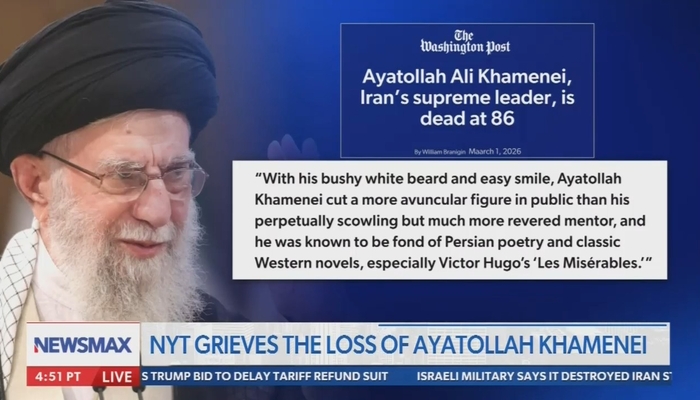
By now the world has been taking notice. Taking notice, of all things, of a particular Washington Post obituary.
The obit, infamously, is of the late Iranian dictator the Ayatollah Ali Khamenei. Khameni was taken out by an American and Israeli bombing attack a few days back. And a decided tyrant he was. Yet that didn’t keep the Post from writing this in the Iranian dictator’s obituary:
With his bushy white beard and easy smile, Ayatollah Khamenei cut a more avuncular figure in public than his perpetually scowling but much more revered mentor, and he was known to be fond of Persian poetry and classic Western novels, especially Victor Hugo’s ‘Les Misérables.’”
Over at TIME magazine, however, was a much more accurate obit, saying this of Khamenei:
“With hard-currency reserves depleted and inflation soaring, Iranians took to the streets en-masse, chanting for the regime’s downfall. On Khamenei’s orders, security forces killed an estimated 30,000 people, according to senior health officials.”
One can only wonder if this current crop of Washington Post obit writers had been around in April of 1945 when they learned that Nazi leader Adolf Hitler, knowing that allied troops were closing in on his Berlin headquarters, had locked himself in his “bunker” with his mistress, pulled out his pistol, put it to his head and pulled the trigger. Can you imagine that obit in the hands of a today-oriented Post obit writer? Possibly writing something along the lines like this?
With his short, carefully clipped mustache, always in a fastidiously pressed uniform with accompanying arm ban bearing his party’s insignia, along with his easily outstretched right arm for perpetual salutes of others, Chancellor Hitler cut a striking figure in front of the cameras. And he was known to be fond of watching American westerns, especially actor John Wayne’s Stagecoach.
No. That would be almost impossible to imagine.
In fact, over at The Conversation, is this decidedly different description of Khamenei:
In more than three decades as supreme leader, Khamenei amassed unprecedented power over domestic politics and cracked down ever more harshly on internal dissent. In recent years, he prioritised his survival – and that of his regime – above all else. His government brutally put down a popular uprising in December 2025–January 2026 that killed thousands.
The real question here is…why? Why in the world would the leading newspaper in America’s capital make a point of softening the decidedly very real sharp edge reality of this Iranian dictator’s life?
The uncomfortable answer is that many in today’s American media have convinced themselves real journalism must be presenting a supposed “both sides” reporting, at least when it comes to America’s enemies. In fact, “bothsideism” is in fact the name applied to this type of journalism over at the Pew Research Center.
In the case of the Khamenei obituary the apparent idea was to present a considerably evil and murderous dictator as a guy whose down time was spent cozily reading poetry and Les Miz.
In fact, this business of modern media propaganda in film did in fact start back there in the 1930’s. Infamously, the German filmmaker Leni Riefenstahl made a point of making 1935’s Triumph of the Will, a decidedly pro-German Nazi film Wikipedia describes as “a major example of film used as propaganda.”
Let’s be clear. The Washington Post obit on Khamenei is not a Leni Riefenstahl-style obit. But it is a brief snapshot of what it looks like when a modern American journalistic media outfit feels the need to somehow present “the other side” of a guy who was in fact a relentlessly murderous tyrant.