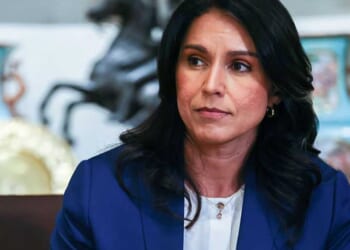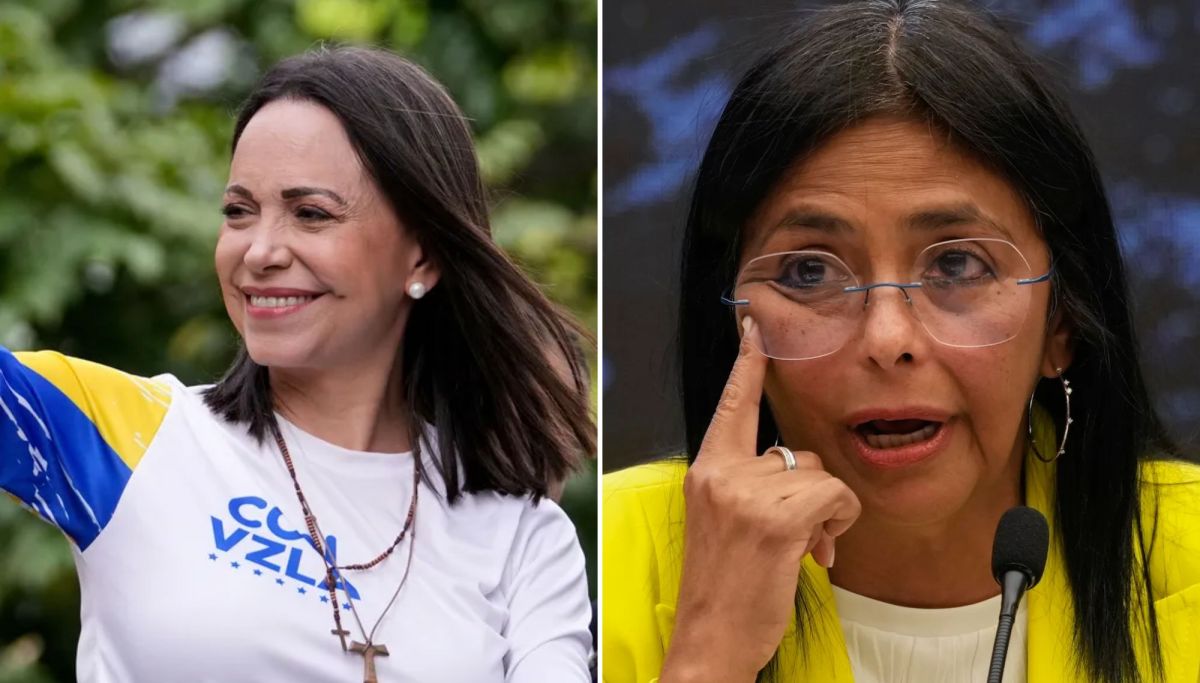
As it finds itself in the most uncertain position in its modern history, Venezuela’s destiny may well be decided by the maneuvering of two powerful women.
After former Venezuelan ruler Nicolas Maduro was snatched from Caracas in the dead of night by U.S. Army Delta Force commandos, most observers were certain the U.S. would push for Maria Corina Machado, Nobel Peace Prize winner and opposition leader, as the next president of Venezuela. Many were shocked, then, when the same morning as Maduro’s capture, President Donald Trump indicated that Machado couldn’t be the leader of Venezuela, and the U.S. would instead support Vice President Delcy Rodriguez for the time being.
Trump’s choice reflected Washington’s newfound realpolitik approach to geopolitics, but also a long-running behind-the-scenes effort from the two to win the president’s favor. Both women are known for their competence and strong-willed nature, but have very different visions for Venezuela in mind.
Maria Corina Machado: “Iron Lady” and idealist
Machado was born into an elite family and began her career studying to be an industrial engineer, then got a master’s degree in finance. Her passion quickly turned to politics after the socialist Hugo Chavez took power, however, spurring a rivalry that would come to define her political life. She defined herself as the co-founder of Súmate, a political group that dedicated itself to promoting a referendum to remove Chavez from power in 2004. While the effort was unsuccessful, she continued to speak out against the authoritarian Chavez, despite criminal conspiracy charges against her.
Another prominent theme of Machado’s political life began just as early — appeals to the U.S. and world support for help in ousting Chavez. She met with then-President George W. Bush in 2005 in the Oval Office, a move that enraged the anti-U.S. Chavez.
Machado proved her popularity in 2010 when she won a seat in the National Assembly in a landslide, using her seat to boldly heckle Chavez and his allies. She slowly rose through the ranks after first running for president in 2012. She would form an even more prevalent rivalry with Chavez’s successor, Maduro. She was accused of trying to assassinate the president, charges she denied by caused her to lie low for much of the next decade, allowing the less politically savvy Juan Guaido to position himself as the head of Venezuela’s opposition, an adventure that ended in failure when he overestimated his own position.
Machado’s finest hour began during the 2023 election, when she took up the mantle of the opposition. She quickly became the most popular politician in Venezuela as voters discontented with the economic collapse caused by Maduro’s regime rallied behind her, delivering her 90% of the vote in the opposition primary. Maduro’s government banned her from running on spurious grounds, triggering widespread outrage.
In her stead, she endorsed former diplomat Edmundo González, a man virtually unknown before her endorsement. He easily crushed Maduro at the polls by a two-to-one margin, according to voting machine records obtained by the opposition and validated by international observers. Nevertheless, the National Electoral Council declared Maduro the winner, and Caracas cracked down on the widespread protests triggered in response. Machado went into hiding, and Gonzalez went into exile.
Machado gambled on throwing her full support behind Trump, even avoiding harming his ego by dedicating her Nobel Peace Prize to him.
Some uncorroborated reports suggested that Trump passed over Machado after capturing Maduro over his jealousy regarding the Nobel Peace Prize, but further reporting has revealed missteps that cost the opposition leader dearly. Machado fumbled several planned meetings with Trump officials, failing to deliver a list of political prisoners, declining to meet in person with Trump’s special envoy Richard Grenell, and drawing frustration after failing to concretely lay out how a democratic government could take power in Venezuela, the New York Times reported.
This culminated in an embarrassment at Trump’s Mar-a-Lago news conference on Jan. 3, during which Trump suggested she wasn’t respected by Venezuelans.
“I think it would be very tough for her to be the leader,” Trump told reporters. “She doesn’t have the support within or the respect within the country. She’s a very nice woman, but she doesn’t have the respect.”
Machado’s allies insisted to the Financial Times that she isn’t dejected and still has hope of taking power.
Ideologically, Machado would get along well with Trump. She’s been broadly described as a Christian liberal democrat, stressing free market capitalism, individualism, transparent elections, and liberalism. She’s long been heavily pro-U.S., and if installed, would likely sign even more favorable agreements with the U.S. She’s even gone so far as to plead for direct U.S. military intervention multiple times throughout her political career, going as far back as 2014.
Machado is now banking everything on charming Trump at a Thursday White House meeting. After showing U.S. dominance over Venezuela with Operation Absolute Resolve, Trump’s decision regarding the country is likely to prove decisive if she ever wants to take power. The meeting will be the first time the two have directly spoken since Oct. 10, when she won the Nobel Peace Prize.
Delcy Rodriguez:
Aside from being strong-willed and a politician, Rodriguez holds almost nothing in common with Machado.
While Machado hails from an elite business family, Rodriguez was born the daughter of a Marxist guerrilla leader who was arrested over his involvement in the kidnapping of an American businessman. Her father died in police custody, allegedly from torture, something that embittered her against the country’s establishment.
“The revolution is our revenge for the death of our father,” Rodriguez said in a past interview, referring to Chavez’s Bolivarian Revolution.
Her brother also shared the family’s leftist views — Jorge Rodriguez would also enter politics and serve as one of the most influential Chavista politicians.
Delcy Rodriguez studied in several different Western countries in college, even spending some of her college years in Santa Monica, California. She first entered politics in 2002 during the military coup attempt against Chavez, rallying support for Chavez from abroad, going so far as to symbolically take over the Venezuelan embassy in London with her mother.
Delcy Rodriguez steadily rose through the ranks after entering national politics, becoming foreign minister in 2014-2017, President of the National Constituent Assembly 2017-2018, vice president beginning in 2018, minister of economy, finance, and foreign trade from 2020-2024, Minister of Petroleum beginning in 2024, and finally acting president in 2026. She was inaugurated into her current position on Jan. 5.
In a widely hated government known for its corruption and inefficiency, Rodriguez won rare respect as an effective, pragmatic operator. She implemented pragmatic economic reforms as minister of economy, finance, and foreign trade, including reductions in price controls, partial dollarization, and establishing relationships with the private sector. Among her most impressive accomplishments was her handling of the country’s lucrative but struggling oil industry, which she wielded significant control over after being appointed vice president.
Under her management, Venezuela’s oil industry saw modest growth despite crippling U.S. sanctions and a lack of international expertise, the primary move that earned her attention from the Trump administration.
Lesser known at the time, but perhaps influential later, was her attempted courting of Trump during his first term. Federal Election Commission records showed that she directed Citgo, a subsidiary of Venezuela’s state oil company, to contribute $500,000 to Trump’s inaugural committee, USA Today reported. This effort is largely viewed as a failure, given Trump’s first administration’s hardline stance towards Venezuela, but it could have planted the seed of the second administration’s cautious trust placed in her.
Despite her accomplishments, Rodriguez was largely unknown to much of the world when she was suddenly thrust into power following Maduro’s capture. Trump’s statement on Jan. 3 expressing confidence that she would work with the U.S. took many by complete surprise.
“She, I think, was quite gracious, but she really doesn’t have a choice,” Trump said of the new president. “She is essentially willing to do what we think is necessary to make Venezuela great again. Very simple.”
Some analysts doubted Trump’s sentiment, given her hostile rhetoric immediately following Maduro’s capture. At her swearing-in ceremony, she denounced Operation Absolute Resolve as an “illegitimate military aggression.”
“I come with sorrow for the suffering inflicted upon the Venezuelan people following an illegitimate military aggression against our homeland,” she said. “I come with sorrow for the kidnapping of two heroes.”
She repeated this rhetoric as recently as Monday, once again denouncing “the illegal, illicit aggression of the United States government against the Venezuelan people.” Her most recent remarks came over anger towards Trump after he posted an edited image listing himself as “President of Venezuela” on Wikipedia.
“I’ve seen some caricatures on Wikipedia about who runs Venezuela,” she said, an apparent reference to the meme posted by Trump.
“Well, there is a government here that runs Venezuela, there is an acting president here, and there is a president held hostage in the United States,” Rodriguez said.
Despite this, she has openly expressed a conciliatory approach to the U.S. elsewhere, especially when not speaking to a domestic audience. She has followed through by adopting policies favoring the U.S., including an oil deal giving the U.S. exclusive discretion over who Venezuela sells its oil to. She has loosened repression and released scores of political prisoners, and renewed ties with the U.S.
She spoke with Trump by phone on Wednesday, a phone call the U.S. president related in gushing terms on Truth Social.
He described the call as “very good,” saying, “We are making tremendous progress, as we help Venezuela stabilize and recover. Many topics were discussed, including Oil, Minerals, Trade and, of course, National Security.”
“This partnership between the United States of America and Venezuela will be a spectacular one FOR ALL. Venezuela will soon be great and prosperous again, perhaps more so than ever before!” Trump said.
DELCY RODRIGUEZ RIPS TRUMP POST CALLING HIMSELF VENEZUELA’S ‘ACTING PRESIDENT’
Rodriguez’s skill in winning over Trump puts Machado in an increasingly difficult position. For her part, the liberal leader has warned that Rodriguez is little different than Maduro.
“Delcy Rodriguez, as you know, is one of the main architects of torture, persecution, corruption, narco-trafficking,” Machado said in a recent interview with Fox News. “She’s the main ally and liaison with Russia, China, Iran, certainly not an individual that could be trusted by international investors. And she’s really rejected, repudiated by the Venezuelan people.”