The Senate sort of debated a war powers resolution on Wednesday that might have eventually stopped the war in Iran, although the resulting vote was only on a motion to bring the resolution to the floor. That vote failed, leaving the Trump administration with what amounts to implied congressional permission to continue. As Rand Paul noted, speaking as the only Republican who supported the measure, “This essentially is the vote whether to go to war or not.”
But the Senate wasn’t debating the war, or debating Trump: It was debating against its own history, poorly and without noticing, in a mostly incoherent series of self-negating rhetorical maneuvers. Taken as a whole, the Senate doesn’t seem to have known what it was debating at all.
You can watch the debate-shaped thing here, in an eight-hour video that doesn’t contain eight hours of war powers discussion. During speeches about the war, senators shouted and spoke of the need for urgency, invoking all of the usual language about the judgment of history. Between speeches, they took long pauses, and senators popped in with speeches on hockey, Netflix, healthcare, tax cuts, and housing shortages in Pennsylvania.
Somewhere around the middle, Colorado Democrat John Hickenlooper got in a campaign speech that mentioned the war while hitting all the major talking points of the day: job growth, rent, child care. Here’s a senator’s urgent contribution to a debate about a war powers resolution, with bombs currently falling: “According to Moody’s, the top 10% of U.S. households now account for nearly half of all spending. That means on paper the economy may look relatively good, but only for half of Americans. Half of Americans at the top. And while working families struggle to get by, the president has given an extra boost to the powerful and well-connected.” Hickenlooper’s office proudly posted a transcript, if you want to see it for yourself. You can feel how deeply he cares about stopping the war.
If you don’t have a habit of torturing yourself by watching legislative debate, you might have found yourself surprised by the coupling of a frequent recourse to rhetoric about urgency with an unmistakable lack of actual urgency. This is normal. It would take the United States Senate nine hours to evacuate a burning tour bus. They give viewers the sense of being the audience for bingo night at a convalescent home.
Turning to the unfortunate substance of the debate over the war, Minority Leader and cartoonish Batman villain Chuck Schumer characterized it as a bizarre outbreak of psychological deviance. “This is insane,” he said, and then, a moment later, “Donald Trump is manic.” What was happening in the Senate was that senators were trying to corral a lunatic: “The resolution is the Senate Republicans’ chance to put pressure on Donald Trump’s manic decision to drag us into war.” Some guy went crazy, and then he suddenly did some bombing. The war is a manic episode, a condition of a bad personality getting the keys to the military.
Preparing to close the debate, many hours later, Democrat Sen. Tim Kaine made precisely the opposite argument: The United States is doing it again. “We are basically asking a question of the entire Senate, and indeed of the entire nation: Have we learned nothing from twenty years of war in the Middle East?” About 14,000 American servicemembers and contractors died in Iraq and Afghanistan, Kaine noted, while the wars ran up the federal debt without helping Americans. “More than eight trillion dollars spent that could have been spent on American healthcare, on American housing, on American education, spent on the war in Afghanistan and Iraq, and what did we get for it? What did we get for it?” Yes, he said that last part twice.
So the war in Iran is a crazy break with American political norms, an odd piece of Donald Trump’s personal deviance, and also the war is a precise expression of decades of American habit, proving that we’ve learned nothing from our own failures. It’s not normal and too normal, Trump’s personal failure only and a deep and a persistent national failure, a new course and the same old course. You can make your own guess whether Schumer and Kaine noticed that they were making the opposite argument.
Splitting the arguments, the uniquely shameless California Sen. Adam Schiff characterized the new conflict as normal behavior, but only for Republicans. “Mr. President, we are at war once again,” he said. “George W. Bush had his Iraq War, and Donald Trump now his Iran War.” You can probably remember a few wars that he missed, and remember who started them.
Connecticut Democrat Chris Murphy did the same thing with what may have been slightly more shamelessness. “The difference between Democrats and Republicans,” he said, “is that Republicans have learned nothing from decades of American hubris in the Middle East.”
Here’s what Murphy quickly went on to offer as an example of that stubborn American hubris: “We ran planes over Libya to release the people from captivity imposed upon them by Gaddafi, only to unleash a new civil war that killed thousands upon thousands. It is amazing to me that my Republican colleagues refuse to learn lessons.” Clearly, the Obama administration’s regime change war in Libya, undertaken without congressional approval, proves the point that Republicans just can’t learn any lessons. Murphy increasingly tries to get his insane arguments across by descending into howling theatrics, by the way, and I had to pause for a screenshot.
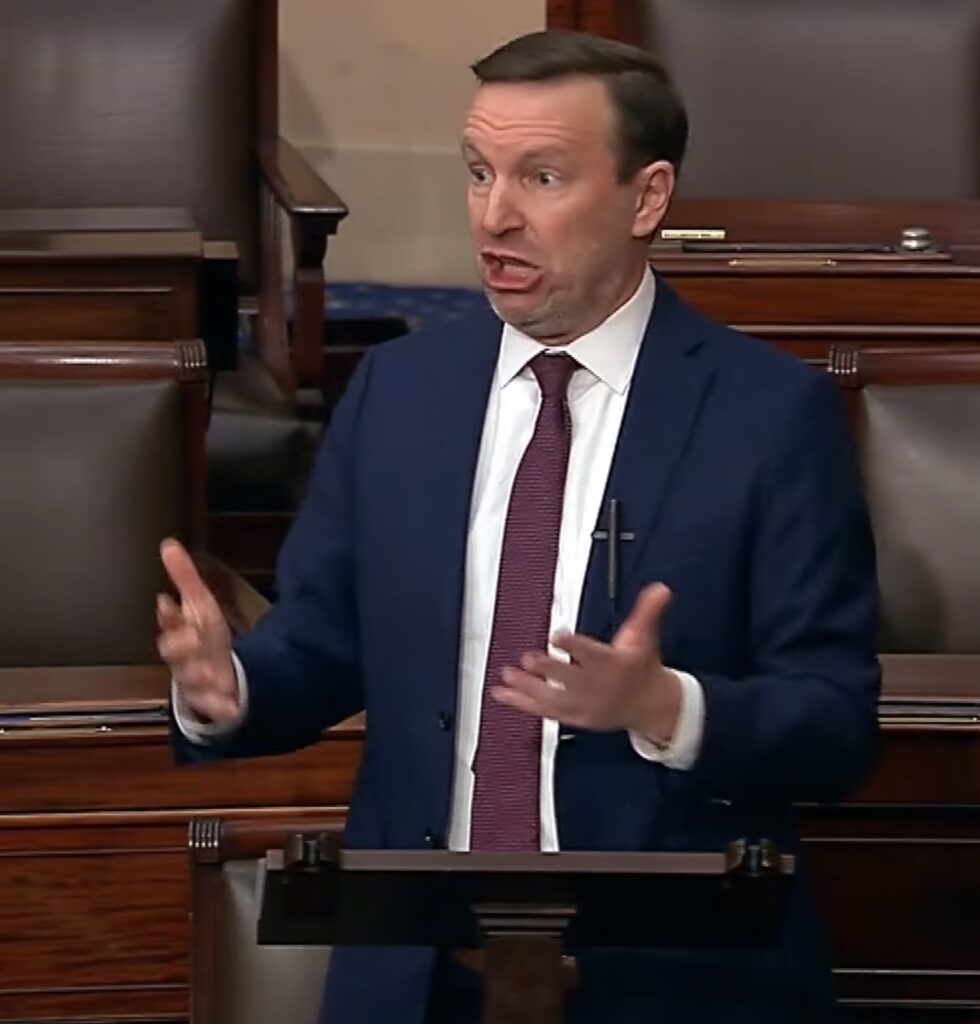
Anyway, they’re all upset by American hubris, and angry that we’ve learned nothing from twenty years of military conflict in the Middle East. If the United States Senate can figure out who’s responsible for all these unfortunate wars, over the last couple of decades, somebody’s really gonna hear about it.
Maybe at some point we’ll get a serious debate, but it’s not at all clear if the Senate can still rise to the challenge of actual discussion, with listening and thinking. There’s a serious question to chew over, and the argument offered against the resolution suggests an outline of that problem. Sounding ready for retirement, Kentucky Republican Mitch McConnell noted that the pattern of using military force without congressional approval had characterized “every American president during my time in the Senate.” McConnell has been in the Senate since 1985.
Start there.