Our world stands at a civilizational crossroads. Again. Nations must decide whether they intend to live in the 21st century or the seventh century. That choice may sound melodramatic, but anyone watching events in the Middle East, across Europe, and increasingly inside the United States understands the stakes.
On the eve of Thanksgiving in Washington, D.C., two National Guard troops were shot by a Muslim jihadist shouting “Allahu Akbar.” One of the soldiers, a young woman from West Virginia, later died. The other survived but has a long road of recovery ahead. Americans once again asked how such an attack could occur in the nation’s capital.
The choice is not between peace and war. It is between confronting an ideology that sanctifies domination or allowing it to advance unchecked under the cover of pluralism.
The answer begins with ideology.
Jihadist doctrine divides the world into two irreconcilable spheres: Dar al-Islam, the “House of Islam,” and Dar al-Harb, the “House of War.” The House of Islam consists of territories governed by Islamic law. The House of War includes every land not under Sharia. That category encompasses Israel, Europe, the United States, and vast portions of Africa and Asia.
For jihadists, this division is not theoretical. The ultimate objective is global submission to Islamic rule. The methods vary. Demographics, migration, political participation, and violence all qualify as legitimate tools of jihad, depending on circumstances.
Modern Sunni jihadist ideology draws heavily from Sayyid Qutb, the Muslim Brotherhood theorist whose book “Milestones” remains foundational. Qutb argued that Muslims should adapt their strategy based on their position within a society. When weak or outnumbered, they should emulate Muhammad’s early period in Mecca, focusing on persuasion and coalition-building. As power grows, they should advance to the next stage, asserting political authority and preparing for dominance.
That framework explains why jihadist movements operate differently across regions. We see the political phase at work in Western cities and institutions, including London, New York City, and Dearborn, Michigan. We see the violent phase in Israel, Nigeria, Europe, and parts of the Middle East.
Qutb held that the Quran justifies violence against non-Islamic governments. That claim draws on classical Islamic jurisprudence and has been codified in influential texts. Sunni and Shia jihadist groups alike act on this logic.
Hamas, Hezbollah, the Houthis, and Iran’s Islamic regime wage war against Israel under its banner. Jihadist violence devastates Christian communities in Nigeria. Terror attacks across Europe and the United States follow the same ideological thread.
The question is not whether this ideology exists. The question is how nations respond.
Governments and citizens must decide whether they will confront a violent, medieval worldview or accommodate it in the name of tolerance and stability. That choice applies both abroad and at home.
Some regimes have already chosen regression. Iran’s rulers prioritize hatred of Israel over the welfare of their own people. The country’s severe water crisis stems not from natural scarcity but from ideological fixation and mismanagement driven by revolutionary dogma.
In Gaza, support for Hamas continues to rise. In Judea and Samaria, Hamas cells plot new attacks. Hezbollah smuggles weapons through Syria while Lebanon’s leaders face a stark decision: Embrace modern statehood or remain trapped in perpetual conflict.
American policy toward the region often sends mixed signals. The proposed sale of F-35 fighter jets to Saudi Arabia and its elevation to major non-NATO ally status were promoted as diplomatic successes. Yet the real measure will come in actions, not assurances. Will Saudi Arabia confront jihadist networks within its borders? Will it normalize relations with Israel? Or will it offer symbolic gestures while tolerating extremism?
Qatar presents an even sharper test. Through Al Jazeera, it shapes anti-Western narratives across the region. It has funded or enabled radical activism abroad and provided safe haven to Hamas and Muslim Brotherhood leaders. Any serious strategy against jihadist ideology must address Qatar’s role directly.
President Trump took a step in that direction by issuing an executive order calling for the designation of Muslim Brotherhood chapters as “foreign terrorist organizations.” That order, however, excluded the International Union of Muslim Brotherhood, based in Qatar, and U.S.-based Brotherhood-linked organizations, including the Council on American-Islamic Relations.
RELATED: Political Islam is playing the long game — America isn’t even playing
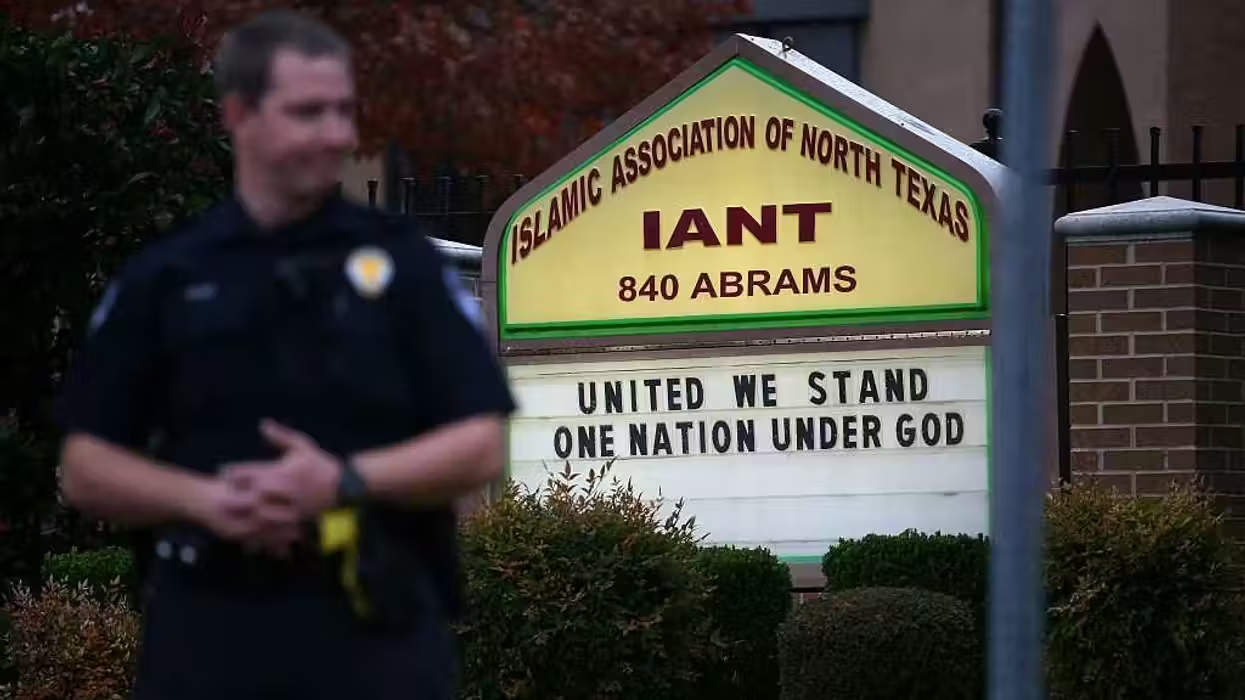 Photo by John Moore/Getty Images
Florida Governor Ron DeSantis (R) went farther last week by designating CAIR and the Muslim Brotherhood as foreign terrorist organizations under state authority. That move reflects a growing recognition that ideological warfare does not stop at America’s borders.
The West must choose whether it will dismantle Muslim Brotherhood networks domestically and demand that its allies do the same. It must decide whether it will confront Iran, which remains the central destabilizing force in the region. Five months after a U.S. strike on Iranian targets, the regime continues to threaten Israel, the Gulf states, and Western interests.
These decisions carry consequences beyond diplomacy. They shape the world our children inherit.
The choice is not between peace and war. It is between confronting an ideology that sanctifies domination and violence or allowing it to advance unchecked under the cover of pluralism. The path forward demands clarity, resolve, and an honest reckoning with reality.
The century we choose will determine whether the future belongs to modernity and peace or to ancient grievances enforced by terror.