Order Michael Finch’s new book, A Time to Stand: HERE. Prof. Jason Hill calls it “an aesthetic and political tour de force.”
They said I was wrong about the Islamization of the West – and I now realize that I was, indeed, wrong.
Let me be clear. I wasn’t wrong in warning, for the last quarter century, that the mass immigration of Muslims into Western Europe would gradually give rise to larger and more numerous and more isolated sharia-run enclaves, to higher crime statistics and ever more violent crime, to snowballing government expenditures on newcomers (and their progeny) that would eat up more and more of the welfare-state budget, and to ever-greater appeasement that would steadily erode Western liberty and result ultimately in utter capitulation to Islam. In response to such warnings, I, along with others who offered the same bleak message, was dismissed and demonized by politicians, journalists, and academics who insisted that such concerns were absurd – that people like me were engaged in gross exaggeration, were displaying wholesale ignorance, or were venting sheer bigotry. Over time, these critics insisted, Muslims would integrate perfectly well into European society, with the children and grandchildren of the original immigrants becoming , like the descendants of the Europeans who emigrated to America a century or more ago, patriotic, freedom-loving citizens, valuable contributors to the economy, guarantors of lasting freedom and prosperity, and role models for future newcomers.
On that little matter, I’m sorry to say, the years have proven me right, and more and more observers are acknowledging it. The sad truth is that the Western European leaders who, over the last couple of generations, welcomed Muslims into their countries in massive numbers initiated a process whereby – unless extensive and dramatic action is taken very soon – those countries, like the Maghreb and most of the Levant before them, will be swallowed up into the Islamic world.
No, I wasn’t wrong about that, as much as I wish I had been. What I was wrong about is this: in the autumn of 2018, I wrote a piece for FrontPage in which I favorably compared Vienna – which I was then visiting for the very first time – to other German-speaking cities with which I was acquainted. To be sure, I was then, and still am, very fond of several of those cities, notably Munich and Berlin. But I found that while Germans today make a career out of distancing themselves indiscriminately from their nation’s history and of embracing a European identity by conspicuously flying the EU flag rather than the German tricolor, Viennese shops, taverns, and restaurants proudly displayed old paintings of their famous forebears along with other fond reminders of the city’s storied culture. Plainly related to this contrast was another difference: while German cities were increasingly overrun with Muslims, whom the natives reflexively, if baselessly, celebrated as a way of showing that they’d thrown over their great-grandparents’ racism (Hamburg, in my experience, had been especially unsettling in this regard), Vienna struck me as being “a city whose people cherish their culture and history” – except for that disagreeable period between 1938 and 1945 – and who were “definitely not on board with the project by other Western European countries to surrender to the imams.” This, I wrote, was “something to cheer.”
Well, that was, as I say, 2018. Based on what I saw, I thought that Vienna might very well have dodged the Islamic bullet. So impressed was I, in fact, by what I experienced in Vienna that I decided it might well be my very favorite of all the cities I’d seen in Europe – which was saying a great deal, given that the list included London, Paris, Rome, wonderful Copenhagen (where I’d stayed, by that point, about a dozen times), and my beloved Amsterdam (to which I’ve probably flown at least fifty times over the years, spending, all told, at least a full year of my life there). I was so fond of Vienna that I booked another trip in 2019, which proved equally delightful. After that, I decided that Vienna would thenceforth be my annual autumn destination. While the other capitals of Western Europe fell to the invaders, I’d visit the holdout. Who could ask for anything more?
Alas, then came COVID. After that, my partner was hospitalized (not with COVID) for much of a year. Somewhere in there I worked in a quick trip – my first – to Budapest, where an old friend lives. And then I got sick, and during the last year my travels have all been domestic and for medical reasons. Six years, then, have come and gone, and I haven’t been back to Vienna. But I now know that when I thought, back in 2018, that the powers that be Vienna, and in Austria generally, were strong and savvy enough to ensure their people’s protection from the Islamic hordes, I was wrong – extremely, tragically wrong.
I know this because I’ve just received an update of sorts in the form of a brief video. It’s by the Hungarian politician Barna Pál Zsigmond. The son of a mechanical engineer and a chemist, he studied mathematics and physics and earned a degree in law and political science before serving in the National Assembly. He’s also worked in the private sector. And he’s highly presentable and very well-spoken in English. Quite an impressive résumé – but because he’s a member of Victor Orban’s own party, Fidesz, which has resisted immense pressure from the EU to open Hungary’s borders to Muslim immigration (indeed, the Hungarian government chooses to pay a daily penalty of €1 million for violating the EU’s asylum rules rather than alter its policies), Barna Pál is the kind of figure who is persona non grata in the corridors of power in Brussels.
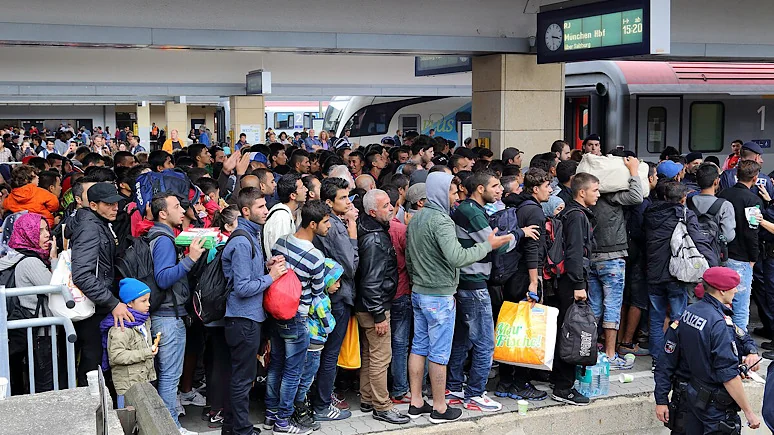
In the video, Barna Pál speaks with Petra Steger, a Member of the European Parliament for the Freedom Party of Austria. Their conversation takes place in the streets of the Favoriten district of Vienna, which were full of women in hijabs and stores with signs in Arabic. During the last ten years, lamented Steger, Vienna – this city by which I was so impressed in 2018 and 2019 because of its lack of such alien elements – has been radically transformed by mass Muslim immigration. “Since 2015,” she said, “over 600,000 migrants have come to Austria.” In Favoriten – which is very close to the place where I stayed in Vienna – 70% of the residents have immigrant backgrounds; in Vienna as a whole, more than 40% of the schoolchildren are Muslims. These are dramatic numbers – especially considering that most of the transformation has taken place since I last set foot in the city.
“What can people do in this situation?” Barna Pál asks Steger. Her answer is simple: “Act like Hungary.” Instead of putting the welfare of Austrian citizens – and of their descendants – first, Austria’s current left-wing leaders have refused to curb immigration or to deport illegals. On the contrary, says Steger, they kowtow to Muslims – shortening the amount of time it takes to acquire citizenship, for example – because the Muslims are the “voters of the future”; the pandering idiots in power don’t seem to grasp that eventually, when the Muslim percentage of any given municipal population grows large enough, they’ll vote not for craven, cowering Austrian appeasers but for their own coreligionists – installing a Muslim mayor in Vienna, for instance, just as voters in London and New York have done before them.
Pondering what has happened to Vienna since I was there not all that long ago, I felt an even stronger appreciation for Donald Trump than I already had. Who, short of a billionaire outsider who has armor of steel and who has proved to be fearless even in the face of a would-be assassin’s bullet, could have done what Trump has done to try to undo at least some of the damage caused by mass – and largely illegal – immigration from countries with problematic cultures? After years of insistence by Democrats that the flow of illegals across the southern border couldn’t be stopped, Trump, after beginning his second term, put an end to it in a matter of days. While Democratic politicians in Minnesota can’t stop telling that state’s small but exceedingly problematic Somali community how wonderful they are, Trump had the audacity to say that “Somalians have caused a lot of trouble” and are “ripping us off for a lot of money.” For heaven’s sake, he’s even ordered a halt to immigration from the Third World – the media and political establishment be damned. The lesson being that if you’re a head of the government of a free country who sincerely wants to save it, you’ve got to be more scared of leaving your children and grandchildren under the thumbs of psychopathic caliphs and imams and moral police than of losing the ersatz friendship of small-souled cowards or of sacrificing the possibility of friendly coverage in the legacy media. That Trump’s example has helped stiffen the spines and loosen the tongues of people all over Europe is palpable. But the level of resistance to Islamization isn’t near where it needs to be. Far from it.
In 1940, Jerome Kern and Oscar Hammerstein II published a song that mourned the fall of Paris to the Nazis, which had taken place in June of that year. The song was recorded by Kate Smith and Noël Coward, among others, and went on to win the Academy Award. The last two lines of its lyrics were as follows: “The last time I saw Paris, her heart was warm and gay / No matter how they change her, I’ll remember her that way.” Well, I’ve been in Paris, and I’d never describe it as gay: grouchy is more like it. Grumpy. Glorious, but grungy.
But Vienna? When I visited Vienna in 2018 and 2019, it was indeed gay, in the old-fashioned sense of the term. Gemütlich! Wunderbar! But no more. This city where the Ottoman armies were turned back in 1683, saving Europe from Islamic conquest, is now falling to the descendants of its would-be 17th-century conquerors – and no matter how they change her, I’ll remember her the way she was six and seven years ago. Meanwhile, just 130 miles up the Danube, Budapest (which, before World War I, was, with Vienna, one of the Austro-Hungarian Empire’s two capitals) remains, as can testify, a jewel, proud and prosperous and safe, and thoroughly Western – thoroughly European – in a way that Vienna, alas, may never be again.