Order Robert Spencer’s new book, Holy Hell: Islam’s Abuse of Women and the Infidels Who Enable It: HERE.
In resigning from his post as director of the National Counterterrorism Center, Joe Kent claimed that Iran “posed no imminent threat to our nation.” Yet in reality, the Islamic Republic of Iran has for decades been targeting Americans and Israelis worldwide.
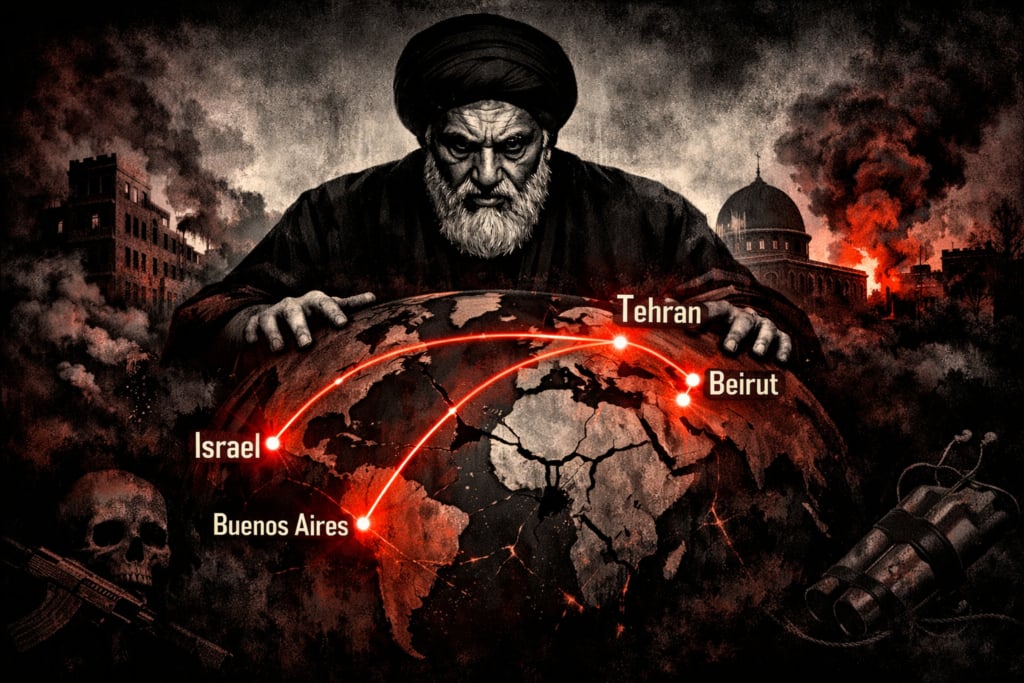
Iranian proxy Hizballah’s slain leader Hassan Nasrallah once said, “If they (Jews) all gather in Israel, it will save us the trouble of going after them worldwide.” Hizballah has certainly targeted Jews in Israel, but it has also taken the trouble to go after them worldwide. On March 17, 1992, a jihad suicide bomber drove a truck filled with 220 pounds of TNT into the Israeli Embassy in Buenos Aires, murdering twenty-nine people and wounding 242.
Iran immediately denied any involvement in the bombing, but a number of facts cast that denial into doubt. A Muslim group called the Islamic Jihad Organization (IJO) immediately claimed credit for the bombing, saying it had been perpetrated by a convert to Islam named Abu Yasser in order to avenge the killing of Hizballah leader Abbas Mussawi and his family, including his five-year-old son Hussein, in an Israeli air raid. “We hereby declare with all pride,” said Islamic Jihad’s statement, “that the operation of the martyr infant Hussein is one of our continuing strikes against the criminal Israeli enemy in an open-ended war which will not cease until Israel is wiped out of existence.”
The IJO was essentially just Iran client Hizballah operating under a different name. Journalist Ronen Bergman explained, “The Hizballah command in Beirut selected the Israeli Embassy in Buenos Aires as the best target for revenge for the Mussawi assassination. The Triple Frontier area — the border region shared by Argentina, Paraguay and Brazil—at the Iguazu Falls was the staging ground, due to its large population of Shi’ite immigrants from Lebanon who maintain close links with their families back home and are ready to help when necessary.”
The IJO had also carried out the bombing of the U.S. Marine barracks in Beirut in 1983. A key Hizballah leader, Imad Mughniyeh, was said to have been one of the principal planners of that attack and to have watched it happen with binoculars from the top of a building nearby. Hizballah’s first Secretary-General, Subhi al-Tufayli, was also implicated in the barracks attack, as was Mohammad Hussein Fadlallah, a key Hizballah spiritual leader.
On July 18, 1994, another jihad suicide bomber destroyed the Jewish-Argentine Mutual Association (AMIA) building in Buenos Aires, killing eighty-five people and wounding three hundred. As years went by and no one was convicted of the attack, numerous accusations were made of cover-ups by Argentine investigators and authorities. Finally, in October 2006, Argentine state prosecutor Alberto Nisman formally charged Iran and Hizballah and called for the arrest of, among others, former Iranian President Hashemi Rafsanjani, charging that he had ordered the attack as revenge for Argentina’s ending its nuclear cooperation with Iran. Nisman’s report alleged that Argentina was providing Iran with low-grade enriched uranium and that since powerful elements in both countries wanted these transactions to continue, both had an interest in covering up Iran’s role in the bombings.
Both Iran and Hizballah denied any involvement. In 2013, Argentine president Cristina Fernández de Kirchner struck a deal with the Islamic Republic to open a joint investigation of the bombing. Nisman, however, charged that this joint investigation was designed solely to divert attention from Iranians who had been accused of involvement in the case, and to quash arrest warrants for them.
On January 14, 2015, Nisman accused President Fernández de Kirchner of negotiating secretly with the Iranians — offering to make the bombing investigation go away in exchange for favorable oil terms from Iran. Nisman was scheduled to meet with Argentine officials on January 19 to give them the details of his accusations, but he was found dead that morning — shot to death in his bathtub.
The connection between Argentina and Iran’s nuclear ambitions was further complicated on September 28, 2015, when Fernández de Kirchner, addressing the United Nations General Assembly, claimed that in 2010 Obama administration officials had exhorted her to provide nuclear fuel to the Iranians: “In 2010 we were visited in Argentina by Gary Samore, at that time the White House’s top advisor in nuclear issues. He came to see us in Argentina with a mission, with an objective: under the control of IAEA, the international organization in the field of weapons control and nuclear regulation, Argentina had supplied in the year 1987, during the first democratic government, the nuclear fuel for the reactor known as ‘Teheran.’”
According to Fernández de Kirchner, the Obama administration, in order to smooth the way for the deal it was negotiating with Iran, wanted Argentina to supply the mullahs with fuel for their nuclear program.
Obama, like so many other Western leaders, was willing to play ball with the mullahs. Trump, by contrast, refuses to be duped. And so the global adventures of this rogue state may be drawing to a close.