In Focus delivers deeper coverage of the political, cultural, and ideological issues shaping America. Published daily by senior writers and experts, these in-depth pieces go beyond the headlines to give readers the full picture. You can find our full list of In Focus pieces here.
I learned what it means to be an orphan long before I learned what it means to be protected by the system that claims to exist for children such as me.
After my mother died, I went to live with a relative from her side of the family. My father had no custody or visitation rights due to his long-standing drug addiction, so there was no fallback parent, no second chance at stability. For the year before I moved in with a relative, I was effectively homeless; sleeping at friends’ houses, trying to finish high school without drawing attention to how precarious my life had become. Like many children in crisis, I learned quickly how to be unobtrusive, how to make myself small.
When I finally moved in, my guardian made what sounded like a solemn promise. She told me she would save my Social Security survivor benefits for me; both the benefits from the year I lived with her and the benefits from the year prior, when I had no stable home at all. This was money my mother had earned through a lifetime of work, federal benefits explicitly intended to support her child after her death. I believed her because I needed to believe someone was looking out for me.
Besides, who would steal from an orphan?
At my high school graduation, when Social Security survivor benefits traditionally end, she announced that I was being kicked out on to the streets of New York City, with everything I owned in black trash bags. In the same breath, she told me she would be keeping every dollar of my survivor benefits, more than $35,000 she had collected while acting as my guardian.
I did what children are told to do when someone wrongs them: I went to the authorities. A Social Security agent, who was clearly cognitively impaired, told me the situation appeared to be a case of fraud and theft. Investigators were sent to my guardian’s home. For a brief moment, it seemed possible that the system might intervene and protect me. Then, just as suddenly, the case was closed because she refused to answer the door for investigators. I was informed that nothing more could be done.
As a penniless orphan, I had no way to hire an attorney. Even if I had scraped together the money for legal representation, I would likely have ended up with nothing after legal fees. The pursuit of justice evaporated, and I moved on with nothing to my name. The money my mother had earned for me, money meant to help me launch into adulthood without her, was gone forever.
The experience permanently altered how I understood authority, vulnerability, and the ease with which adults can rationalize taking from children who have no ability to fight back. This is why the news coming out of the Department of Health and Human Services this month matters so deeply to me, not merely as policy, but as a long-overdue moral reckoning.
Earlier this month, the Administration for Children and Families sent letters to 39 governors informing them that their states allow child welfare agencies to intercept Social Security survivor benefits earned by foster children and divert those funds to reimburse state care costs. These benefits are tied to a deceased parent’s work history and are intended to be, as the letter notes, “the last, or only, financial support deceased parents can provide to their children.” Yet for decades, states have quietly taken them to offset the cost of a child’s care, often without notifying the children at all.
Only 11 states currently prohibit this practice. The rest, representing the overwhelming majority of the country, including both blue and red states, permit it as a matter of routine administration.
The letter, signed by ACF Assistant Secretary Alex J. Adams, is unusually blunt in its moral framing. The practice, it states, is “contrary to the best interests of children,” and ACF makes clear that it is “working to put an end to this practice” by encouraging states to stop intercepting children’s survivor benefits and to conserve them for the child’s unmet needs.
Adams told the Washington Examiner that he has seen this issue from every angle, including the one states often use to justify it. “Before running the Department of Health and Welfare in Idaho, I used to run the state budget,” he said. “And it’s clear to me this isn’t a budget issue, this is a moral issue. I would never try to balance my budget on the backs of orphans.”
During his tenure in Idaho, Adams ended the practice entirely. Survivor benefits were used only for genuine unmet needs, and the remaining balance was preserved for the child’s future. The fiscal impact on the state was negligible. The implications for foster youth were profound.
“The amount we collected was, in the grand scheme of things, almost insignificant in the context of the state budget,” Adams explained. “But it means everything to these kids. So many foster youth age out into homelessness or near-homelessness, and the difference between success and failure in life could be these resources.”
The ACF letter echoes this concern, emphasizing that child welfare agencies bear responsibility not only for safeguarding children while they are in state custody, but for “ensuring they are better off when they leave the state’s custody than when they entered.” Intercepting a child’s only financial asset does the opposite.
Youth who age out of foster care already face dramatically higher rates of homelessness, incarceration, unemployment, and early parenthood than children raised in a home by their family members. Removing survivor benefits from the equation does not merely worsen those odds; it all but guarantees failure.
What is most disturbing is how normalized this practice became and how it was justified when it was implemented. “If you chase down the history on this,” Adams said, “a lot of states started doing it in the early 1990s. They began treating children as a revenue-maximization opportunity to help balance their budgets.” After three decades, the practice has become so embedded in bureaucratic routine that many governors are genuinely unaware it is happening in their states at all.
That ignorance is beginning to lift. Adams says states have already begun responding to ACF’s outreach, and with most state legislatures convening in January, he expects swift movement. “We’ve heard from a number of states, and I anticipate a flurry of activity in the upcoming legislative sessions based on the drumbeat we’ve been hearing for the past two weeks.”
New Jersey has already announced plans to address the issue, launching state-level efforts to rectify what officials are now openly acknowledging is a grave wrong.
What makes this moment particularly notable is its bipartisan character. Two policy organizations, the America First Policy Institute and the John Marshall Project, have spearheaded the issue at the think-tank level, developing model legislation that states can adopt immediately. Adams used that language as a blueprint in Idaho and is now informing federal guidance to the remaining states.
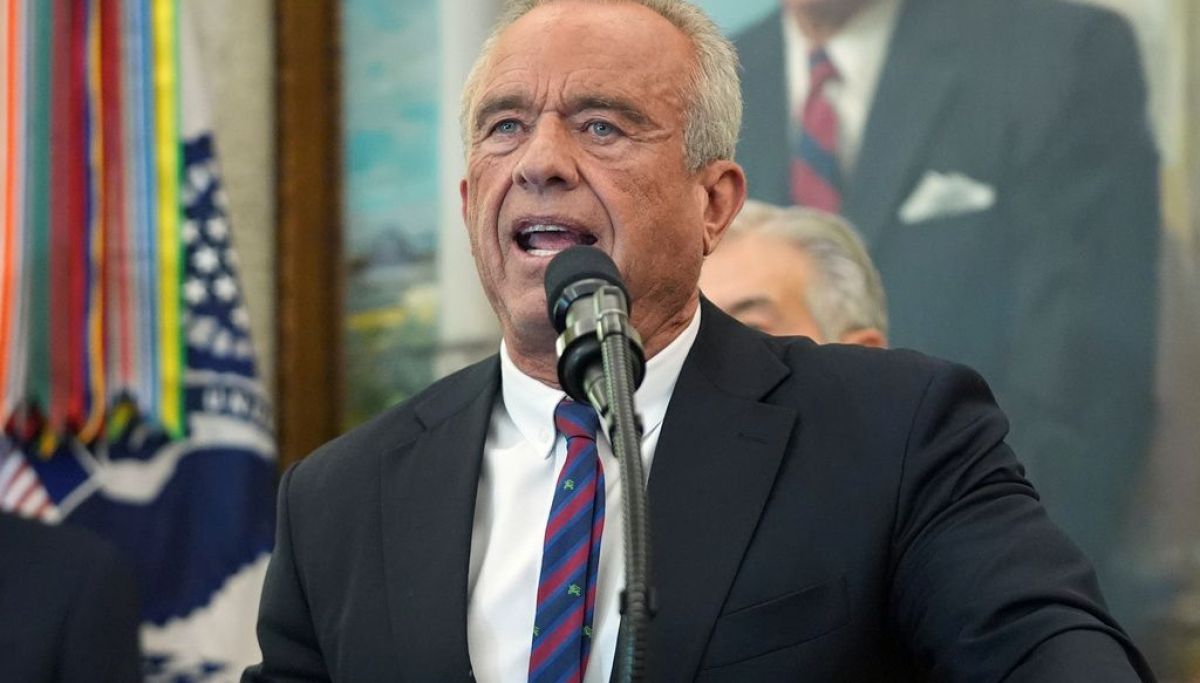
At a time when much of what Health and Human Services Secretary Robert F. Kennedy Jr. has done has generated intense controversy, this initiative has managed to cut cleanly across ideological lines.
“Protecting children should be a bipartisan effort,” Adams told the Washington Examiner. “I am committed to working with all 38 states that continue to steal from orphans to ensure our child welfare systems actually serve the best interests of children.”
That word, steal, is not a rhetorical excess. It is an accurate description of what has been happening for decades under the cover of administrative procedure. As the ACF letter makes clear, states may have done this “perhaps unknowingly,” but the harm is no less real for the children who paid the price.
Survivor benefits are often the only inheritance foster youth will ever receive. They are not extra; they are a lifeline.
THE CAMPUS VIBE SHIFT IS AN ILLUSION
Ending this practice will not undo the harm that has already been done. It will not return the money taken from former foster youth who aged out with nothing. However, it will mean that the next child does not begin adulthood empty-handed, because the adults entrusted with their care helped themselves first.
That alone makes this one of the most consequential and plainly moral policy fights unfolding in America today.