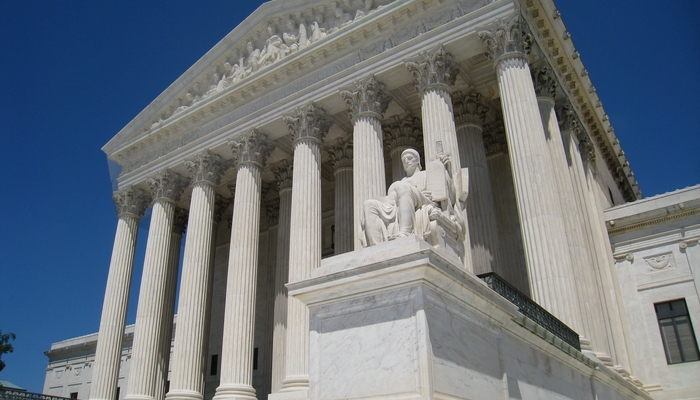
The U.S. Supreme Court restored the rights and authority of parents Monday by ruling that California schools can no longer secretly gender-transition students.
In its ruling, the High Court restored an injunction against California school policy – which prohibits disclosure of students’ school-time gender identities to parents – granted in the case of parents and teachers challenging the school policy in Mirabelli v. Bonta.
“Before us is an application to vacate a Court of Appeals order staying a permanent injunction entered by a District Court on behalf of parents and teachers who claim that certain California policies violate their rights under the Free Exercise Clause of the First Amendment and the Due Process Clause of the Fourteenth Amendment,” the Supreme Court explains:
“The parents object that these policies prevent schools from telling them about their children’s efforts to engage in gender transitioning at school unless the children consent to parental notification.
“The parents also take issue with California’s requirement that schools use children’s preferred names and pronouns regardless of their parents’ wishes.
“The teachers object to their compelled participation in the implementation of the State’s policies.
“The same is true for the subclass of parents who object to those policies on due process grounds.”
“Under long-established precedent, parents—not the State—have primary authority with respect to “the upbringing and education of children,” the decision states:
“Gender dysphoria is a condition that has an important bearing on a child’s mental health, but when a child exhibits symptoms of gender dysphoria at school, California’s policies conceal that information from parents and facilitate a degree of gender transitioning during school hours. These policies likely violate parents’ rights to direct the upbringing and education of their children.”
The Supreme Court grants the parents’ application for a stay of the 9th Circuit’s reinstitution of California’s secrecy policy because the parents are likely to ultimately succeed based on the merits of the case and would otherwise suffer “irreparable harm.” The opinion also rules that “the balance of equities” is on the parents’ side and that the lower court’s procedural issues with the case are unjustified. The opinion rejects the teachers’ request to be freed of obeying school policy.
California’s policy fails the “strict scrutiny” required in cases involving the Constitution’s Due Process and Religious Freedom protections and cannot pass other tests imposed by Supreme Court precedent, the High Court finds.
“The decision puts even greater focus on another case,” legal scholar and George Washington University Law Professor Jonathan Turley wrote Tuesday, explaining that the Supreme Court has been petitioned to review a case that “could allow the Court to reaffirm the fundamental rights of parents and, most importantly, clearly establish the standard for review in future cases.”
By taking up that case, the Supreme Court would be able to correct a lower court decision ruling that “the expertise of school officials” trumps parents’ authority:
“Last year, I wrote about a startling decision in Foote v. Feliciano in which the United States Court of Appeals for the First Circuit ruled against parents in a similar challenge. Massachusetts parents Marissa Silvestri and Stephen Foote demanded notice of any gender identity change of their child after learning that the 11-year-old child had self-declared as ‘genderqueer.’
“The First Circuit dismissed the challenge, holding ‘as per our understanding of Supreme Court precedent, our pluralistic society assigns those curricular and administrative decisions to the expertise of school officials, charged with the responsibility of educating children.’”
“It is time for the Court to back up [parents’] constitutional right with clear and robust protections,” Turley concludes.
The Thomas More Society, which is representing the parents in Mirabelli v. Bonta, cheered Monday’s ruling, declaring it a historic, groundbreaking landmark decision that “reinstates U.S. District Judge Roger Benitez’s December 2025 decision on behalf of statewide class of parents, finding California’s secret gender transition regime unconstitutional”:
“In a historic and groundbreaking ruling, the U.S. Supreme Court today granted the Thomas More Society’s emergency application in Mirabelli v. Bonta, holding that secret gender transition policies in schools violate the religious liberty and due process rights of parents.
“The ruling restores the class action injunction that Thomas More Society had secured against the State of California for parents across the state who object to the state’s directives requiring schools to conceal children’s gender transitions from their own parents, facilitate those transitions without parental knowledge or consent, and compel teachers to actively deceive families.
“The landmark 6-3 decision is the most significant parental rights ruling in a generation. The Court found that California’s secret transition regime likely violates parents’ rights under both the Free Exercise Clause of the First Amendment and the Due Process Clause of the Fourteenth Amendment, holding that the state “cut out the primary protectors of children’s best interests: their parents.”
While Monday’s Supreme Court decision may not permanently settle the issue, it does restore parental rights and suggest which way the majority of justices might vote if the case makes it to them.