Order Jamie Glazov’s new book, ‘United in Hate: The Left’s Romance with Tyranny, Terror, and Hamas’: HERE.
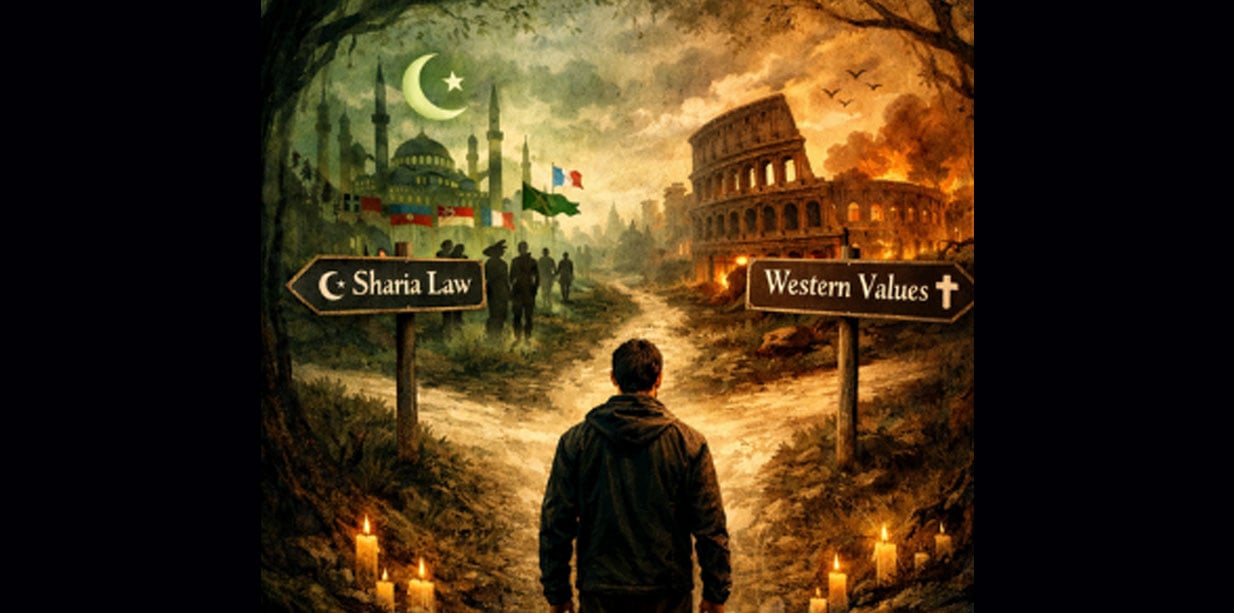
Midway upon the journey of our life
I found myself within a forest dark,
For the straightforward pathway had been lost.
– Dante, beginning of Purgatorio, Canto I,
trans. Longfellow
Two years ago at about this time, I wrote here about a development in Western Europe that was utterly predictable, given the dangerous direction in which things are headed. In many a Western European country, the usual selection of political parties has been supplemented by something new: a Muslim political organization that’s determined to exploit the growth of the Muslim electorate in such a way as to expedite Islamization.
In Britain, the organization in question is called The Muslim Vote. Founded in 2023, it boasts on its website that it places “Muslim issues at the forefront,” that the British Muslims whom it represents “will no longer tolerate being taken for granted,” and that they are “a powerful, united force of 4 million acting in unison.” Just in the last few days, The Muslim Vote has stated that it will be endorsing the Green Party’s as-yet-unnamed candidate in a by-election for the parliamentary seat of Gorton and Denton in Greater Manchester. In response, Rupert Lowe MP of Reform UK commented: “Muslims are increasingly voting along organised religious lines. If that doesn’t scare you, it should.” Tommy Robinson agreed.
I don’t know what The Muslim Vote thinks about a man named Shahid Butt, but according to The Telegraph he’s running on the Independent Candidates Alliance line, established by two gentlemen named Akhmed Yakoob and Shakeel Afsar, to represent an overwhelmingly Pakistani ward on the Birmingham city council. “With the help of Allah,” he told voters upon announcing his candidacy, “I know we are going to take this.” Butt has quite the résumé: as a kid, he belonged to violent gangs; in 1999, he was imprisoned in Yemen for conspiring with several chums under the direction of hate preacher Abu Hamza “to bomb the British consulate, an Anglican church and a Swiss-owned hotel.” He now claims to have put the choices of his youth behind him. Apparently the folks at the British Home Office – the same geniuses who recently refused to grant entry to the Dutch activist Eva Vlaardingerbroek – have chosen to put Butt’s history behind them, too. I’m sure they know what they’re doing.
In the Netherlands, the closest counterpart to The Muslim Vote is the Denk Party, established in 2015. In each of the last four elections – 2017, 2021, 2023, and 2025 – it won three seats in the Dutch Parliament; in 2022, members of Denk were elected to the municipal governments of Rotterdam and Schiedam. Its party manifesto contains cozy words like “tolerant,” “caring,” and “just,” but it has also demanded, in fine Orwellian fashion, the abolition of the Dutch words for “immigrant” and “integration.” In addition, it’s closely tied to the Erdogan regime in Turkey, and its leadership has refused to distance itself from Hamas. But who, honestly, would expect otherwise?
Last October brought a new development in the Netherlands: a group of Syrian-Dutch citizens introduced a group called We Rise. “We are claiming our voice,” they said at a meeting in The Hague, where co-founder Mahmoud Al-Naser demanded greater dialogue between politicians and immigrants and explained that the new group seeks “to inform people about the importance of participating and using their vote.”
Meanwhile, Sweden has something called the Nuance Party, which came along in 2019. Among its many objectives are to build more mosques, welcome more Muslims, increase Muslim participation in police departments, teach an ideology of Muslim victimhood in schools, and make criticism of Islam a severely punishable offense. Not very surprisingly, some of its leaders have supported ISIS, praised suicide bombers, spread antisemitic rhetoric, and been convicted of felonies. In 2022, it won three seats in local elections, although it turned out that many of its candidates were on the ballot in municipalities where they didn’t live and were running in several different elections at once.
Nonsense, of course, but perfidious nonsense.
Now it’s Italy’s turn. In November, inspired in large part by the election of a Muslim as mayor of New York, and apparently undeterred by Georgia Meloni’s efforts to keep Italy Italian, a group of Muslims in Rome formed an association called MuRo27 – Muslims for Rome 2027. Their stated goal is for MuRo27 to “become a political player”; their founding premise is that if London and New York can elect Muslim mayors who pursue policies that are in line with both Marx and Muhammed, why not the Eternal City? Like The Muslim Vote in Britain, MuRo27 doesn’t consider itself a political party; to quote Francesco Tieri, an Islamic convert who is one of its founders, it seeks to make use of this “Mamdani moment” to “bring issues into the political discussion” and “embrace the unprecedented nature of Muslims as political subjects and no longer political objects.” Meaning what? Meaning, says Tieri, that MuRo27 wishes to use Muslim “values” to “contribute to the common good.”
It sounds to me like a nice way of saying “Islamization.” Indeed, MuRo27 has been described by critics as “Islamist” and accused of seeking “to replace the Constitution with Sharia law.” Tieri has said that he wants the 80,000 Muslims in Rome who aren’t Italian citizens (an additional 40,000 do hold citizenship) to be granted full rights to “democratic participation.” Does this mean allowing non-citizens – including those who can’t even speak the language – to hold elective office?
MuRo27 isn’t alone on the Italian political scene. In January, the Muslim Party, a bonafide political party with nationwide scope, was founded with the express intent of increasing the Muslim “impact at the ballot box.” In the January 23 issue of Il Giornale, Giulia Sorrentino reported that its leaders include Brahim Baya, “an Islamic preacher from Turin,” and Davide Piccardo, “founder of the Islamist website La Luce (The Light).” Both had recently spoken on a podcast about how important it is that Muslims in Italy – who number between three and five million – be informed about their rights and taught how to assert them. (Yes, time for European Muslims to stop being so shy.) Baya, noted Sorrentino, had praised the mastermind of Hamas’s October 7 attack on Israel, while Piccardo had reposted social-media quotes wishing people a “Happy October 7.” Lovely pair.
These fledgling Muslim groups in Britain, Sweden, and the Netherlands have caused a great deal of hand-wringing. It’s understandable: when the percentage of Muslims in a country reaches a point at which a Muslim party or political organization can become a serious player on the electoral scene, the whole calculus changes. At present, the approach of most of the existing parties, where Muslims are concerned, is to take cynical policy stands, and cast votes, that may lose them non-Muslim support but that will gain them more than enough Muslim support to make up for it. But once Muslim parties have gained a firm foothold in the political establishment, and can automatically count on receiving an overwhelming majority of Muslim votes, they’ll be in a position to push their own agendas and, when they inevitably become parts of ruling coalitions, to gain concessions of a not insignificant nature – the kind of concessions that can accelerate Islamization big time.
But perhaps most important of all is what you might call the question of perception: the very existence of Muslim parties and their representation, however minimal at first, in parliaments and city councils will serve to normalize, in the minds of the general public, the idea of political parties whose agendas are rooted in scripture – rooted, specifically, in a set of holy laws that are utterly at odds with Western notions of individual liberty and sexual equality. Wait a few years and the youngest adults, who will have grown up with such parties, will take them entirely for granted. (After all, young people in Western Europe already take for granted aspects of Islam that, a generation ago, unsettled their parents and grandparents.)
In any event, Italy is now headed down this same path, and some Italians are none too happy about it. Giulia Sorrentino, the reporter for Il Giornale, has made it clear that she recognizes the formation of these Muslim political organizations as a clear and present danger to Italian liberty. In response to her criticism, these new arrivals on the political scene have behaved in a way that should not surprise anyone who has followed the steady ascent of Islam in Europe: they’ve targeted her with fatwas. And so a new phase in the Islamization of one major European country begins. Better stock up on the Pinot Grigio, amici: it’s going to be a long, tough journey, and there’s no Virgil to guide us.