U.K. Prime Minister Keir Starmer’s recent state visit to China yielded minimal rewards, despite significant concessions made to Beijing. The trip was marred by diplomatic humiliations that undermined both his personal standing and Britain’s reputation.
Like other liberal leaders in Europe and Canada who dismissed President Trump’s “tough love,” Starmer mistakenly believed that engaging with the communist regime would reduce Britain’s dependence on the United States. Furthermore, Starmer likely had hoped that a successful overseas trip would improve his low approval rating at home. However, Beijing sensed Starmer’s desperation and exploited it without mercy.
The Chinese government reportedly withheld its endorsement of Starmer’s state visit, insisting that he greenlight China’s plan for a massive new embassy in central London. To increase their leverage, the Chinese authorities have gone so far as to keep turning off the heating at the UK embassy in Beijing in the middle of the winter, and have even issued eviction notices to UK embassy staff.
Many, including the Trump administration, warned Starmer that the proposed new Chinese embassy in London poses significant security risks due to its proximity to fiber-optic cables that carry financial and communication data. If built, the new Chinese embassy could facilitate espionage and threaten the UK’s national security, as well as its intelligence-sharing agreements with the U.S. and its allies. Despite these concerns, Starmer yielded to Beijing’s demand this January. Only after Starmer caved did China agree to his state visit, leading to a hectic last-minute scramble for visas for those accompanying Starmer to China, according to a British media outlet.
Cybersecurity analysts have lambasted Starmer’s decision as trading “token handouts from the CCP for a permanent threat to democracy.” Ironically, in preparation for their trip to China, Starmer’s team brought burner cell phones and laptops equipped with temporary email addresses, aiming to reduce the risk of sensitive data falling into the hands of Beijing’s operatives. Yet, this precaution only amplifies the recklessness of Starmer’s approval of China’s new embassy, a potential espionage hub, in the heart of London.
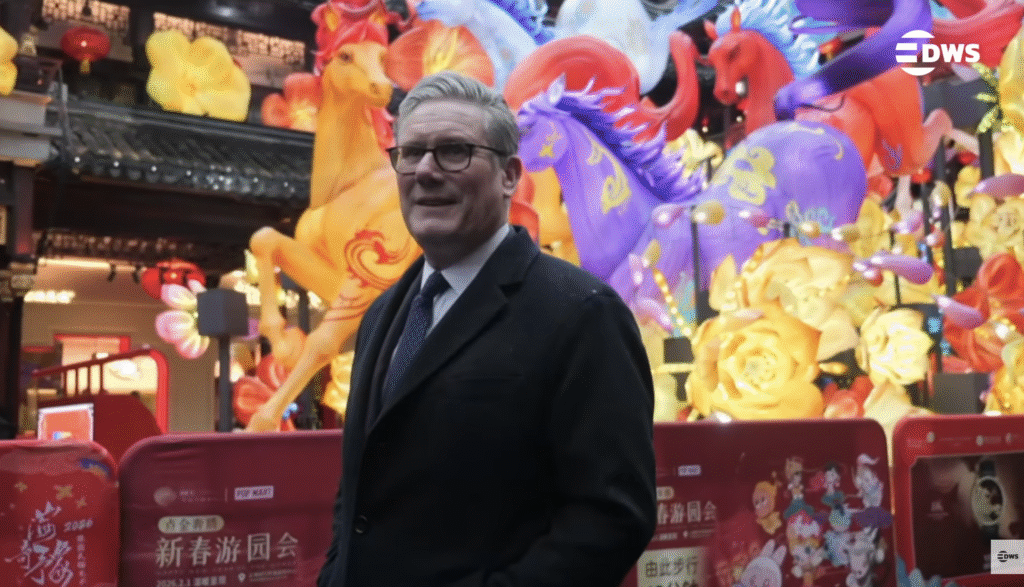
Once on the ground in China, Starmer looked out of his depth, like a nervous student about to meet a strict school principal. There were some awkward moments, such as when he needed physical guidance to take his position during a red-carpet ceremony, and his visible uncertainty around the guards. Protocol spoke volumes: unlike Donald Trump’s 2017 visit, where Xi Jinping closed the Forbidden City, an impressive world-heritage site, for a private tour with personal escort, Starmer toured amid public crowds with one tour guide — treated more like a tourist than a head of government.
This disparity in treatment did not go unnoticed and led to widespread ridicule on social media. Beijing is infamous for its meticulous attention to protocol, meticulously designed to convey hierarchy. China observer Ken Cao noted, “Xi doesn’t greet equals the same way he greets subordinates. The difference is intentional.” U.K. Professor Anthony Glees lamented that Starmer was treated “like a humdrum tourist,” emphasizing the troubling dynamics at play and the growing imbalance in the U.K.-China relationship that deserves serious attention.
To add more insult to injury, in the Chinese official readout of the Xi-Starmer meeting, which lasted less than an hour, Xi referred to Starmer as 你 (nǐ), the standard/neutral “you” often used by a superior to an inferior. In contrast, Starmer’s side used 您 (nín), the more polite/respectful “you” typically reserved for superiors, elders, or formal deference. Critics such as Charles Burton interpret China’s asymmetry in translation as intentional, “Starmer is depicted as subordinate supplicant to [a] superior ‘emperor.’”
Starmer returned from China with disappointingly little to show for, despite the concessions he made and the humiliation he endured. No significant trade deal was announced, and no release for Jimmy Lai, a British citizen and pro-democracy activist imprisoned in Hong Kong since 2020.
Instead, Xi offered only symbolic concessions: the Chinese tariffs on U.K.’s whisky were reduced from 10 percent to 5 percent, and a 30-day visa-free framework for British citizens. Calling Starmer’s China trip “pathetic,” former U.K. Foreign Secretary Sir James Cleverly lamented: “Having contorted himself to please Beijing, Starmer’s ‘big win’ is essentially the same visa deal France and Germany already enjoy. He sells himself, and the UK, so cheaply.”
Starmer’s debacle should serve as a wake-up call for other European leaders — whether from France, Ireland, or Canada — who have eagerly courted Xi, despite his brutal authoritarianism and rejection of liberal values. These European liberals need to understand that Xi operates under the principle that “might makes right.” He only plays nice when faced with resolute strength, not bowing and scraping.
The more European leaders kowtow to Xi, the less Xi is interested in compromising and modifying China’s policies. He views Europe merely as a dumping ground for surplus goods and a wedge to divide and weaken the alliance between Europe and the United States. While receiving his European visitors like an emperor, Xi has categorically dismissed European concerns over issues such as human rights abuses, international espionage, interference in elections, and the dumping of electric vehicles. Furthermore, Xi has ignored European officials’ pleas that urge him to influence Russian President Putin to cease the conflict in Ukraine.
Therefore, European leaders need to stop seeking false goodwill from the Communist regime. The way forward for the continent is not by cozying up to Xi, but by strengthening the continent’s economies, defenses, and alliances — particularly with the United States. This involves addressing honest differences rather than resorting to denial and resentment. Anything less will continue to embolden Beijing and further undermine Europe’s security and relevance in a fast-changing world.