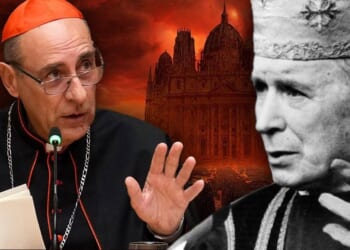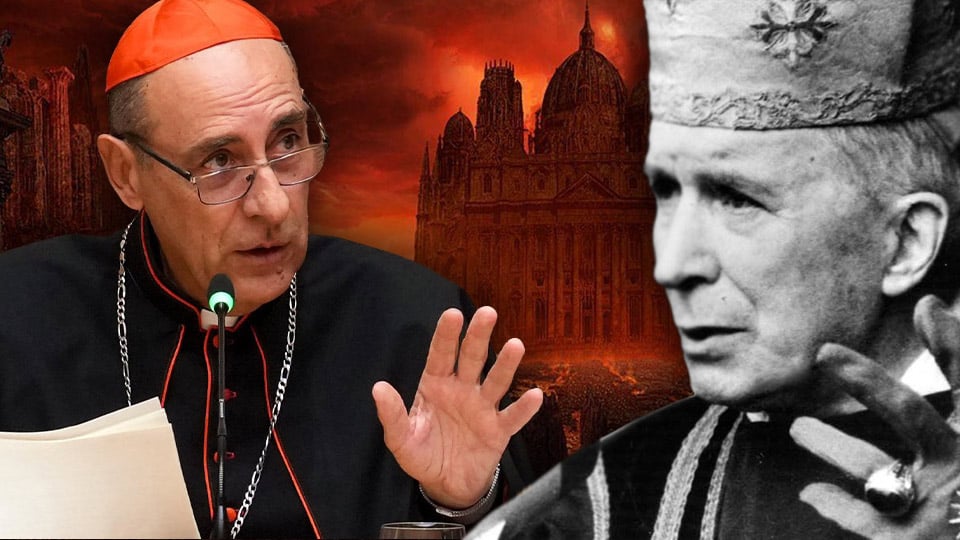
There is something rather theatrical—about Cardinal Víctor Manuel Fernández’s sudden fixation on the importance of the Society of St. Pius X (SSPX) abiding by the Vatican’s requirements in order to enjoy being in “full communion with the Catholic Church”, especially given the prelate’s past contentious writings regarding sexuality and mysticism.
One cannot help but observe a double standard: conscience is praised—until it defends Tradition.
For decades since the Second Vatican Council (Vatican 2), Catholics (and the rest of the world) have been told that conscience is the utmost “sanctuary” of man, upon which neither creed nor force may encroach. As “Gaudium et Spes” stated:
“In the depths of his conscience, man detects a law which he does not impose upon himself, but which holds him to obedience. Always summoning him to love good and avoid evil, the voice of conscience when necessary speaks to his heart: do this, shun that. For man has in his heart a law written by God; to obey it is the very dignity of man; according to it he will be judged. Conscience is the most secret core and sanctuary of a man. There he is alone with God, Whose voice echoes in his depths. In a wonderful manner conscience reveals that law which is fulfilled by love of God and neighbor. In fidelity to conscience, Christians are joined with the rest of men in the search for truth, and for the genuine solution to the numerous problems which arise in the life of individuals from social relationships.”
“At the same time, however, there is a growing awareness of the exalted dignity proper to the human person, since he stands above all things, and his rights and duties are universal and inviolable. Therefore, there must be made available to all men everything necessary for leading a life truly human, such as food, clothing, and shelter; the right to choose a state of life freely and to found a family, the right to education, to employment, to a good reputation, to respect, to appropriate information, to activity in accord with the upright norm of one’s own conscience, to protection of privacy and rightful freedom even in matters religious.”
In the years since Vatican 2, Catholics have been instructed to believe that liturgical forms may change, theological focuses may evolve, and ancient rite disciplines may be reconsidered.
Likewise, “Dignitatis Humanae”, Vatican 2’s 1965 Declaration on Religious Freedom, declared that “the human person has a right to religious freedom… such that no one is to be forced to act in a manner contrary to his own beliefs”.
Notably, this aforementioned paragraph from “Dignitatis Humanae” has often been quoted by many liberal-leaning Catholics and non-Catholics alike to exalt private judgment at the expense of the objective, perennial, and immutable teachings of the Catholic Church.
In the years since Vatican 2, Catholics have been instructed to believe that liturgical forms may change, theological focuses may evolve, and ancient rite disciplines may be reconsidered—all in the name of aggiornamento. One must follow one’s conscience, we have been told, even if it directs souls away from what previous generations of Catholics believed and lived.
However, one cannot help but observe that the post-conciliar Vatican’s zeal to respect individual men’s consciences tends to dwindle when such consciences lean in favor of pre-Vatican 2 church doctrines and discipline.
Other more conservative commentators have tried to point out how implied that individual men’s consciences are still accountable to the objective divine law, instead of being entirely detached from it.
Both interpretations of “Dignitatis Humanae” and “Gaudium et Spes” can be used to justify the conscience-based reasons behind the decision undertaken by Archbishop Marcel Lefebvre, founder of the SSPX, to consecrate four bishops in 1988.
Yet even when comprehended in this light, both interpretations of “Dignitatis Humanae” and “Gaudium et Spes” can be used to justify the conscience-based reasons behind the decision undertaken by Archbishop Marcel Lefebvre, founder of the SSPX, to consecrate four bishops in 1988.
On February 2, the SSPX alluded to the extent of the crisis facing the Catholic Church today (as it has faced the Church for decades) in its move announcing its plans to consecrate more new bishops on July 1, 2026. In a letter addressed to Cardinal Fernández, SSPX Superior General Don Davide Pagliarani, wrote:
“We both know in advance that we cannot agree doctrinally, particularly regarding the fundamental orientations adopted since the Second Vatican Council. This disagreement, for the Society’s part, does not stem from a mere difference of opinion, but from a genuine case of conscience, arising from what has proven to be a rupture with the Tradition of the Church. This complex knot has unfortunately become even more inextricable with the doctrinal and pastoral developments of recent pontificates.”
“Over the last decade, Pope Francis and yourself have abundantly advocated ‘listening’ and understanding of non-standard, complex, exceptional, and particular situations. You have also wished for a use of law that is always pastoral, flexible, and reasonable, without pretending to resolve everything through legal automatism and pre-established frameworks. At this moment, the Society asks of you nothing more than this—and above all it does not ask it for itself: it asks it for these souls, for whom, as already promised to the Holy Father, it has no other intention than to make true children of the Roman Church.”
Following the SSPX’s revelations on February 2 this year, all hell seemed to break loose in certain sections of the Catholic world. Suddenly, it appeared that for some Vatican authorities, including Cardinal Fernández, one’s individual “conscience” must be “properly understood”, “ecclesially approved” and “carefully overseen” by Rome.
Notably, “Dignitatis Humanae” proclaimed that “it is through his conscience that man sees and recognizes the demands of the divine law” (DH, 3).
Nonetheless, following criticisms of the SSPX from mainstream Catholic media outlets and certain intransigent elements in the Vatican who seem hell bent on eradicating the Traditional Latin Mass (TLM) and the traditional Catholic Faith, it appears that “Dignitatis Humanae” forgot to encapsulate a footnote stating that its “inclusive” and “all-embracing” proclamations did not apply to God-fearing, traditional Latin-Mass going Catholics!
One may question as to how a faithful and intellectually honest Catholic, upon assessing the chaos brought about by doctrinal confusion, liturgical abuses and catechetical disintegration, can deny that preserving the traditional Catholic priesthood, Faith, and sacraments (as demanded by divine law) can save Holy Mother Church from further confusion and diabolical disorientation!
What was used to justify change is now being used to justify resistance.
When interpreted through this lens, the SSPX’s proposed episcopal consecrations on July 1, can assume the logic of “Dignitatis Humanae” that if conscience is the manner by which one identifies divine law, and if one is not to be forced into acting against it, then acting in sync with it becomes not only permissible but also mandatory.
In other words, the permissive language of “Dignitatis Humanae”, frequently invoked to explain divergences from pre-Vatican 2 Catholic Tradition, can, likewise provide a rationale for the SSPX’s principled opposition to doctrinal heterodoxies and liturgical abuses. As the saying goes: “What is sauce for the goose is sauce for the gander.” Unsurprisingly, some may try to provide further clarifications to “Dignitatis Humanae”, stating that an individual can rely on his or her own conscience to recognize divine law only if the conscience is properly formed.
Nevertheless, given the relativist mindset that the many in the Church and of the world have adopted, embraced, and disseminated in the past six decades, one can and should probe if an individual’s conscience has been formed by the perennial teaching and traditions of the Catholic Church across centuries or solely by the subjectivist fads of the last sixty odd years!
When interpreted either way, a modernist reading of “Dignitatis Humanae” can be turned back upon itself.
On one extreme, if “conscience” is to be taken as an absolute, all-encompassing, and impregnable shield for individual actions and beliefs, then the SSPX can appeal to the same “shield” of “conscience” for its acts meant to preserve the Catholic priesthood and the TLM.
On the other end of the spectrum, if conscience is to be formed in accordance to objective truth and divine law, then the caricature of Archbishop Lefebvre as a mere “rebel” for consecrating four bishops in Écône in 1988 would likewise crumble as the archbishop publicly stated that he was only doing so in a time of grave necessity (particularly after Pope John Paul 2’s gathering with other leaders of false religions at Assisi in 1986 that dramatically altered how mainstream Catholics viewed the Catholic Faith vis-a-vis other false religions).
If conscience cannot be violated, can Rome forbid the preservation of Tradition?
In the case of SSPX-Vatican relations, when traditional Catholic priests and laity make decisions based on a desire to preserve long standing church doctrine, the Catholic priesthood, and Catholic traditions, liberal Vatican authorities denounce these “rigid traditionalists” for “disobedience” and merely for abiding too closely by what was universally believed and lived out for centuries.
One cannot help but perceive a thought-provoking asymmetry (and double-standardness) in terms of how the Vatican treats others; conscience and individual actions seem to be celebrated when they divert souls away from Church teaching, as in the case of the controversial publication of Cardinal Fernández’s “Fiducia Supplicans” regarding pastoral blessings of “same-sex” couples.
Yet all of a sudden, Cardinal Fernández, the very author of “Fiducia Supplicans”, has become curiously particular about fidelity to ecclesial communion when it comes to the matter of the SSPX and its decision to consecrate new bishops!
The logic of Vatican II may now be working against its own architects.
Having said all of these, one silver lining to the extensive media coverage on the SSPX’s planned decision to consecrate new bishops on July 1 this year can be summarized in SSPX priest Fr. Francois Laisney’s remarks about a comparatively delicate situation surrounding Archbishop Lefebvre in 1976 when the latter ordained new priests:
“All the media coverage of the ordinations of 1976 was providential: many faithful and priests around the world attached to the unchangeable Catholic Faith were greatly encouraged by his example. Before, the situation was very gloomy for them: the Traditional Mass was said by older priests who would die out and then what? But after, they knew there was a bishop training young priests who would keep the Mass for them! He gave them hope. I want to give here the testimony of Clovis Areui, chief of a tribe of Kanaks (les Gouaraoui) in the depths of New Caledonia: he heard of Archbishop Lefebvre in 1976 and his reaction was: ‘what is wrong with that bishop? He says the Traditional Mass; he must be a good bishop!’ Later, after a scandal in the cathedral of Nouméa (around 1980) he wrote to Ecône asking for a Mass in reparation and ending his letter: ‘you train priests who will say the Traditional Mass, you are our hope!’ By then, Archbishop Lefebvre was receiving vocations from all over the world. I entered Ecône in October 1976; there were 19 nationalities! The seminary was full.”
***On a side note, refuting those who have accused the SSPX of disobedience to the Holy Father, Fr. Laisney elaborated in the same article, saying:
“Compliance to a particular order responds to the use of authority. If a command is bad, such a command is more an abuse of authority than a proper use of it; authority itself remains good. Hence resisting such command can very well co-exist with submission to authority itself, i.e. the readiness of the will to obey any legitimate order coming from that authority. There is a huge difference between the one who follows his own will, even when complying with a command (because it pleases him), and the one who, out of obedience to the higher authority and ultimately to God, resists the abuse of authority, while keeping the readiness to obey any legitimate order. The first one is not really obedient though he complied; the second is really obedient, though he did not comply. The modernists complied with the changes, not out of obedience but because these changes were what they wanted: they were not really obedient. But Archbishop Lefebvre who resisted these changes was truly practicing the virtue of obedience which resists the abuse of authority out of obedience to the higher authority of God. As he said: ‘the masterstroke of Satan was to lead so many into disobedience to Tradition in the name of obedience.’”
Maria, Mater Ecclesiae, ora pro nobis.