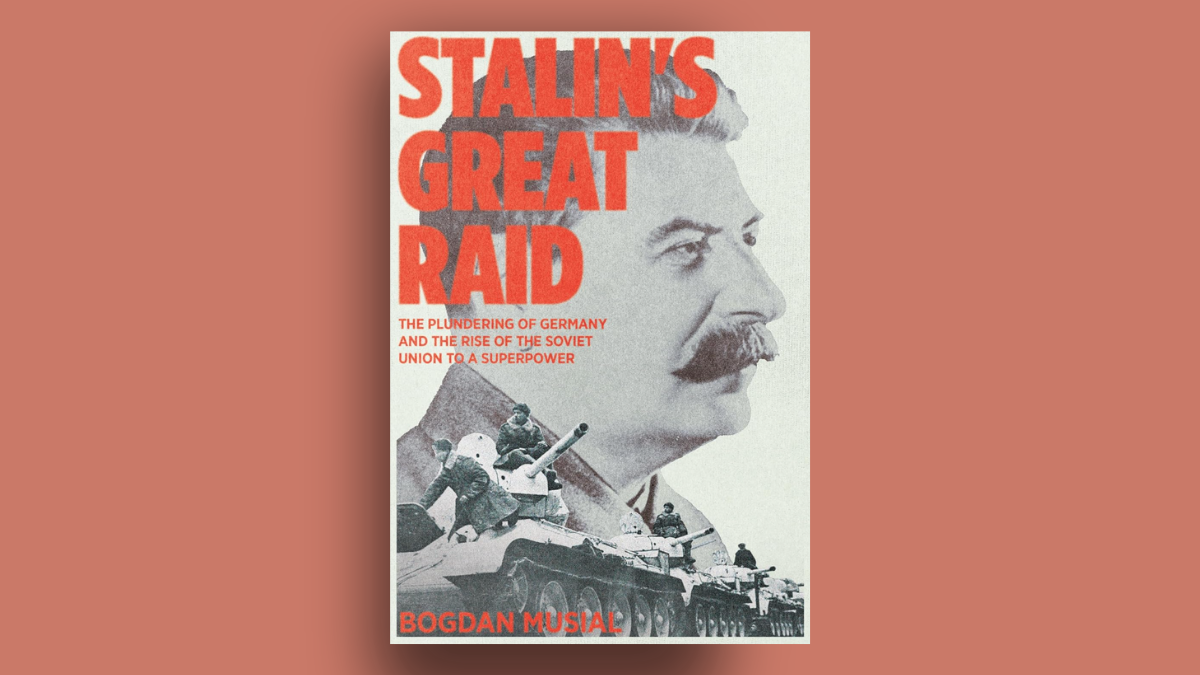
Soviet history, in Bogdan Musial’s Stalin’s Great Raid: The Plundering of Germany and the Rise of the Soviet Union to a Superpower, was less a burning of ideological fervor than a deliberate, predatory architecture. The Soviet Union, that vast, shivering colossus of the mid-twentieth century, did more than defeat Germany; it inhaled it. Musial’s thesis is as cold as a Siberian morning: The rise of the Soviet superpower was a metabolic process, a two-phase ingestion of German technology and industrial bone. The history is that of hard surfaces: steel, machine tools, and the indifferent math of extraction.
Before the first shot of 1941 was fired, there was the commerce of the Molotov-Ribbentrop pact, a cynical intimacy that Musial treats as the essential prologue to empire. The 1939 non-aggression agreement was a shopping list. Stalin was a predator waiting for the capitalist powers to exhaust their blood and treasure in a wider war, while he quietly strengthened the sinews of his own state. The exchange was a grim symbiosis: Soviet grain, oil, and phosphates flowed west to feed the German war machine and bypass the British blockade. In return, Germany sent the very instruments of its future undoing: aircraft, naval technology, and the specialized industrial machinery that would modernize Soviet armaments.
The machine tool is the silent protagonist of Musial’s first chapter. While historians have long noted the grain and the oil, they have been less attentive to the reverse flow of German industrial capacity. The Soviet tank industry, that legend of indigenous proletarian genius, is revealed here as a construct of foreign technology and internal agony. The foundations of the T-34 were laid in the purchase of entire factories and foreign designs from Germany and the United States during the 1920s and 30s. This modernization was financed through the “coercive extraction” of the Soviet countryside, a polite term for the starving of the peasantry and the engine of forced labor. The Soviet state was built by pressing the life out of its own people.
When the German invasion arrived in June 1941, it was a military catastrophe of such scale that the Red Army formations simply disintegrated. Yet, the Soviet system itself did not. Musial attributes this survival to a brutal, hurried, eastward migration of industry. Factories were dismantled and shoved into the Urals and Siberia, a logistical miracle performed under the lash. By late 1941, the tank industry had been reassembled in the east, consolidating its authority under a specialized commissariat. This massive relocation was the turning point of the war. While German equipment often remained technically superior, it was the sheer volume of Soviet production, built on those imported German foundations, that became the decisive instrument of attrition. By 1944, the material edge of the Red Army was an overwhelming fact of nature.
Musial is particularly astringent when discussing the mobilization of Soviet society. He rejects the soft comfort of “spontaneous patriotic unity.” Order was restored through a precise application of terror. Blocking detachments stood behind the front lines to shoot any who retreated, and military tribunals sentenced both soldiers and “labor deserters” with the same mechanical indifference. Perhaps his most chilling claim is the link between the Great Terror of the 1930s and the resilience of 1941. By destroying every potential counter-elite (the peasants, the intellectuals, the independent leaders), Stalin ensured there was no organized group left to facilitate an internal collapse during the invasion. The prewar purges were a preparation for survival under the weight of a foreign occupation.
As the tide turned, the rhetoric shifted from cooperation to sharp, punitive anti-German propaganda. Stalin’s war aims were the permanent deindustrialization and territorial reduction of the German state. He spoke of executing the German technical elite and “pushing back” the areas of historic German settlement. Poland, in this geopolitical reordering, became a movable piece on a map, shifted westward at Germany’s expense to compensate for the territories the Soviet Union had annexed in 1939. The Oder-Neisse line was a mechanism of ethnic and territorial reorganization, designed to leave Poland a dependent client of the Soviet sphere.
The final section of the book, on the “looting,” is where Musial’s archival research in Moscow yields its most damning evidence. Reparations were reimagined as the physical removal of the German industrial heart. Soviet officials planned to hide this stripping of assets under the neutral language of “disarmament.” A centrally directed “Special Committee” coordinated a vast apparatus of extraction. Red Army “trophy formations” moved across East Germany, Silesia, and the wider Eastern Bloc, dismantling everything of value: metal-cutting machine tools, chemical plants, and cultural property.
The numbers cited are staggering, even as Musial warns they are likely undercounted by Soviet statistics that ignored what was lost or destroyed during the transit. Over 10 billion Reichsmarks in equipment and more than 400,000 machine tools were swallowed by the Soviet interior by 1948. The “economic miracle” of the postwar Soviet Union was a growth impulse fueled by looted capital and the subordination of the Eastern Bloc. Poland and other satellites were bled through unfavorable exchange rates and coal deliveries, creating a third major modernization push built on the ruins of the neighbor.
Yet, for all this gathered strength, Musial concludes with a reminder of the structural rot that remained. The Soviet system, though now a superpower, was still a machine of central planning distortions, chronic shortages, and a fundamental incapacity for innovation. The state could steal a factory but could not sustain the spirit that built one. Stalin’s Great Raid is a masterful, if bleak, account of how Soviet power was actually assembled. It is a story of a parasite that outlived its host, then began slowly to die. Musial has written a history as heavy as the iron it describes.