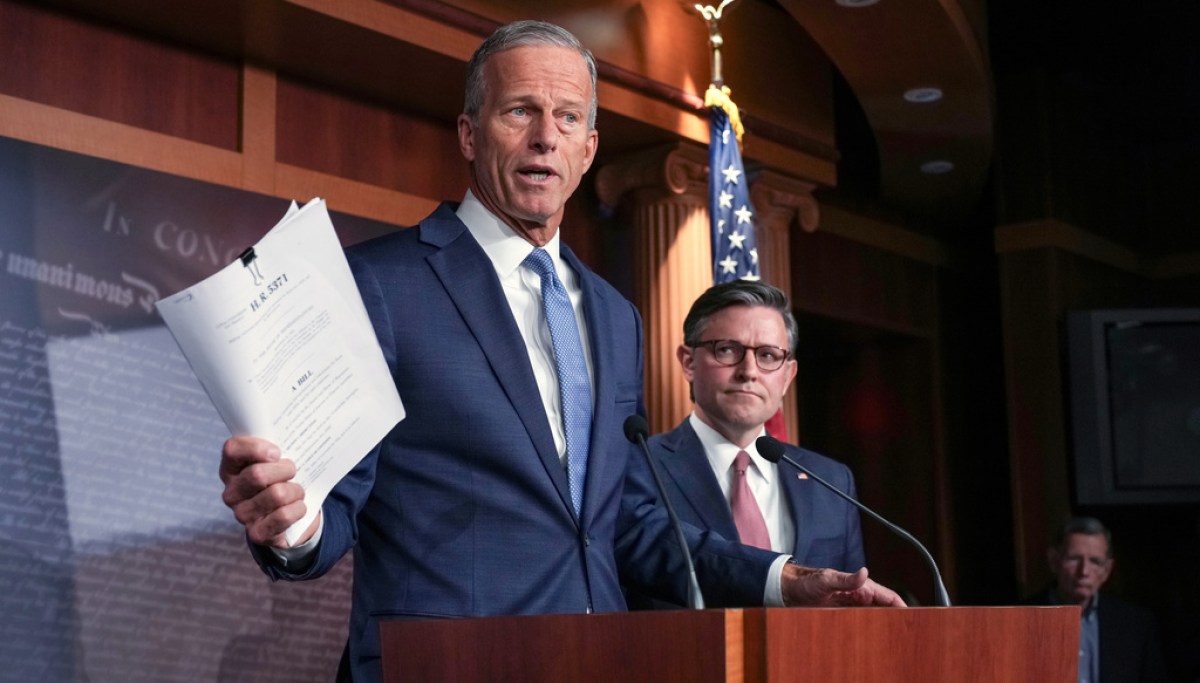
The Senate passed bipartisan housing legislation designed to help boost the housing supply, but the measure faces an uncertain future because of conservative opposition in the House of Representatives and apathy on the part of President Donald Trump.
On Thursday, the Senate voted overwhelmingly, 89-10, to pass the legislation, which would lessen some government regulations on housing and provide incentives for state and local governments to ease land-use regulations. Controversially, it would also ban large investors from buying single-family housing, a provision demanded by Trump but opposed by many free-market conservatives.
A handful of conservative and centrist Republicans voted against the measure, along with Sen. Brian Schatz (D-HI), who opposes the investor ban.
The bill is meant to alleviate one of the most acute economic pressures on American families, namely the soaring cost of housing.
Since the end of the pandemic restrictions, housing prices have risen sharply, and mortgage rates have also shot up. The monthly mortgage payment for a typical new home has nearly doubled in recent years, from $1,597 at the beginning of 2021 to $2,926 to start this year, according to the Federal Reserve Bank of Atlanta.
As a result, homebuying has been put out of reach of many. That, in turn, has played into enormous dissatisfaction with prices and the economy more generally, with surveys indicating that consumer sentiment is as low as it normally is in terrible recessions.
The sense that housing is in a crisis created urgency in both political parties to try to increase the supply, leading to bipartisan measures in both chambers. The Senate version, the 21st Century ROAD to Housing Act, was written by Senate Banking, Housing, and Urban Affairs Committee Chairman Tim Scott (R-SC) and ranking member Elizabeth Warren (D-MA).
TIM SCOTT DEFENDS BAN ON LARGE INVESTORS BUYING HOUSES AGAINST INDUSTRY CRITICISM
The version of the bill passed Thursday is a combination of the Senate’s ROAD to Housing Act and the House-passed Housing for the 21st Century Act. The newest iteration of the legislation is the Senate’s attempt to reconcile the differences between the two bills before sending it back to the House.
House GOP opposition
But in addition to adding the ban on large investor purchases, the bill also leaves out portions of the House bill that helped it clear the lower chamber, especially measures meant to strengthen community banking’s role in housing.
House Financial Services Committee Chairman French Hill (R-AR), who spearheaded the House’s version, discussed this exclusion during a recent Milken Institute event.
“At the heart of [housing] is who finances it,” he said. “So in my judgment, adding those kinds of key community banking elements make the housing bill more fulsome.”
Hill raised the notion of negotiations and even a conference to work on changes to the legislation.
Some in the Freedom Caucus have also pushed back on the combined legislation. Freedom Caucus Chairman Andy Harris (R-MD) said the legislation is “not as conservative” as the House bill, which passed 390-9.
The biggest problem for conservatives is the ban on large investor purchases, which is a policy proposal that has typically been supported by liberals. Generally, they argue that major firms such as Blackstone have outbid families for homes and should be banned from the market.
Free-marketers argue that it is an unwarranted restriction on industry and will crimp supply, particularly by making it uneconomical for developers to invest in build-to-rent properties. There are 160,000 build-to-rent units in the pipeline, according to John Burns Research and Consulting.
Sen. Thom Tillis (R-NC) said he was voting against the bill over the provision.
“My God, when did conservative Republicans start carrying Elizabeth Warren’s banner on housing strategy?” Tillis said.
Looming over the entire process is Trump’s ambivalence about lowering housing prices. He has said on multiple occasions recently that he wants to keep housing prices high to benefit homeowners. He is also more focused on national voter ID legislation, and reportedly told House Speaker Mike Johnson (R-LA) this week that “no one gives a s*** about housing.”
Changes in the bill
One significant departure from the initial version of ROAD to Housing is that it cuts the Housing Supply Frameworks Act from the language.
That provision in the Senate bill would have had the Department of Housing and Urban Development create zoning guidelines and then essentially grade every locality on how its rules stacked up against the ideal.
States and localities have been blamed for increasing the cost of housing by strangling supply through zoning restrictions and other regulations.
In response to a question from the Washington Examiner, Scott said the provision’s excision came down to concerns about the “heavy hand” of the federal government telling local jurisdictions what zoning needs to be in place.
One surprise inclusion in the latest version of the bill is a temporary ban on central bank digital currencies.
A CBDC is a form of digital currency issued by a central bank. In the United States, that would be the Federal Reserve. Consumers would be able to use digital money issued directly by the Fed in addition to cash. Proponents of a CBDC argue that a centralized dollar would help prevent bank bailouts and increase efficiency.
But opponents, many of whom are Republicans, contend that it could give the Fed too much power or could raise Fourth Amendment concerns, depending on how much control the government would have over individual accounts.
The 21st Century ROAD to Housing Act would ban the Fed from issuing a central bank digital currency through 2030.
Some conservative Republicans in the House are upset that the CBDC provision is not permanent.
Rep. Scott Perry (R-PA) blasted the Senate’s bill on Wednesday.
“We’re interested in making sure that there’s never going to be a central bank digital currency that controls what people spend and where they spend it,” Perry said, according to Politico.
MAJOR HOUSING BILL GETS INDUSTRY PUSHBACK OVER BAN ON PURCHASES BY LARGE INVESTORS
He also took umbrage at some of the other provisions in the bipartisan legislation, hitting at them from a free-market perspective.
“I’m not thrilled about being asked to vote for a bunch of Elizabeth Warren rent control policies, pricing control, and rent policies that are downright socialist, if not outright communist,” Perry said.