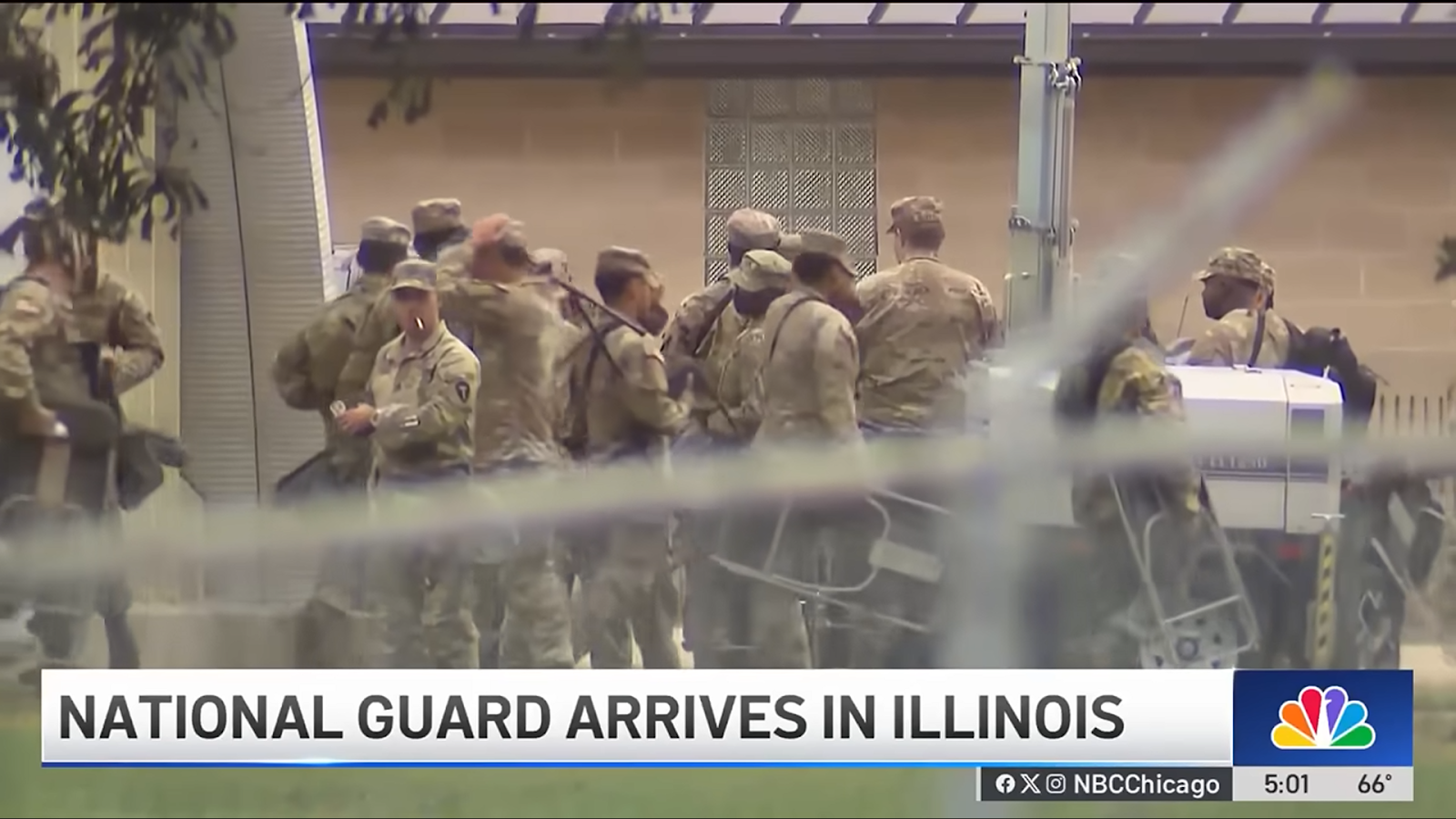
In a tough blow for the Trump administration, the U.S. Supreme Court shot down a bid by President Trump to deploy the National Guard to Chicago late Tuesday.
In its order in Trump v. Illinois, the high court denied a request from the Trump administration to temporarily stay an Oct. 9 temporary restraining order issued by Biden-appointed District Judge April Perry. That order sought to prevent Trump from deploying the National Guard to Chicago to protect federal property and immigration officials under siege by left-wing anarchists.
Perry’s order prompted the federal government to file an application for temporary stay with the 7th Circuit Court of Appeals, which granted in part and denied in part the administration’s request. As described by Justia, the three-judge panel “denied the administration’s motion for a stay pending appeal as to deployment [of the Guard], but continued to stay the portion of the order enjoining federalization.”
The Trump administration appealed to SCOTUS for relief on Oct. 17.
Associate Justices Clarence Thomas, Samuel Alito, and Neil Gorsuch would have granted the administration’s request to stay the lower court’s blockade.
In its order, the majority claimed that, “At this preliminary stage, the Government has failed to identify a source of authority that would allow the military to execute the laws in Illinois.” It further argued that Trump “has not invoked a statute that provides an exception to the Posse Comitatus Act,” and that, “Instead, he relies on inherent constitutional authority that, according to the Government, allows him to use the military to protect federal personnel and property.”
“But the Government also claims — consistent with the longstanding view of the Executive Branch — that performing such protective functions does not constitute ‘execut[ing] the laws’ within the meaning of the Posse Comitatus Act. … If that is correct, it is hard to see how performing those functions could constitute ‘execut[ing] the laws’ under §12406(3),” the order reads. “Thus, at least in this posture, the Government has not carried its burden to show that §12406(3) permits the President to federalize the Guard in the exercise of inherent authority to protect federal personnel and property in Illinois. We need not and do not address the reviewability of findings made by the President under §12406(3) or any other statute.”
Associate Justice Brett Kavanaugh authored a separate opinion in which he concurred with the court’s judgement in rejecting the stay application. The justice, however, added that he “would do so on narrower grounds.”
Kavanaugh noted that, in his view, the phrase “regular forces” in §12406(3) “likely refers to the U. S. military, not to federal civilian law enforcement officers,” and that, under the “current record … it does not appear that the President has yet made the statutorily required determination that he is ‘unable’ with the U. S. military, as distinct from federal civilian law enforcement officers, to ensure the execution of federal law in Illinois.”
While noting that he would deny the government’s application for relief “[o]n that narrow ground,” the Trump appointee went on to criticize the majority for going further than it should have with its opinion. He said that although he agrees with the majority’s conclusion that “regular forces” refers to the U.S. military, its conduction of “a complicated and debatable statutory analysis” could ultimately “lead to potentially significant implications for future crises that we cannot now foresee.”
To underscore this point, Kavanaugh went on to pose a hypothetical scenario in which a “mob” gathers outside a federal courthouse, is “threatening” to attack the building and any officials inside, and the U.S. military “cannot readily mobilize to deploy to the site in time, that the local police and federal court security officers are outnumbered, and that the President wants to federalize National Guard units to protect the courthouse and the judges, prosecutors, and other personnel.”
“Under the Court’s order today, even in those circumstances the President presumably could not federalize the National Guard under §12406(3),” Kavanaugh wrote. “Of course, that kind of hypothetical scenario does not often arise, and we can hope that it will not arise in the future. But the potential consequences, combined with the novelty and difficulty of the statutory issues addressed by the Court, underscore why I would not opine more broadly than necessary to resolve this application.”
The court’s decision prompted scathing dissents from Alito (joined by Thomas) and Gorsuch.
In his opinion, Alito excoriated the majority for “unnecessarily and unwisely” abandoning its standard protocols by ruling on an argument that Chicago and Illinois abandoned during the case’s litigation in the lower courts. He further criticized its willingness to “reach[] out and express[] tentative views on other highly important issues on which there is no relevant judicial precedent and on which we have received scant briefing and no oral argument.”
The George W. Bush appointee went on to highlight four problematic areas with the court’s ruling.
He pointed out how the majority “in effect add[ed] new language to the text Congress enacted” by “suggest[ing] that the principal statutory provision involved in the case … contains a restriction that has no grounding in the statutory text, namely, that ‘unable with the regular forces to execute the laws of the United States’ actually means ‘unable with the regular forces to execute the laws of the United States for reasons other than the lack of lawful authority to do so.’” He further characterized the court’s suggestion that the statute in question “does not constitute an ‘Act of Congress’ within the meaning of that phrase in the Posse Comitatus Act” as a “surprising conclusion, to say the least.”
Alito additionally expressed shock at the court’s “tentative view that the phrase ‘execute the laws of the United States’ in §12406(3) does not include ‘protective functions’ so that even if the National Guard is properly deployed under that provision, it may not be given the task of preventing potentially lethal attacks on civilian federal law enforcement officers or the takeover or destruction of Government facilities.” He also chastised the majority for failing to rationalize why the president’s “inherent constitutional authority to protect federal officers and property is not sufficient to justify the use of National Guard members in the relevant area for precisely that purpose.”
“I am not prepared at this point to express a definite view on these questions, but I have serious doubts about the correctness of the Court’s views. And I strongly disagree with the manner in which the Court has disposed of this application,” Alito wrote.
In his solo dissent, Gorsuch similarly expressed opposition to the majority’s chosen route of ruling on legal questions and arguments not presented by the parties in their briefs to the court. While saying he would grant the Trump administration’s application for many of the reasons cited by Alito, the Trump appointee noted that he “would hazard no opinion beyond that, leaving instead all the weighty questions outlined above for another case where they are properly preserved and can receive the full airing they so clearly deserve.”
“Under these circumstances, caution seems to me key, and I would decide this application narrowly, based only on those few arguments the parties preserved and the evidentiary record as it stands,” Gorsuch wrote.
Shawn Fleetwood is a staff writer for The Federalist and a graduate of the University of Mary Washington. He is a co-recipient of the 2025 Dao Prize for Excellence in Investigative Journalism. His work has been featured in numerous outlets, including RealClearPolitics, RealClearHealth, and Conservative Review. Follow him on Twitter @ShawnFleetwood