[Order Michael Finch’s new book, A Time to Stand: HERE. Prof. Jason Hill calls it “an aesthetic and political tour de force.”]
Renowned filmmaker Martin Scorsese has had a lifelong fascination with Christianity. Early on, he was even drawn to the priesthood and attended a Catholic seminary before finding his calling in film. But he returned to his spiritual fascination in such films as The Last Temptation of Christ (1988) with Willem Dafoe as a Jesus struggling with his humanity, and Silence (2016) starring Liam Neeson in a tale of Jesuit missionaries struggling against persecution in 17th century Japan.
Scorsese pursued other projects in the same vein that never made it to the finish line. Over twenty years ago I was working with a film producer who told me Scorsese was contemplating a project about Jesus’ apostles, so he asked me to prepare for the director a breakdown of the biographical highlights of the apostles’ lives, which I did. The project never materialized, however.
Scorsese reportedly had also completed a screenplay for a film about Jesus, based on a book by Shusaku Endo, the author of the novel on which Silence was based, but filming was postponed.
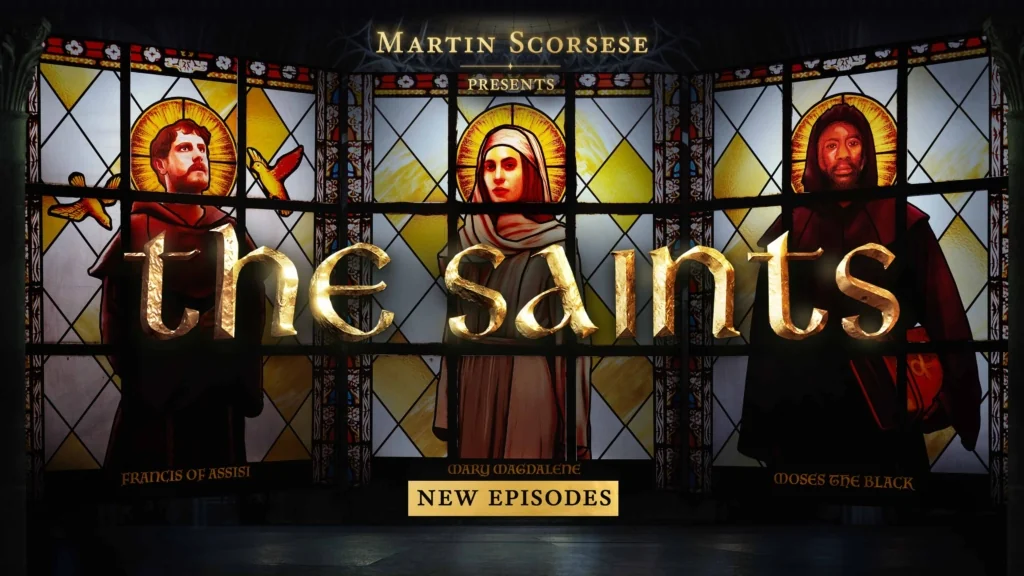
He also considered, as far back as the 1980s, shooting a series of television documentaries on the lives of different saints, but that project too never materialized – until last year, when the Fox Nation streaming service premiered Martin Scorsese Presents: The Saints, a series of docudramas profiling Christian holy men and women. The first season featured the 15th century warrior maiden Joan of Arc, early Christian martyr Saint Sebastian, John the Baptist, Holocaust victim Maximilian Kolbe, Mary Magdalene, 4th century Egyptian monk Moses the Black, and Francis of Assisi.
“I’ve lived with the stories of the saints for most of my life,” the 81-year-old filmmaker has said,
thinking about their words and actions, imagining the worlds they inhabited, the choices they faced, the examples they set. These are stories of… very different men and women, each of them living through vastly different periods of history and struggling to follow the way of love revealed to them and to us by Jesus’ words in the Gospels.
These stories “gradually became legend – that is, the realm where historical truth gives way to a spiritual truth,” Scorsese narrated.
Now Fox Nation has renewed the series for a second season of eight episodes which will run through spring of 2026, encompassing both the Christmas and Easter holidays. Season one reportedly broke Fox Nation viewership and engagement records. The Saints was the most-watched series on Fox Nation for each month in which a new episode was released.
“It was evident our subscribers wanted more, and we delivered,” Fox News Media chief digital officer Jason Klarman said in a statement. “The Saints celebrates the very best of humanity — courage, sacrifice, and above all, faith.”
“For many years, I dreamed of telling stories of the lives of the saints. It’s been an obsession of mine for as long as I can remember,” Scorsese stated. “So the chance to do this series meant the world to me, and it’s heartening to know that people have responded to it.”
As with season one, the show features one saint per episode. Season two began with Ireland’s Saint Patrick (episode one) and Saint Peter (episode two); the remaining episodes will feature the Virgin Mary, Saint Carlo Acutis (the Italian teen known for his devotion to the Eucharist and his use of digital media to promote Catholic devotion), Saint Paul, Saint Longinus (the Roman centurion who pierced the side of Jesus during the Crucifixion and later converted to Christianity), Saint Lucia (4th-century patron saint of the blind, martyred during the persecution under Emperor Diocletian), and Archbishop of Canterbury Thomas Becket (murdered at the altar by followers of Henry II, with whom Becket clashed over the rights and privileges of the Church). The docudrama “explores the lives of these extraordinary figures and their extreme acts of kindness, selflessness and sacrifice,” according to Fox Nation.
Each episode consists of 30-40 minutes of dramatization that is a serious cut above the usual kinds of History Channel-quality re-creations you get with most docudramas. (It’s Martin Scorsese, after all, so you would expect him to raise the bar a good bit). Then each episode wraps up with a studio conversation among Scorsese and a few “experts” who include: prominent Jesuit Fr. James Martin; Mary Karr, “Professor, Poet, Memoirist”; and Paul Elie, author and Senior Fellow at the Berkley Center for Religion, Peace, and World Affairs. All lean Left, especially Martin, who is a controversial LGBT activist, and Karr, a self-described “cafeteria Catholic,” is an abortion-supporting feminist. But so far in their discussions, their political worldview has not overtly reared its ugly head.
I found these conversational segments unfortunately disappointing – less than stimulating intellectually. I don’t recall any real insights or comments that added significantly to the dramatizations. The series and the saints themselves might have been better served by expanding upon the dramatizations and dropping the post-game analysis – or perhaps by swapping out Scorsese’s experts with more scholarly thinkers (in all fairness, the lives of the saints and the history of Christianity are all familiar territory for me; perhaps these conversations might be a good starting point for the more casual, less critical viewer).
That having been said, Martin Scorsese Presents: The Saints is definitely worth viewing, and kudos to Hollywood icon Scorsese for being willing to buck his secular industry to bring these stories of Christian heroes to the screen (even if they have been relegated to a conservative outlet, Fox Nation, rather than a broader audience). As Scorsese himself noted, “You mention Christianity to many people today and they’re shocked. They look at me and they say, ‘You believe in that stuff?’”
He does. “I believe in the tenets of Catholicism,” Scorsese has said:
I’m not a doctor of the church. I’m not a theologian who could argue the Trinity. I’m certainly not interested in the politics of the institution. But the idea of the Resurrection, the idea of the Incarnation, the powerful message of compassion and love — that’s the key. The sacraments, if you are allowed to take them, to experience them, help you stay close to God.
Martin Scorsese Presents: The Saints, season two, can be seen here with a free trial of Fox Nation.
Follow Mark Tapson at Culture Warrior