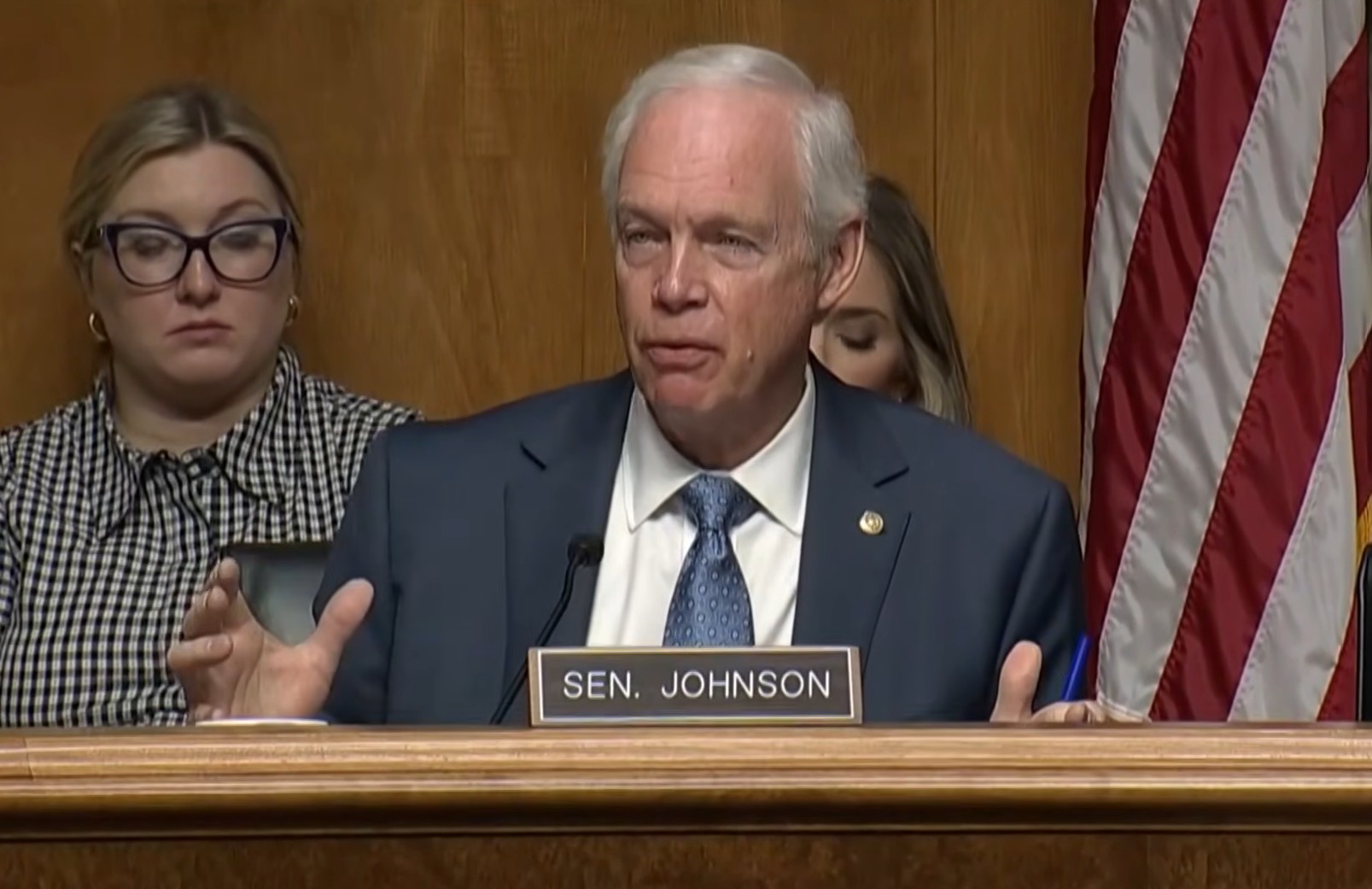
WASHINGTON, D.C. — Sen. Ron Johnson, R-Wis., says putting the SAVE America Act on the Senate floor for a “one-and-done” vote, as seemingly suggested by Senate Majority Leader John Thune, R-S.D., would be a “disastrous” failure.
“We ignore our base at our own peril, and we don’t want to dispirit our base,” Johnson said. “And right now, that’s kind of the path we’re going on.”
After an enormous amount of pressure from the Republican base and the White House, Thune announced this week that he plans to bring the SAVE America Act up for a floor vote. The legislation would require voter ID and proof of American citizenship to register to vote. Many anticipate the bill will inevitably fail in a floor vote because it won’t reach the 60-vote threshold for cloture.
Responding to Thune’s inability to pass the SAVE America Act, President Donald Trump said, “he’s got to be a leader,” adding, “It’s the most popular bill I’ve ever seen put before Congress.”
Invoking cloture is one way to break the filibuster, and moving forward in the way Thune intends to is commonly known as “failure theater,” meaning GOP senators are “not going to make Democrats do anything other than show up and vote no. Then they’ll throw up their hands, pretend to be upset, and say they’ve tried nothing and are all out of ideas,” as The Federalist’s CEO Sean Davis pointed out.
Meeting with a group of reporters on Capitol Hill Tuesday evening, Johnson said, “I’ve cautioned leadership. What you can’t just do is a one-and-done vote, because that gives the Democrats the out of just voting no and say, ‘Oh, it’s Jim Crow, 2.0.’”
“At a minimum, you’ve got to have this on the floor for debate and force Democrats, day after day, to defend why they are opposed to something that the American people support by 90 percent margin,” he said. “Our goal ought to be to try and pass it. But short of that, if we can’t, let’s make sure that we don’t get blamed for it.”
Johnson was referencing another form of breaking the filibuster, the spoken or standing filibuster, which requires dissenting senators to hold to the floor constantly for as long as they possibly can. It turns into a battle of will and physical strength for both the majority and minority. As Johnson pointed out, Republicans will need to maintain 51 senators in the chamber in order to kill any amendments Democrats offer over the course of the filibuster, which would derail passing the bill.
“We can fight like hell and still lose, but we have to at minimum fight,” he said.
Still, Johnson said he is not convinced that a spoken filibuster would work the way its advocates imagine, because he said it has been “neutered” by a 1986 rule created by former Sen. Robert Byrd, D-W.V. The rule essentially allows Democrats to offer unlimited amendments, letting them effectively bypass the two-speech rule, which limits each senator to two speeches, for however long they are able to do so, Johnson said.
The Byrd rule would need to be changed before attempting a spoken filibuster, Johnson claimed. With a genuine two-speech rule, Johnson said he’d be happy to have senators on a 24/7 “shift schedule” in order to win the filibuster, but, “when we met the parliamentarian, and she talked about the Byrd precedent change in ’86 where offering amendment that’s not considered a speech, all of a sudden I realize that means it’s an infinite number of amendments — there’s no way to bring this to a close.”
Johnson believes that pursuing the talking filibuster will not ultimately end in passage of the SAVE America Act, which is why he is “reluctantly” behind getting rid of the filibuster entirely. “If you have a goal of actually passing it, that probably requires eliminating the filibuster. When we won the majority here in this Congress, what I recommended very early on in Congress, I said our first vote ought to be to change the rules to eliminate the filibuster,” he said.
He added that such a vote would at the very least put Democrats on the record as being for or against the filibuster, stating, “Let’s get them on the record. First vote out: ‘Let’s end the filibuster,’ and just see what they do. If they go down and vote no, it’s probably the only thing that would restrain them from not ending the filibuster the next time they’ve got power because they’re on the record.”
But he said there are obstacles to doing so. Some of his Republican colleagues genuinely do not believe the Democrats will eliminate the filibuster next time they are in the majority, pointing to Democrats like former Sens. Kyrsten Sinema, D-Ariz., and Joe Manchin, D-W.V. “I’ve got colleagues who just simply won’t believe the Democrats will actually do it, just because two of them held out last time — those two have been purged from their party,” he said.
Another obstacle is Republicans’ continued belief in the value of the filibuster. GOP politicians have been able to block “awful Democrat initiatives” like nationalizing elections, D.C. and Puerto Rican statehood, and packing the Supreme Court using the filibuster, and they do not want to give up that ability.
Without the filibuster, the Democrats “will complete their goal, which is a one-party nation. That’s what the whole immigration surge was about: Bring a bunch of people, make them dependent on the government, flood them into sanctuary cities, pump up our members of Congress. That’s the game plan,” Johnson said.
Johnson added that it would be a “very long shot,” but Republicans might be convinced to nuke the filibuster if Democrats continue to hold up funding for the Department of Homeland Security (DHS). “There may be enough pressure on Republicans for the good of the nation, for the security of this nation — you start seeing Iranian sleeper cells being set loose … if I were President Trump, I’d soon say, ‘Guys, we can’t afford to not fund DHS.”
In an op-ed on Wednesday, Sen. John Cornyn, R-Texas, also came out in favor of eliminating the filibuster in order to pass the SAVE America Act (though he appeared to backpedal on his new position shortly after publication). Cornyn, as a reliably unreliable RINO in the Senate, was effectively forced to do back nuking the filibuster to court Trump’s endorsement in a Republican primary runoff against Texas Attorney General Ken Paxton, who said he “would consider dropping out of this race” so long as the legislation passes.
When The Federalist asked Johnson about how the Texas race and Paxton’s offer affect Senate leadership’s thinking on passing the bill and saving Cornyn, he said, “I would say that probably has little to no impact, and that’s, that’s kind of the battle that’s going on in Texas. We want to make sure that we win that seat. Beyond that, I really don’t want to comment on that race.”
Breccan F. Thies is the White House correspondent for The Federalist. He is a co-recipient of the 2025 Dao Prize for Excellence in Investigative Journalism. As an investigative journalist, he previously covered education and culture issues for the Washington Examiner and Breitbart News. He holds a degree from the University of Virginia and is a 2022 Claremont Institute Publius Fellow. You can follow him on X: @BreccanFThies.