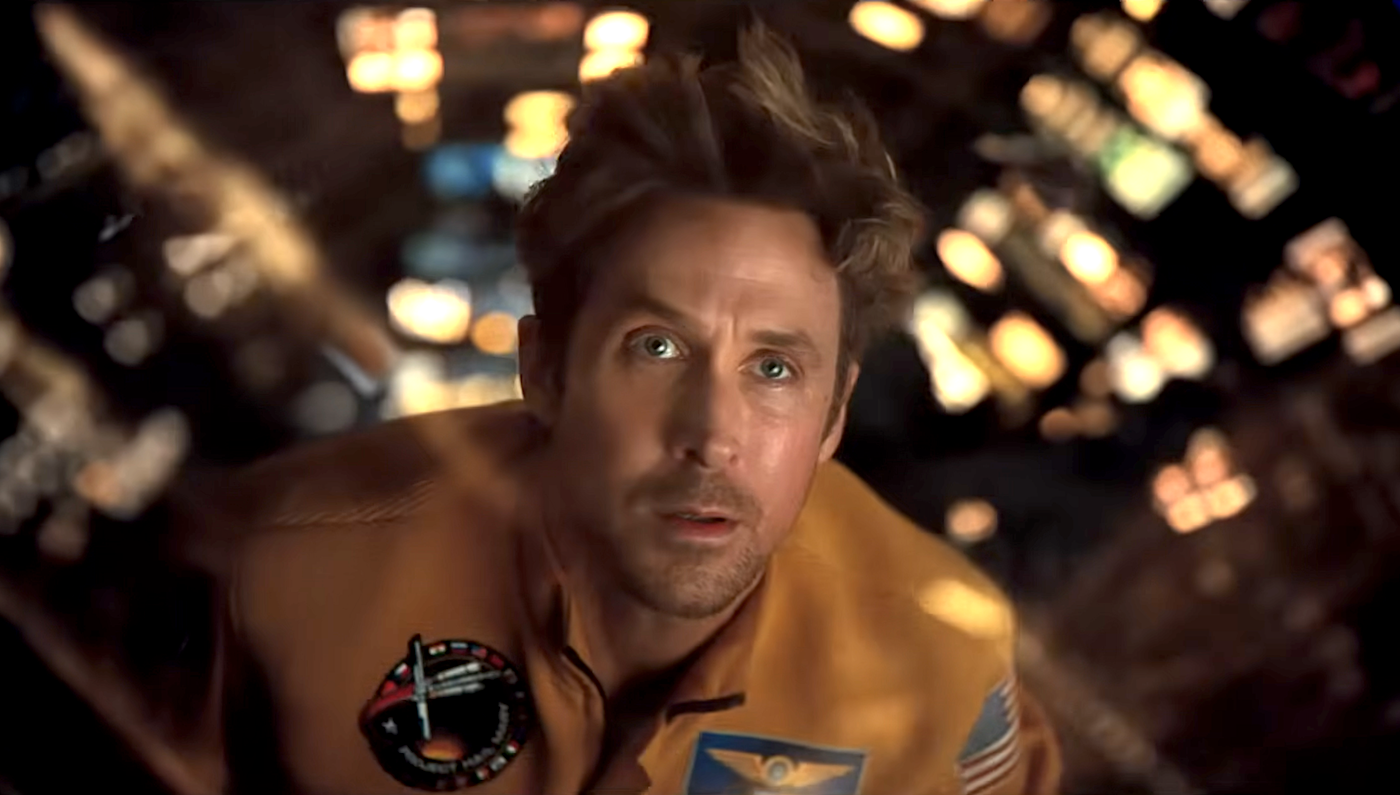
Many young Americans, especially Gen Z, have learned to structure their lives around avoiding fear. They build their lives carefully, setting boundaries and minimizing risk. “Stay safe” has become the unconscious mantra of the masses. In the biggest debut film of 2026 so far, Project Hail Mary, a sci-fi movie adapted from a novel of the same name by Andy Weir, Ryland Grace has done the same thing.
(Warning: Spoilers!)
Before he ever wakes up alone on a spacecraft, Grace, portrayed by actor Ryan Gosling, is not a natural hero. His life is intentionally small and restrained. As a middle school teacher, he operates in an environment where outcomes are predicable and risks are contained. The classroom gives him something deeper than purpose. It gives him a sense of control while allowing him to avoid the kind of responsibility that might expose his limitations.
That instinct to shrink yourself down smaller than your potential speaks to the behavior of today’s youth. Gen Z was raised in a culture that emphasized safety — emotional, social, and physical — but often failed to teach what to do when discomfort is unavoidable. We have learned to disappear or defer to higher authorities when it comes to confrontation, to “block” others instead of forgiving them, and to label peers as “toxic” instead of working through disagreements. Despite people being hyper-connected digitally, they’re still lonely. Avoidance, in other words, has become a way of life.
Grace embodies that mindset. When he is recruited to help solve the Astrophage crisis, an organism slowly dimming the sun, he contributes intellectually but resists any role that would put him in danger. Faced with the one-way mission to Tau Ceti, he refuses. He believes he is not brave enough. Like many today, he assumes courage is something innate, something you either have or you don’t.
When Grace wakes up aboard the Hail Mary spacecraft with no memory, his carefully structured life is gone. There are no boundaries to retreat behind, no safe exits. His human crewmates are dead. The mission is already underway. The stakes are immediate: Solve the problem, or Earth dies. For the first time, avoidance is no longer an option.
Importantly, the film does not transform Grace into a fearless man. He remains anxious, uncertain, and often overwhelmed. What changes is not his internal state but his behavior. He begins to act despite fear.
That shift becomes the clearest when he meets Rocky, an alien engineer from another star system. Their relationship is built across radical differences in biology, language, and even perception itself. Despite such cultural and communication barriers, they learn to cooperate, then to trust, and eventually to care for one another. In a culture where people cut ties at the first sign of discomfort, their bond is striking to audiences. The two do not retreat when things are difficult because they must adapt and move forward together.
This is precisely what Gen Z desires but tends to avoid. Real relationships require friction in the form of misunderstanding, vulnerability, and the risk of rejection. Many young Americans have been conditioned to flee at the first sign of discomfort, mistaking distance for self-protection. We are too quick to believe everything we feel is a fact, meaning that when adversity strikes, we are inclined to shy away from its character-building force.
Grace begins his story the same way. He avoids anything that might demand too much of him because he doesn’t trust himself to successfully meet the challenge. But through his work with Rocky, he learns something new: Meaning is not found in safety but in commitment. And he is way more resilient than he initially believed.
The film’s defining moment comes when Grace faces a final choice. He now has the means to return to Earth. He can survive there and reclaim the life he once carefully protected. But he discovers that doing so will doom Rocky and his species. There is not enough fuel for both outcomes.
Everything in his old mindset points one way: Go home.
However, Grace turns around. He decides not to act for recognition or even for humanity in the abstract. He acts for a friend. In doing so, he rejects lapsing into the avoidant patterns that once defined him. He chooses to sacrifice his comfortable lifestyle on the Earth that he and Rocky saved to ensure his friend stays alive.
The highest form of courage comes through self-sacrifice. Grace does not overcome fear by eliminating it because, while fear still exists, he refuses to let this negative emotion paralyze him from acting.
Suddenly, the film’s strong acclaim makes sense. Beneath its marketable sci-fi and cinematic spectacle, Project Hail Mary challenges the culture’s idea that safety is the way to paradise. It suggests instead that a meaningful life is built through taking on responsibility, giving relationships a chance to develop, and sacrificing your own comfort in the name of love.
By the end, Grace has not returned to Earth. He lives among Rocky’s species, once again becoming a teacher — this time in a world far beyond anything he once found comfortable. The man who previously built his life around control now embraces the unknown, serving others.
Gen Z has been taught to avoid pain and to protect peace at all costs. However, Project Hail Mary offers a different path. You do not find meaning by minimizing risks. You find it by choosing to act when fear tells you not to.