Order Michael Finch’s new book, A Time to Stand: HERE. Prof. Jason Hill calls it “an aesthetic and political tour de force.”
Peter Heller is one of America’s greatest novelists of today. He is not a writer of unknown quality. His book The Dog Stars, was after all a bestseller, published in 26 different languages, and is now being turned into a Ridley Scott movie to be released later this year. Still, Heller seems to write in the realm of obscurity. He wins some awards and is noticed, but not often mentioned in the canon of great American writers of this century.
Heller deserves significantly greater recognition. His work is on par with the recently passed, and splendid novelist, Cormac McCarthy. Heller is a worthy successor to McCarthy in his ability to convey the stories of our people and our land, of the times that we live in. He captures the beauty of America’s natural landscapes—our back roads, paths, and rivers, and the animals that inhabit our woods, mountains, and prairies.
He holds an MFA from the Iowa Writers’ Workshop in poetry and fiction and that learning comes through brilliantly in his writing. I don’t know if he was taught by the poet and novelist, James Galvin, a visiting professor at Iowa, but when reading Heller I sense the impact and influence of Galvin, particularly from his beautiful novel The Meadow. Heller and Galvin’s descriptions of the land and nature are beauties to behold. They have both produced some of the greatest writing today on the beauty of nature, the strength of the individual, of art and beauty, literature and poetry. And of family and friendship.
I have no idea if Peter Heller is a conservative, liberal, libertarian, populist or any other political identifier. And that is a good thing. He is a novelist, a poet, and a storyteller. He rarely touches on things cultural or political, and when he does, it is with great subtleness.
His book Burn, for instance, is partly about a secessionist movement in a section of Maine. The secessionists are “right wing,” or at least, that is the implication. When I reached that point in the book, my eyes rolled, anticipating a that “here we go again” moment that I come across in so much of today’s literature. Time to take the expected, and oh so predictable, jabs at conservatives, Trumpers, right wingers, I thought. But that doesn’t happen. While not necessarily sympathetic to the secessionists, Heller doesn’t preach; no Left-wing sermons are given. He tells a story, an exceptional story of America today, its people and its divisions. You, the reader, can arrive at your own judgements and draw your own conclusions. He writes as a writer should.
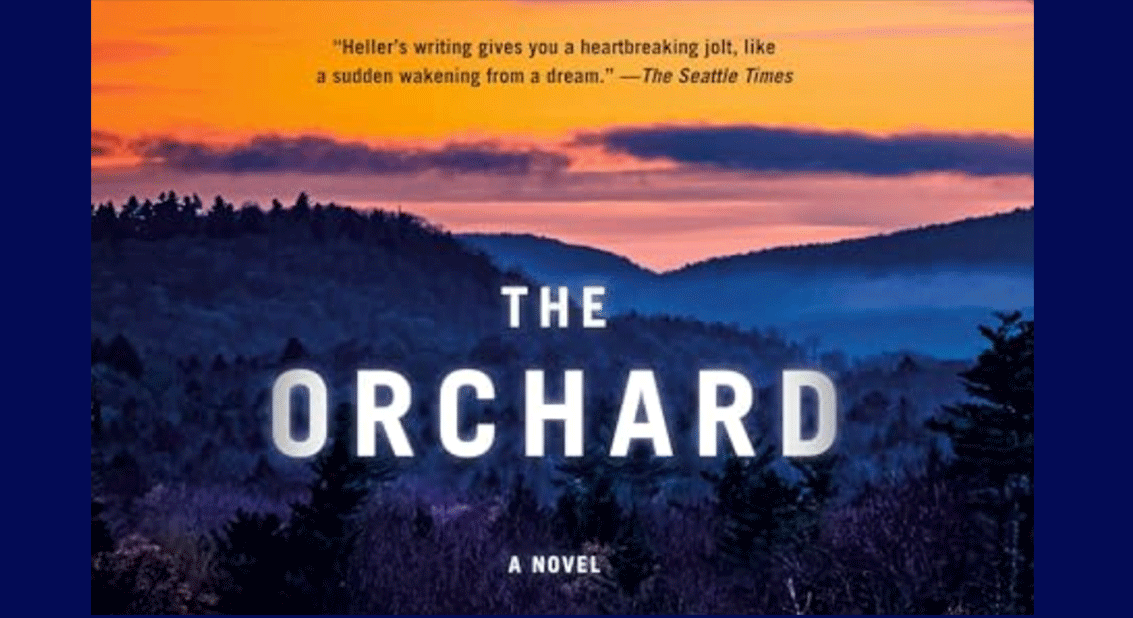
His latest book, The Orchard, is nothing short of a masterpiece, my favorite of all his novels. The story follows a mother named Hayley who takes her seven-year-old daughter, Firth, to live in a rustic cabin with no electricity near the Green Mountains of Vermont. Hayley is a renowned translator and author of a book on Chinese Tang dynasty poetry (618 to 907 AD). he walked away from her career to escape from the craziness of today’s academia to live among the wild things. And no one can describe nature and her incredible beauty better than Peter Heller.
The book is about many things: friendship, the power and beauty of nature, love, goodness, and fidelity. The book reads like a poem; Heller’s prose is that powerful. Just one short example of his writing:
“….the flow of cold air down the mountain and the certainty that soon the night would freeze and the wet runnels between the tufts of new grass would glaze to thin glass that would crackle under my footsteps in the early morning. The opening of my heart and the release, like the song of a night bird, of joy.”
The book is worth reading just for its beautiful poetic prose and magnificent storytelling, but it’s more than that. There is one moment in the book when things turn from the idyllic life of a mother and daughter living in quiet, rural Vermont to the present day, the politics and nastiness of our lives in mid-2020’s with all of its chaos and madness. It is worth going into some detail, as the moment is an inflection point in the story. It also says much about Heller’s thoughts and sentiments about this critical moment in academia and our shared American culture that we find ourselves in today.
This key moment in the story occurs after Hayley is invited to a Tang poetry translation conference in Jackson Hole, Wyoming. She had previously often passed on these invitations, but this one is to take place amongst her peers and mentors. She is a celebrity in her field for her book of translations, and so she decides to attend.
The conference goes splendidly until, at the end, she is interviewed by a female reporter from the The Nation who has a radio show in Boston. Hayley is then ambushed by the interviewer, who a few minutes into the interview, asks: “So why, in the age of feminism, do we need ancient Chinese poems which recapitulate the male gaze?” Hayley’s reaction mirrored mine as a reader: “What?”
Hayley manages a response, explaining that “most of the poetry of the Tang, the entire catalog, from Li Shiman to Yu Xuanji, is about loss, as I said. Loss of home, loss of a friend, loss of a lover. Loss of youth, of life itself. Male and female alike, that’s what they write about.”
The interviewer is undeterred in her attempt to score ideological points, stating: “I mean, ok, Li Xue is a great poet….Fantastic at what she does, granted, but all in the service of the male-gratification industry? Waiting for her man and crying. I mean, why do we need this? You are a skilled translator, why bend your skills, your prodigious intellect, to these plaints? Isn’t that a kind of sellout?”
Hayley is speechless, almost. All she can say is, “I translate the poems because I love them…” This exchange devastates her and confirms her reasons for leaving the madness and intolerance of academia.
Throughout this section, Heller’s restraint is admirable. He doesn’t force the point; he doesn’t make any sermons. In a 245-page book, this is the only instance, in just a few pages, of anything close to commentary on the state of our culture and academia and the wokeness and madness that has infected it. How it has infected the world of love, of beauty, and of art for art’s sake.
And Heller does it so wonderfully and with such beauty, in a poetic prose that is unrivalled today. Sometimes, despite the hatred and censors, the blacklisting of art that speaks of beauty for beauty’s sake, true greatness breaks through. True art shines. That this art still exists in America today, in this culture that has embraced its uglification, despises all that is traditional and true, speaks volumes. It shows us that there is hope and that we will overcome this madness.
Just over 100 years ago, one of the greatest writers in the American canon, Willa Cather, stated “the world broke in two in 1920 or thereabouts.” She was speaking of the turn of American literature, the turn away from tradition and beauty into what would become a century of cynicism, despair, self-loathing, and the politically correct seeking of the great American novel written of hatred for what is good and great, in our people, our culture, and our country.
Maybe we are taking another turn, a turn back to trueness and beauty, to a form of storytelling that we have sought from the ancients on down. The story of human tragedy and cruelty, yes, but also of human creation, exceptionalism, goodness, and most importantly, of beauty. Peter Heller writes of magic and wonder. He is perhaps the greatest novelist of our generation and without doubt the most needed.