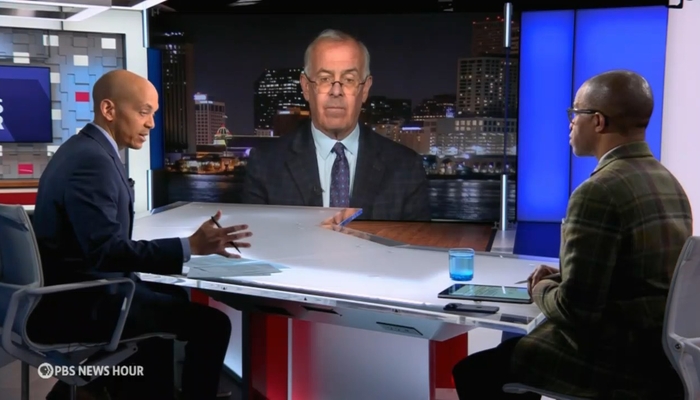
PBS News Hour host Geoff Bennett, The Atlantic podcaster David Brooks, and MS NOW host Jonathan Capehart assembled on Friday for their usual weekly news recap and displayed a noticeable religious double standard. On one hand, Brooks suggested that various Iran War videos put out by the White House are un-Christian because they trivialize war, which naturally involves death. On the other hand, Bennett and Capehart omitted any meaningful reference to Islam, ISIS, or Hezbollah when discussing the recent attacks on the Temple Israel synagogue in Michigan and Old Dominion University because, to them, the real story was President Trump’s reaction.
Talking over some videos that included airstrikes coupled with video game footage from Wii Sports and Call of Duty, Bennett asked Brooks, “What’s your assessment of this? I mean, does this reflect modern political communication or is something here more troubling about how this war is being framed to the public by the White House?”
The Altantic’s David Brooks isn’t a fan of the White House’s memes, “You know, the White House has pastors come in. They have prayer breakfasts they go to. They talk a lot about Christianity and upholding Christian values. At the core of Christianity is a belief in the dignity of… pic.twitter.com/H6LHZQg54T
— Alex Christy (@alexchristy17) March 14, 2026
Brooks began, “The White House has pastors come in. They have prayer breakfasts they go to. They talk a lot about Christianity and upholding Christian values. At the core of Christianity is a belief in the dignity of each person. That each human being is made in the image of God. And that’s true of all humans, not just the ones you happen to like.”
He then urged the administration to be more matter-of-fact in how it conducts itself:
And what’s happening here, in Lebanon and in Iran is death, is human death. And I don’t care who’s dying, whether it’s good guys or bad guys, innocents or supposed guilties. It’s death. And the people who fought World War II, who led our conflict in World War II, whether it was Franklin Roosevelt down to George Marshall to Omar Bradley, they understood the seriousness of this, that killing human beings is not a video game. It’s not pixels on a screen. And whatever you think of the war—and I’m probably a little more hopeful than most—the way this is being described is almost barbaric.
Brooks concluded by citing the “great tradition of just war theory. Sometimes, wars are just, but they’re never good. They’re never anything but horrific. And to treat them otherwise is to insult the American people and to really be unnerving. It should be unnerving to everybody to see this level of triviality.”
Bennett then moved on to Capehart, “Well, we saw two attacks here in the U.S. yesterday, a shooting at Old Dominion University being investigated as terrorism and a car ramming at a synagogue in Michigan. The president, President Trump, was asked about it.
He said the perpetrators were sick people. And then in an interview with Brian Kilmeade of Fox, he added this:”
In the clip, Trump declared, “They’re sick people. And a lot of them were let in here. They shouldn’t have been let in. Others are just bad. They go bad. Something wrong. There’s something wrong there. So, genetics are not exactly—they’re not exactly your genetic—it’s one of those problems.”
Next, Bennett moved on to the Temple Israel and Old Domininon attacks, but of course without any reference to ISIS or Hezbollah, “Well, we saw two attacks here in the U.S. yesterday, a shooting at Old Dominion University being investigated as terrorism and a car ramming at a… pic.twitter.com/qwDBqdK6aT
— Alex Christy (@alexchristy17) March 14, 2026
Capehart replied, “No one should be surprised to hear that kind of language come from Donald Trump. He ran—his second presidential campaign was an openly racist, xenophobic, white nationalist campaign. So the fact that he’s talking about genetics in this circumstance, it’s not surprising.
Widening his attacks to Trump supporters, Capehart added:
If we ever hope to put a lid on some of the passions and the hatreds that are in this country, we look usually, we should, to the president to be the example, to step out and say, ‘This isn’t who we are.” We band together. People are hurting. Say all the comforting words to bind the country together. And instead, he and so many of his supporters are out there rending the garment of our American society. It’s really—it’s as troubling as it is angering.
Yes, trying to kill Jews in Michigan because Israel killed your Hezbollah brothers in Lebanon or being an ISIS adherent is ideological and not genetic, but Bennett and Capehart never talked about that. The only reference to Islam was at the very beginning when Bennett teased an upcoming discussion about “a wave of anti-Muslim and anti-immigrant rhetoric.” Brooks’s argument may be worth considering, but the moral panic about the memes seems trivial when it is juxtaposed with PBS memory-holing multiple attacks by Islamists.
Here is a transcript for the March 13 show:
PBS News Hour
3/13/2026
7:40 PM ET
GEOFF BENNETT: And, David, one unusual feature of this conflict has been the White House’s messaging online. They have been posting these meme-style videos, these pop culture montages celebrating the U.S. strikes. There are some of them are playing out right now on the screen.
What’s your assessment of this? I mean, does this reflect modern political communication or is something here more troubling about how this war is being framed to the public by the White House?
DAVID BROOKS: You know, the White House has pastors come in. They have prayer breakfasts they go to. They talk a lot about Christianity and upholding Christian values. At the core of Christianity is a belief in the dignity of each person. That each human being is made in the image of God. And that’s true of all humans, not just the ones you happen to like.
And what’s happening here, in Lebanon and in Iran is death, is human death. And I don’t care who’s dying, whether it’s good guys or bad guys, innocents or supposed guilties. It’s death.
And the people who fought World War II, who led our conflict in World War II, whether it was Franklin Roosevelt down to George Marshall to Omar Bradley, they understood the seriousness of this, that killing human beings is not a video game. It’s not pixels on a screen.
And whatever you think of the war — and I’m probably a little more hopeful than most — the way this is being described is almost barbaric.
There’s a great tradition of just war theory. Sometimes, wars are just, but they’re never good. They’re never anything but horrific. And to treat them otherwise is to insult the American people and to really be unnerving. It should be unnerving to everybody to see this level of triviality.
BENNETT: Well, we saw two attacks here in the U.S. yesterday, a shooting at Old Dominion University being investigated as terrorism and a car ramming at a synagogue in Michigan. The president, President Trump, was asked about it.
He said the perpetrators were sick people. And then in an interview with Brian Kilmeade of Fox, he added this:
DONALD TRUMP: They’re sick people. And a lot of them were let in here. They shouldn’t have been let in. Others are just bad. They go bad. Something wrong. There’s something wrong there. So, genetics are not exactly—they’re not exactly your genetic—it’s one of those problems.
BENNETT: Genetics, he says.
CAPEHART: Genetics. And no one should be surprised to hear that kind of language come from Donald Trump. He ran—his second presidential campaign was an openly racist, xenophobic, white nationalist campaign. So the fact that he’s talking about genetics in this circumstance, it’s not surprising.
But, again, this is the president of the United States. If we ever hope to put a lid on some of the passions and the hatreds that are in this country, we look usually, we should, to the president to be the example, to step out and say, “this isn’t who we are.” We band together. People are hurting. Say all the comforting words to bind the country together.
And instead, he and so many of his supporters are out there rending the garment of our American society. It’s really—it’s as troubling as it is angering.