Order Daniel Greenfield’s new book, Domestic Enemies: The Founding Fathers’ Fight Against the Left: HERE.
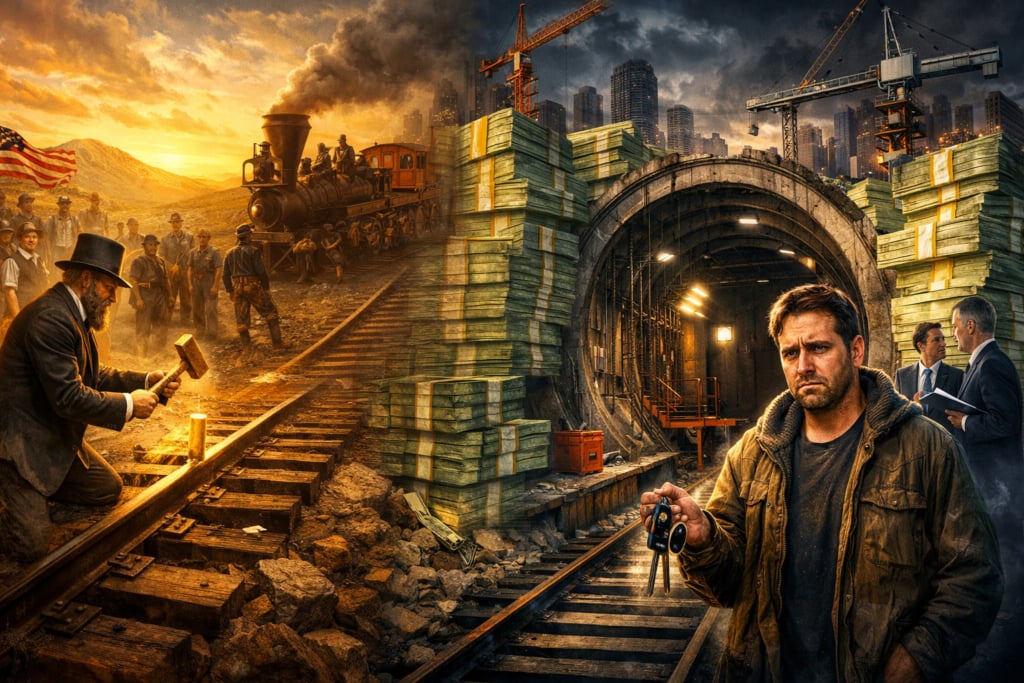
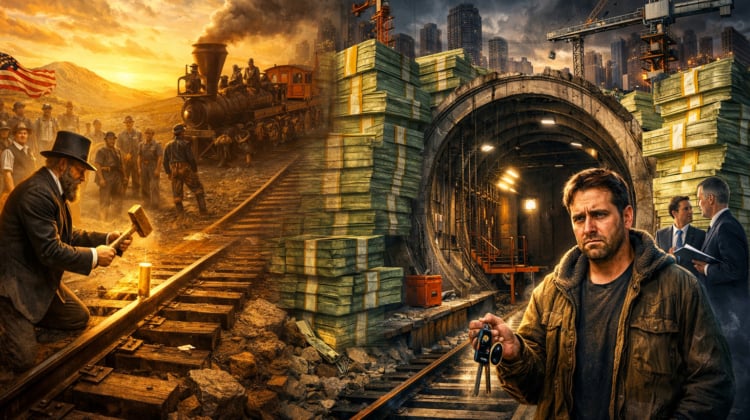
On May 10th, 1869, the first transcontinental railroad of almost 2,000 miles was completed and marked with a ‘Golden Spike’ driven in. Over 150 years and another 2,000 miles later, the New York City subway is struggling to finish its 10 mile Second Avenue line, underway in one form or another since the 1970s, and is suing Trump to help secure funding for $4 billion per mile.
That’s not a typo.
Houston’s entire budget is $7 billion. NYC wants to spend more than that on two stations.
The $7.7 billion second phase of the 10 mile Second Avenue line will run only 1.8 miles. That’s $4.27 billion a mile. That’s more than double the cost of the whole nearly 2,000 miles of the first transcontinental railroad in today’s dollars. All to build a walkable distance of subway tracks.
After $3.4 billion in grants from the Biden administration, the Metropolitan Transportation Authority is suing the Trump administration for an immediate $58 million payout complaining that if the notoriously corrupt and inept agency doesn’t get the money right away it’ll lead to “‘a domino effect’ of delays and inflated costs” and the last thing anyone wants is to see what delays and inflated costs look like for a 50-year-old project spending over $4 billion a mile.
But that’s optimistic. The first phase of the Second Avenue Line already became the world’s most expensive project at $2.5 billion a mile and cost a total of $4.45 billion, but was originally budgeted at $3.8 billion, if the same thing happens to the second phase, it will cost $9 billion.
That would bring the final cost to over $5 billion a mile.
At that rate all the spikes might as well be made out of gold. Indeed, if New York City were to make the tracks out of silver, it would only cost a little over $1 billion, a net savings of $3 billion over the cost of the current project. (Note to the MTA, this is not serious, please don’t do this.)
Gov. Kathy Hochul blasted President Trump, clamoring that “his actions alone have put the commutes of over 130,000 New Yorkers and the jobs of thousands of union workers on the line, but New York will not back down.” Not back away from spending more than the budget of Houston or the budget of Armenia on two subway stations and thousands of ‘union jobs’.
But suppose 130,000 riders do use the new stops. That comes out to around $60,000 a rider. That’s enough money to buy each commuter their very own BMW 3 or Mercedes GLE Coupe.
Somehow I suspect the locals would rather have the car (“Oh Governor Hochul, won’t you buy me a Mercedes Benz) than a chance of getting stabbed by a recently released crackhead.
The second phase of the line will add two subway stations in East Harlem, a slum no one really wants to go to unless they have a great hankering to visit the Graffiti Hall of Fame. (Warning: Despite what Google Maps may tell you, the ‘Graffiti Hall of Fame’ is not an actual place.)
If we don’t spend another $7.7 billion to build two subway stations at 106th and 116th and 2nd Avenue, then people will have to either take the bus (the M15 runs on 2nd Avenue, but it’s too slow) or walk two blocks over to Lexington Avenue and then a few more blocks to the 106th or the 110th to grab the 4,5 or 6 trains, ride them down and transfer over at Lexington Avenue.
Surely a fate worse than death that is only occasionally fatal due to the regular stabbings and assaults on the subway by serial criminals and psychos ever since New York got rid of bail.
As a former New Yorker, I understand the inconvenience well enough. I had one memorable summer defined by having daily transfers at 59th Street and Lexington and I owe my leg muscles to the 139 step staircase of the 53rd and Lexington station (immortalized in a New York Times essay) and frantic headlong dashes through rabbit warrens of randomly interconnected staircases, ramps and tunnels linking stations that had been assembled by rival companies in the art deco age in the vain hope of catching a train only to see it pulling out of the station.
But most of the country and many of the people reading this article (some who stopped reading once I unspooled a New Yorkese litany of numbers and streets that define life in the city) are lucky to have a bus line that may show up once an hour and traverse a handful of major streets.
Spending $7 or $9 billion so the residents of East Harlem within a ten block radius don’t have to ride the M15 bus that’s right outside their door or walk 6 blocks over to a subway station is nuts.
New York Gov. Hochul and local politicians claim that they’re “helping the people of East Harlem”. But what the people of East Harlem seem to need the most help with is a 1 in 21 chance of being a crime victim in an area where a man in a COVID mask recently pled guilty to “discharging a machine gun” that killed a 69-year-old woman standing with a walker.
If only there had been a billion dollar subway station nearby.
Will spending $5 billion a mile to add two subway stations help the “people of East Harlem”?
Not the ones getting evicted to make way for the subway stations. As a certain New York Times Pulitzer Prize winner once quipped about Communist mass murder, “to put it brutally, you can’t make an omelet without breaking eggs.” And, also to put it brutally, you can’t spend $9 billion on two subway stations to help black people without also kicking them out of their homes.
After exercising eminent domain last summer, tenants and shopkeepers have been in limbo, forced to spend money to move to make way for unnecessary massive aboveground glass stations so the remaining residents won’t have to walk six blocks or take a bus.
Where is all the money really going? The $5 billion a mile project was handed to the Connect Plus Partners consortium of FCC Construcción (aka Grupo FCC), a Spanish company, and Halmar International, which is part of the ASTM Group (Autostrada Torino-Milano), an Italian company, also Skanska Walsh Traylor, a joint venture of Skanska, a Swedish construction company, along with two American companies, Walsh and Traylor Bros, and much of the money will be spent on a 4.15 million pound German boring machine. So it’s as American as Mamdani.
A few years ago, ASTM co-chaired a gala of the Citizens Budget Commission at which Gov. Hochul was honored with the “Medal for High Civic Service”, along with special appearances by New York State Attorney General Letitia James, under federal investigation, and Mamdani ally and former comptroller, Brad Lander. And all it cost us was $7.7 billion. Or $9 billion. We’ll see.
But surely soon a federal judge will rule that American taxpayers are obligated to pay for it. Hopefully he gets a Medal for High Civic Service out of it too. All we’ll get is the bill.