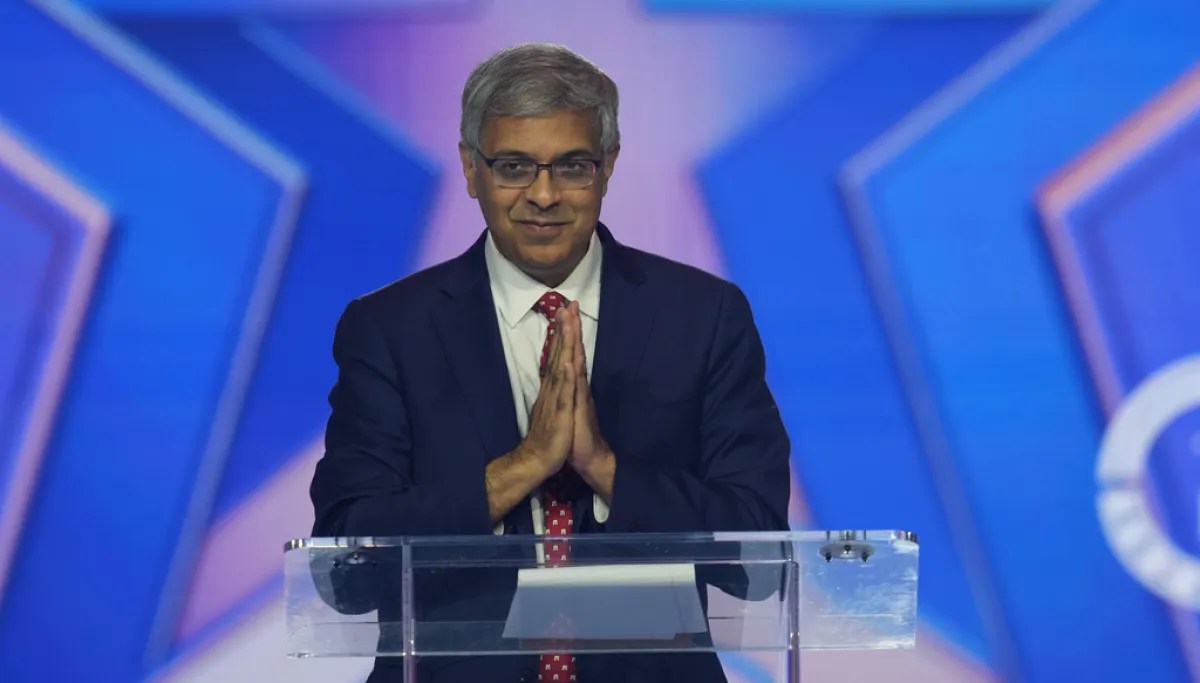
National Institutes of Health Director Jay Bhattacharya launched a new bi-monthly “Scientific Freedom Lecture” series with a case claiming that COVID-19 originated in a lab incident in China, saying that understanding the cause of the pandemic is essential to the future of societal trust in science and public health.
Bhattacharya, who rose to public prominence by being critical of government policy during the pandemic, made the case at the start of the inaugural lecture on Friday that getting to the heart of what caused the pandemic is essential for rebuilding public trust in scientists.
“Science depends on public trust,” Bhattacharya said in his opening remarks. “The activities that we do, all of our work at the NIH, is supported by the public, and so it’s absolutely vital that we maintain this public trust.”
The debut lecture featured British journalist and former politician Matt Ridley, who supports the theory that the coronavirus, known as SARS-CoV-2, came from bat virus research conducted at the Wuhan Institute of Virology in China. He and others contend that a lab leak was the more probable cause of the pandemic than the virus spreading from animals to humans, referred to as zoonotic spillover.
Ridley, who has written a book and several articles on the lab origins of COVID-19, said it would have been an “incredible coincidence” if the virus spread to humans from animals in the same city where scientists were conducting highly technical research experiments on coronaviruses to make them more infectious to humans.
Ridley outlined several virological, epidemiological, and circumstantial pieces of evidence that have been hashed out by both sides of the debate since the beginning of the pandemic in 2020, including the fact that scientists in China and the United States asked for federal funding to create a virus similar to SARS-CoV-2 in 2019.
Neither Ridley nor Bhattacharya said there will ever be definitive proof on the origins of COVID-19.
Instead, Ridley described his argument as a “good old Bayesian thing, you add up all the probabilities until you get to a final result,” or a court case in which a jury reaches the most reasonable conclusion.
“And I’m pretty sure that if this was put before a jury, that the lab leak would win the case,” Ridley said.
Public health experts, the World Health Organization, and intelligence agencies from multiple countries have said it will likely be impossible to definitively pin down the origins of the pandemic without the Chinese government providing more details about the experiments conducted at the Wuhan lab.
Dr. Angela Rasmussen, an American virologist in Canada and staunch supporter of the zoonotic theory of origin, called Bhattacharya a “bad actor” who distorts the evidence during a livestream on X fact-checking Ridley’s presentation.
She criticized Bhattacharya for casting aspersions on virology research more broadly by calling COVID-19 a lab leak and said he and other supporters of the lab-leak theory rely too heavily on the intelligence community’s assessment of the situation.
“They count on there being enough uncertainty that you can say, ‘Well, the intelligence community thought this and FBI, CIA, like they’re so important, and it’s classified and it’s national security and all this stuff, it must be really, really good evidence,’” Rasmussen said on X before the event.
Bhattacharya said during the discussion portion of the event that he was inclined to find Ridley’s argument more compelling than theories supporting animal origins for the virus, but as a matter of policy, he said it likely does not matter whether the virus came from a lab or from animals.
Instead, he said, scientists and public health officials need to strengthen biosecurity no matter the cause of the pandemic.
“If the origin stems from a natural spillover, we must deepen our understanding of zoonotic transmission and strengthen surveillance of human-animal interface,” Bhattacharya said. “If a lab associate incident played a role, we must carefully examine research practices, biosafety protocols, and systems of oversight, and actually, we probably should just do both.”
FIVE YEARS AGO: FAUCI DISMISSED LAB LEAK THEORY EVEN AS ADVISERS PRIVATELY DOUBTED
He also compared U.S. scientific relations with China to those with the Soviet Union during the Cold War, arguing that America should not be partnering with China or other adversarial countries on scientific research in the interest of national security.
“There were two scientific worlds all throughout the Cold War, the Soviet bloc and the Western bloc, in part, because the thought was that there was no way to do fruitful collaboration that wouldn’t result in exploitation of scientific knowledge developed in the West,” Bhattacharya said.