Order Michael Finch’s new book, A Time to Stand: HERE. Prof. Jason Hill calls it “an aesthetic and political tour de force.”
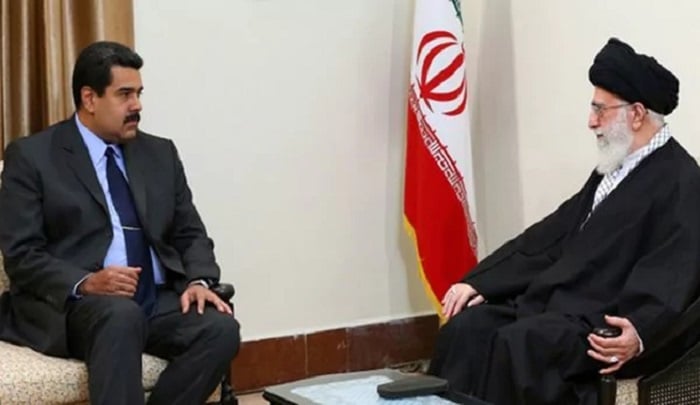
Nicolás Maduro was Iran’s man in Latin America. He allowed Iran-linked Hezbollah operatives to operate freely in his country, trafficking in drugs to raise money, and then sending both money and weapons to Hezbollah in Lebanon. Now he’s in a New York jail. More on what the overthrow of Maduro means for Iran, and consequently, for Israel, can be found here: “Iran’s friends vanishing: Why Maduro’s arrest matters for Israel – analysis,” by Herb Keinon, Jerusalem Post, January 4, 2026:
For Israel, the significance of Washington’s weekend arrest of Venezuelan strongman Nicolás Maduro and his wife goes well beyond the shiver it likely sent down spines in Tehran.
Yes, the spectacle of a US-led operation removing a defiant anti-American autocrat will inevitably sharpen anxieties among Iran’s leaders about their own vulnerabilities, especially at a time when protests are roiling the country.
But further meaning is found elsewhere, in the dismantling of yet another supporting pillar in the global network Iran painstakingly constructed to finance, shield, and sustain its war against Israel. Venezuela was never an Iranian proxy in the way Hezbollah, Hamas, the Houthis, or Bashar al-Assad’s Syria were.
Caracas was not directly under Tehran’s thumb and operational command, nor did it host Iranian forces on the scale seen in the Middle East. Yet, through Hezbollah, Venezuela became something no less important to the ayatollahs – a critical offshore hub that generated cash, laundered funds, moved operatives, and enabled Iran to project power far from the Mideast.
Maduro’s arrest comes on the heels of a series of blows to Iran’s regional position. Israel battered Hamas in Gaza, decapitated Hezbollah in Lebanon, and degraded Houthi capabilities in Yemen. Also, Assad’s regime fell in Syria. Taken together, these developments illustrate Iran’s declining power.
Tehran’s problem today is not restricted to the protests in the streets or the pummeling it absorbed in June, but also the unraveling of far-flung support systems it spent years and billions of dollars putting together abroad….
Gone, all gone, thanks to relentless attacks by Israel — the threat once posed to the Jewish state by Hamas in Gaza, Hezbollah in Lebanon, the Houthis in Yemen — while Assad’s regime also collapsed, followed by the IDF managing to destroy most of his regime’s weaponry so that it would not fall into the hands of Ahmed al-Sharaa. The last ally of Iran, that helped it project its power in the Western Hemisphere, was Venezuela under Chavez and then Maduro. Now that Iranian ally is gone with the toppling of Maduro; whatever regime takes over in Caracas will not tolerate a Hezbollah presence, which would only invite another U.S. military intervention.
In Iran, the regime is reeling. The country-wide protests are no longer about economic conditions, but about the very existence of the regime. The protesters now shout “death to the dictator.” The Supreme Leader is said to be making contingency plans to flee to Moscow with his extended family and closest cronies.
But words in a recent interview from Venezuela’s most prominent opposition figure, Nobel Peace Prize winner Maria Corina Machado, give Israel an even greater reason to grin. She has been explicit in describing Iran, Hezbollah, and Hamas as foreign forces that penetrated Venezuela under Maduro’s rule. In her telling, Venezuela was not merely misgoverned; it was commandeered by external actors whose interests ran directly counter to those of a sovereign country.
She accompanied that framework with warm words toward Israel, rarely heard from Caracas in decades. Asked in a November Israel Hayom interview directly whether a post-Maduro Venezuela would restore relations with Israel and move its embassy to Jerusalem, Machado replied: “Certainly. Venezuela will be Israel’s closest ally in Latin America.” She said that cooperation with Israel would be part of the broader Venezuelan struggle against the “crime and terror” that had characterized the country under Maduro.”…
Trump, for reasons I fail to fathom, has ruled out Machado as a possible leader for Venezuela. At a press conference he said about her “I think it would be very tough for her to be the leader. She doesn’t have the support within or the respect within the country.” On what basis does he say this? Machado has international recognition as the winner of the 2025 Nobel Peace Prize. She has proven her toughness in fighting the regime, even remaining in Venezuela, where, ever since the rigged election, she has had to conduct her campaign against Maduro while in hiding. It seems to me that she has proven her toughness, and that the people of Venezuela see her, and not Edmundo Gonzalez (the candidate who ran against Maduro) as the opposition leader most qualified to run the country.
For years, Iran sought to demonstrate that its reach was global and its options limitless. Today, the picture looks different. Gaza, Lebanon, Syria, Yemen – and now Venezuela – tell a story not of expansion, but of contraction.
Maduro’s fall does not overhaul Israel’s strategic reality overnight, nor does it end the war Israel is fighting against Iran’s proxies. But it does represent another incremental setback in Iran’s global posture – a reminder that Iran’s power was built patiently, piece by piece, and is now being dismantled the same way.
Now they have all been greatly weakened, one by one, all of Iran’s proxies — Hamas, Hezbollah, the Houthis — and Syria’s arsenal greatly degraded, in the Middle East itself. Now the last of Iran’s allies outside the region, Venezuela, has just seen its anti-Israel dictator overthrown, and Hezbollah’s operations in the country will be definitively shut down. Caracas will renew diplomatic ties with Israel, and — if María Corina Machado becomes Venezuela’s leader — put Venezuela’s embassy in Jerusalem. And just now, the beleaguered regime in Iran itself is trying to contain a storm of popular rage that cannot be quelled. Iran’s dreams of that Shi’ite crescent it so laboriously, at such great effort and expense, tried to build, have been shattered. The Supreme Leader is said to be packing his bags just in case he has to leave hurriedly for a refuge in Moscow. For Israel, things in Caracas could hardly be better. And for Iran, things could hardly be worse.