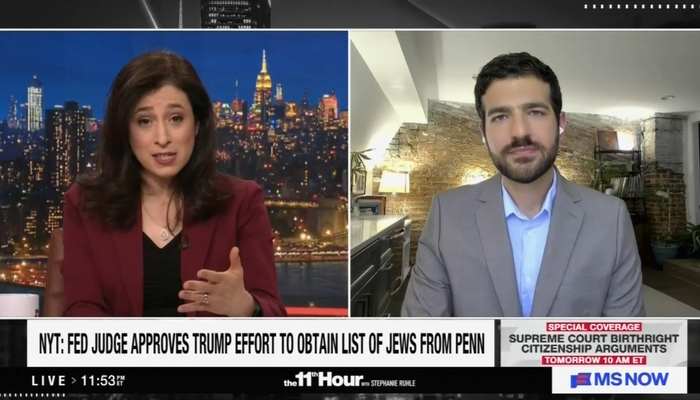
 At the end of Tuesday night’s The 11th Hour on MS NOW, fill-in host Catherine Rampell, with guest Mark Joseph Stern, a liberal court writer for Slate and a member of the BlueSky Brigade, compared a Trump administration investigation into alleged antisemitism at UPenn to the Holocaust. Why? Because the admin asked for names of Jewish students on campus as part of the investigation.
The segment was the last the late night news show aired after Stern just talked about the Birthright Citizenship Supreme Court case, where he suggested arguments supporting the Trump Executive Order were white supremacist in nature.
Rampell then introduced a The New York Times story on the Trump administration’s ask of the names of Jewish employees at the University of Pennsylvania as part of an investigation into possible antisemitism and discrimination against Jews on the campus. This was part of a broader crackdown after the anti-Semitic activities seen on campuses in 2024.
An AP wire story published by PBS said the ask from the government was “not unusual” according to a former federal official.
On Tuesday night, MS NOW’s Catherine Rampell, guest hosting The 11th Hour, and Slate writer Mark Joseph Steyn compared the Trump Administration investigation of antisemitism at UPenn to the Holocaust. pic.twitter.com/R4T9Y5Gp62
— Nick (@nspin310) April 1, 2026
Nevertheless, Rampell, the person who made sure to clarify she was “not a Democrat, I’m a journalist,” framed her question to Steyn in a way to compare the situation to lists and Holocaust:
They say that they need this list to investigate anti-Semitism, to protect Jews. What can you tell us about this particular ruling? And if I may ask, I recall your writing a couple of years ago about how your grandfather was a Holocaust survivor. You know, lists and Jews, good thing historically? Bad thing historically? What do you make of this?
Steyn agreed as he said Trump’s Birthright Citizenship executive order case has brought back the “old history” of the Nazi regime:
Speaking of stateless people, my father and my grandfather actually arrived here as a stateless person because he was stripped of his citizenship in Poland, under laws pushed by the Nazi regime and occupying forces.
Then, Steyn questioned if the investigation of antisemitism at UPenn was legitimate:
Well, really, there’s very little evidence that this is a legitimate investigation. It looks a lot more like harassment of Penn using Jewish employees and Jewish groups as conduits to get at university administrators who are deemed to be too woke by this government. And I think that this really does raise troubling first amendment issues.
He ended with worry that a “list” of names of Jews will be handed over to the government with an attack on a completely unrelated Supreme Court ruling, presumably about Citizens United v. FEC.
(…)The fact that the judge just wrote that off and said that this list of Jews could readily be turned over and in fact, had to be turned over, or else Penn could face sanctions. It seems tone deaf, it seems historically unwise, and it also seems to clash with First Amendment rights that the Supreme Court has been very willing to grant to those who are wealthy enough to want to purchase influence in elections anonymously.
Since Mark Joseph Steyn had moved to be a member of the BlueSky Brigade, it’s not surprising to hear him spew some old-fashioned Trump to Nazi comparisons.
The transcript is below. Click “expand”:
MS NOW’s The 11th Hour with Staphanie Ruhle
March 31, 2026
11:53:41 PM Eastern
(…)
CATHERINE RAMPELL: I want to ask you about another judicial decision that just came out today. A federal judge today approved the Trump administration’s efforts to obtain a list of Jewish people on campus from the University of Pennsylvania.
They say that they need this list to investigate anti-semitism, to protect Jews. What can you tell us about this particular ruling? And if I may ask, I recall your writing a couple of years ago about how your grandfather was a Holocaust survivor. You know, lists and Jews, good thing historically? Bad thing historically? What do you make of this?
MARK JOSEPH STERN: Yes, I think a bad thing, historically. My own family history certainly bears that out. Speaking of stateless people, my father and my grandfather actually arrived here as a stateless person because he was stripped of his citizenship in Poland, under laws pushed by the Nazi regime and occupying forces. So, this is not new history. It’s just history that Trump is trying to bring back.
It’s a disappointing decision. The judge actually kind of criticized the university for raising this comparison to Nazi Germany and said, oh, it’s nothing like that. We shouldn’t be worried. The Trump administration is just trying to validly investigate anti-semitism on campus.
Well, really, there’s very little evidence that this is a legitimate investigation. It looks a lot more like harassment of Penn using Jewish employees and Jewish groups as conduits to get at university administrators who are deemed to be too woke by this government. And I think that this really does raise troubling first amendment issues.
The Supreme Court has generally been very protective of anonymous speech and anonymous association. It has protected very wealthy groups’ ability to donate large sums of money, millions of dollars to political causes, anonymously, concealing their names from lawmakers and from the public.
Here, it would seem that Jewish members of the Penn community should have at least the same right to be able to affiliate with other Jews anonymously, without having their names exposed to the federal government. The fact that the judge just wrote that off and said that this list of Jews could readily be turned over and in fact, had to be turned over, or else Penn could face sanctions. It seems tone deaf, it seems historically unwise, and it also seems to clash with First Amendment rights that the Supreme Court has been very willing to grant to those who are wealthy enough to want to purchase influence in elections anonymously.
(…)