“There is a certain enthusiasm in liberty, that makes human nature rise above itself, in acts of bravery and heroism.” —Alexander Hamilton (1775)
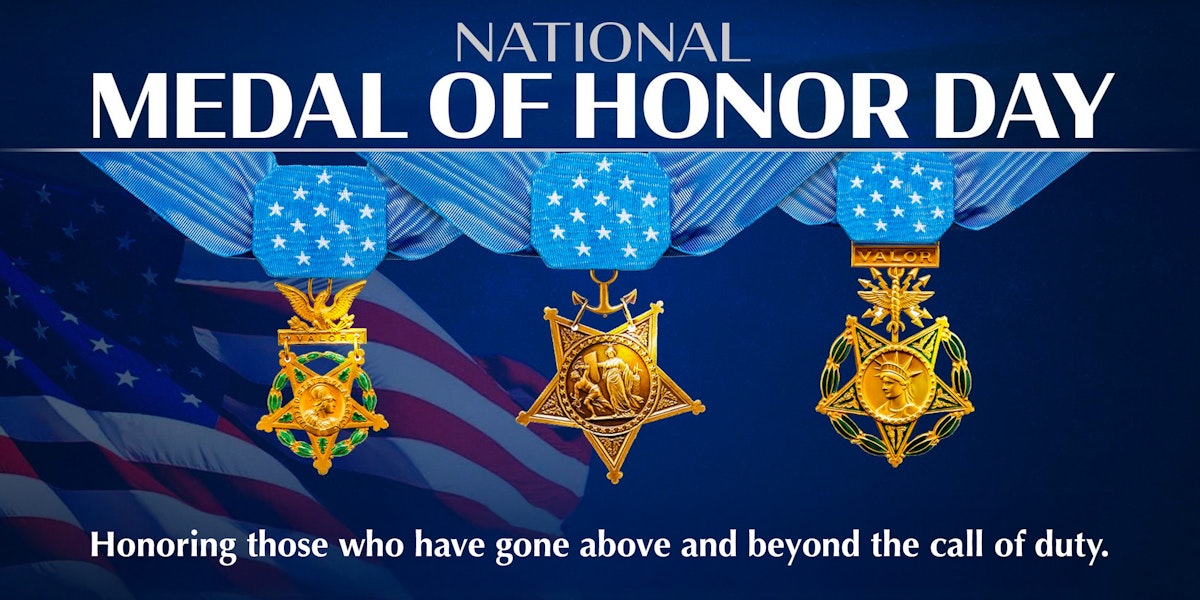
Today, 25 March, is National Medal of Honor Day, set aside to recognize all recipients of our nation’s highest military award. Each of these recipients has demonstrated “conspicuous gallantry and intrepidity at the risk of life above and beyond the call of duty” on behalf of their brothers in arms, and in keeping with their oaths “to support and defend” our Constitution and the American Liberty it enshrines.
It marks the anniversary observance of the first medals awarded on 25 March 1863 for the valorous actions of Andrews’ Raiders on 12 April 1862 — actions memorialized in books and films as “The Great Locomotive Chase.”
Those actions occurred just south of Chattanooga, the Birthplace of the Medal of Honor and home of the National Medal of Honor Heritage Center. The Heritage Center is dedicated to teaching future generations of Americans about the six character-trait pillars of the Medal of Honor — traits that are common to all recipients: Courage, Sacrifice, Patriotism, Citizenship, Integrity, and Commitment.
Since those first medals were awarded, American presidents and military commanders have, in the name of Congress, presented 3,533 Medals of Honor to a very elite few among the almost 40 million American Veterans who have served our nation since 1861. In a nation of some 330 million people today, there are only 64 living recipients (as of March 2026).
On occasion, this day coincides with my Wednesday column, providing an opportunity to both promote Medal of Honor Day and devote my essay to a noted recipient.
This year, that recipient is LtGen James Doolittle (USAF).
There is a connection between Doolittle’s World War II Raid on 18 April 1942 against the Japanese mainland and the actions of Andrews’ Raiders 80 years earlier during the War Between the States.
In retrospect, Andrews’ Raiders accomplished very little tactically, given that it had rained just before their mission and all the bridges and lines they set out to burn were too wet to ignite. However, as my colleague GEN B.B. Bell (USA-Ret.), Advisory Board chairman of the National Medal of Honor Heritage Center, observed: “Their mission did have a great impact on Union morale at the time. News of the Raiders’ bold mission deep into Confederate territory spread rapidly at a moment when Union setbacks were considerable. The morale boost of the Raiders’ actions can’t be overstated.”
By comparison, B.B. notes, it was similar to Doolittle’s daring raid on Tokyo just months after the Japanese attack on Pearl Harbor, the first American air operation to strike the Japanese archipelago. And though the raid, much as Andrews’ raid, caused only minor damage, it greatly boosted American morale by demonstrating that the Japanese mainland was vulnerable.
Jimmy Doolittle was born in Alameda, California, to parents Frank and Rosa, but he spent his early years on the frontier in Nome, Alaska, where he honed his wilderness skills. He was also of slight build, but he fended off bullies, earning a reputation as a young boxer. When a teenager, his family moved back to California, where he attended high school in Los Angeles. Jimmy saw his first plane up close at an air show there, and he was hooked.
After high school, he entered the University of California, Berkeley, before enlisting in the Signal Corps Reserve, where he then trained at the UC School of Military Aeronautics and Rockwell Field. He served at Camp Dick, Texas; Wright Field, Ohio; and Gerstner Field, Louisiana, before returning to Rockwell Field as a flight leader and gunnery instructor. He returned to Texas, serving with the 104th Aero Squadron and the 90th Squadron before receiving his commission as a First Lieutenant.
The first of his many historic flights was in 1922, when he flew a single-engine Airco DH-4 coast to coast with only crude instrumentation, a feat that earned him one of three Distinguished Flying Crosses. That same year, he graduated from UC Berkeley with a BA degree. He continued his education at the Massachusetts Institute of Technology, where in 1925 he was awarded a doctorate in aeronautics. According to MIT, “There were not 100 men in the world who held comparable advanced degrees.”
After graduation, he went to the Naval Air Station in Washington, DC, to fly high-speed seaplanes, testing their aeronautical limits and winning the Schneider Cup Race, averaging an astounding 232 miles per hour. He would also receive the Mackay Trophy for this record.
In 1926, despite having broken both ankles in an air crash, he flew his Curtiss P-1 Hawk in casts, winning an air competition in South America. After being confined to Walter Reed Army Hospital for recovery, in 1927, he was assigned as an instructor pilot with the 385th Bomb Squadron and became the first pilot to perform an outside loop, a maneuver previously assumed to be fatal. In 1928, he helped develop artificial horizon and directional gyroscopes, and a year later, he pioneered the ability to fly by instruments (“blind flying”), which won him the Harmon Trophy for demonstrating that aircraft could operate in all weather conditions.
He resigned his regular commission in 1930, becoming a Major in the Specialist Reserve Corps. He became manager of Shell Oil Company’s Aviation Department, conducting aviation tests, and periodically returned to active duty with the Army Air Corps in order to conduct tests in military aircraft. In 1932, he set the world speed record for land-based planes at 296 miles per hour. Having won the Schneider, Bendix, and Thompson air races, he retired from racing, saying, “I have yet to hear anyone engaged in this work dying of old age.”
He spent the next eight years in the private sector, becoming president of the Institute of Aeronautical Science before being recalled to active duty with the Army Air Corps in July 1940. Six months later, then-LtCol Doolittle was assigned to Army Air Forces Headquarters, where he planned the first retaliatory air raid on the Japanese homeland after their attack on Pearl Harbor.
The attack would involve launching 16 B-25 medium bombers from the aircraft carrier Hornet and targeting key Japanese political and military sites.
After training at Eglin and Wagner Fields in Florida, Jimmy and his volunteer crews went to McClellan Field in California for necessary modifications of their aircraft before being loaded on the Hornet at Naval Air Station Alameda.
The Raid was a daunting 12-hour one-way run against Tokyo, Kobe, Yokohama, Osaka, and Nagoya. Each aircraft carried four 500-pound bombs; three were high-explosive munitions, and one was a cluster of incendiaries.
At about 07:30 on 18 April, still about 650 nautical miles from the Japanese mainland, the Hornet was spotted by a Japanese picket boat, which radioed the fleet about a possible pending attack. Doolittle decided to launch immediately. By 09:20, all 16 B-25s launched successfully despite the fact that the pilots, including Doolittle, had never taken off from a carrier prior to this mission.
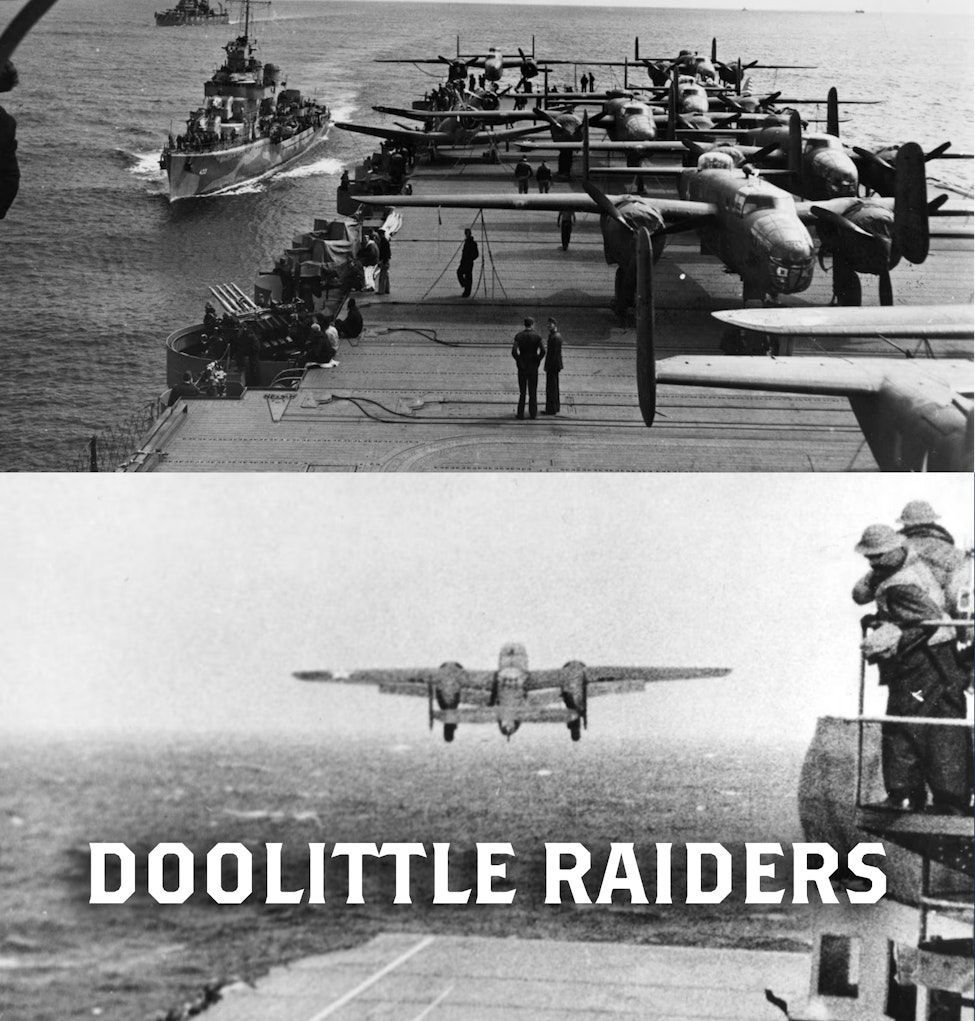
They reached their targets six hours after launch, about 12:00 Tokyo time, and experienced some resistance. The bombers shot down three Japanese fighters.
Once completed, the planes began their flight over the East China Sea, another 600 nautical miles, to a recovery airfield in China. Of the 16 B-25s, 15 either crash-landed or ditched at sea due mostly to fuel exhaustion. One plane made it to a Russian airfield.
Of the 80 airmen, most evaded Japanese capture with the help of Chinese guerrillas. Seven crew members were killed, three in crashes and four after being captured by the Japanese. Doolittle bailed out over China and reached safety with the assistance of American missionary John Birch.
Notably, Doolittle initially believed that he would certainly face a court-martial for failing to hit his primary targets and losing his aircraft. However, he would receive a Medal of Honor from Franklin Roosevelt, which he accepted on behalf of all his “Doolittle Raiders.” He was also promoted by two grades to Brigadier General.
His citation notes: “For conspicuous leadership above the call of duty, involving personal valor and intrepidity at an extreme hazard to life. With the apparent certainty of being forced to land in enemy territory or to perish at sea, Brigadier General (then Lieutenant Colonel) Doolittle personally led a squadron of Army bombers, manned by volunteer crews, in a highly destructive raid on the Japanese mainland.”
In 1942, Doolittle was assigned to the famed 8th Air Force in Europe. He then became commanding general of the 12th Air Force in North Africa and the 15th Air Force in the Mediterranean Theater, and he later returned to command the 8th Air Force in Europe and the Pacific until the end of World War II. He made two major changes to air war tactics as commander of the 8th: first, allowing bomber-fighter escorts to fly ahead of the bomber combat box formations in order to engage the Luftwaffe’s fighters; and second, cutting our escort fighters loose after bombing missions to hit any “targets of opportunity” before returning to base. And the P-38 Lightnings, P-47 Thunderbolts, and P-51 Mustangs did just that with great precision.
Jimmy Doolittle returned to reserve status in 1946 and fully retired in 1959. In 1973, at Key Biscayne Presbyterian Church in Florida, he delivered the eulogy for his friend and fellow Medal of Honor recipient, CPT Eddie Rickenbacker, who earned his Medal for aerial combat heroism in World War I.
In 1985, Congress promoted Doolittle to an honorary rank of full General, with President Ronald Reagan pinning on his fourth star. In addition to his three Distinguished Flying Crosses, he had two Army Distinguished Service Medals, a Silver Star, and a Presidential Medal of Freedom.
His autobiography, I Could Never Be So Lucky Again, is outstanding.
Jimmy was married 71 years to his life love, Josephine “Joe” Doolittle, who died in 1988 at age 93, while Jimmy passed away on 27 September 1993 at age 96. They had two sons, both of whom became military pilots. His grandson, Col James H. Doolittle III, became vice commander of the Air Force Flight Test Center at Edwards AFB in California. At his burial service in Arlington National Cemetery, his great-grandson played Taps.
Please join us in honoring these extraordinary warriors so that their service and sacrifice will never be forgotten.
Fellow Patriots, if you ever find yourself short of inspiration, I invite you to read selections from our Profiles of Valor on Medal of Honor recipients.
On the subject of inspiration, Air Force recipient Col Leo Thorsness, a Vietnam POW, always mentioned in his public remarks a fellow POW, Navy pilot Mike Christian. Mike was the subject of a column, “Our Flag — What Do You See?” and a children’s book we published, I’m Your Flag So Please Treat Me Right!.
At the dawn of our nation’s founding, Thomas Jefferson declared: “Honor, justice, and humanity, forbid us tamely to surrender that freedom which we received from our gallant ancestors, and which our innocent posterity have a right to receive from us. We cannot endure the infamy and guilt of resigning succeeding generations to that wretchedness which inevitably awaits them if we basely entail hereditary bondage on them.”
Indeed.
As for those who today enjoy these freedoms with no acknowledgement or respect for those who paid the ultimate price for them, I invoke the words of Samuel Adams: “Contemplate the mangled bodies of your countrymen, and then say, ‘What should be the reward of such sacrifices?’ … If ye love wealth better than liberty, the tranquility of servitude than the animating contest of freedom, go from us in peace. We ask not your counsels or arms. Crouch down and lick the hands, which feed you. May your chains sit lightly upon you, and may posterity forget that ye were our countrymen!”
Finally, I have the privilege of co-chairing, with GEN Bell, the National Medal of Honor Sustaining Fund supporting the National Medal of Honor Heritage Center in Chattanooga. As I said above, our primary mission is teaching future generations of Americans about the six character-trait pillars of the Medal of Honor — traits that are common to all recipients: Courage, Sacrifice, Patriotism, Citizenship, Integrity, and Commitment.
Notably, Chattanooga was not only the location where the first Medals of Honor were awarded, but also the field of service for the only woman who holds a Medal of Honor, Dr. Mary Walker.
Other well-known recipients from our area include World War I’s Alvin York, whose life story was immortalized in the film “Sergeant York.” It was also home to our neighbor for the last 20 years of his life, World War II’s Desmond Doss, whose heroic actions were featured in the 2016 movie “Hacksaw Ridge.” Other local recipients include T/Sgt Charles Coolidge and CPT Larry Taylor.
LtGen James Doolittle: An ordinary man faced with extraordinary circumstances, he summoned the greatest measure of courage in service to our nation. His example of valor — a humble American Patriot defending Liberty for all above and beyond the call of duty — is eternal. Live your life worthy of his sacrifice.
“Greater love has no one than this, to lay down one’s life for his friends.” (John 15:13)
(Read more Profiles of Valor here.)
Semper Vigilans Fortis Paratus et Fidelis
Pro Deo et Libertate — 1776
Follow Mark Alexander on X/Twitter.
Join us in daily prayer for our Patriots in uniform standing in harm’s way in defense of American Liberty, and for the families awaiting their safe return. Pray also for our Veterans, First Responders, and their families.
Please consider a designated gift to support the National Medal of Honor Sustaining Fund’s character education initiatives through Patriot Foundation Trust’s online donor page, or by check payable to “NMoH Sustaining Fund” and mail it to:
Generosity Trust
National MOH Sustaining Fund
345 Frazier Avenue, Unit 205
Chattanooga TN 37405
Thank you for supporting The Patriot Post, our nation’s premier journal of American Liberty.