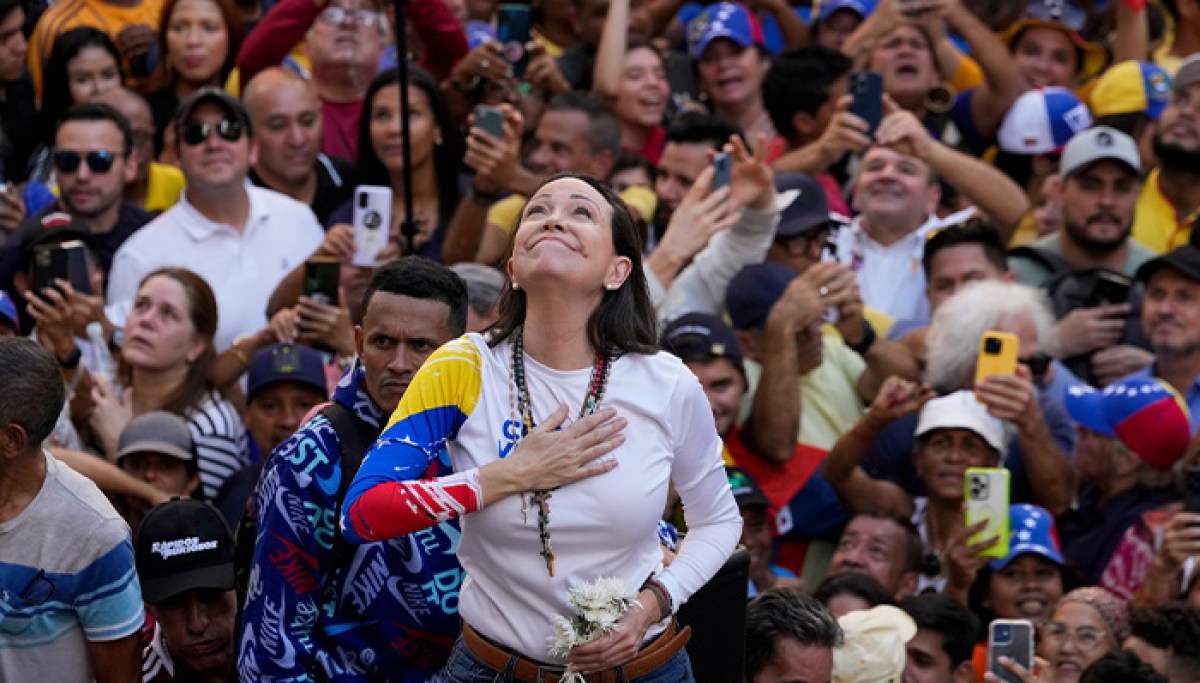
When dawn broke on the morning of Jan. 3, there was no Venezuelan more ecstatic over the capture of the country’s former dictator, Nicolas Maduro, by U.S. Delta Force commandos than María Corina Machado, the wildly popular opposition leader who spent the last year and a half in hiding until she emerged to accept her Nobel Peace prize in Oslo last month.
“Venezolanos, llegó la hora de la Libertad,” Machado posted on social media that Saturday morning, which means, “Venezuelans, the hour of freedom has arrived.”
But hours later, at a news conference at Mar-a-Lago, President Donald Trump dashed any hope that democracy would be restored quickly to Venezuela, or that Machado would play a role in any transition.
“She’s a very nice woman, but she doesn’t have the respect within the country,” Trump said. “I think it would be very tough for her to be the leader.”
Machado won her party’s primary with 90% of the vote, which prompted Maduro to ban her from running against him in the 2024 presidential election.
As Machado evaded Maduro’s security forces, she anointed Edmundo González to run as a surrogate in her place.
In the general election, González won in a landslide with roughly 70% of the vote, as confirmed by tally sheets painstakingly collected from hundreds of polling places by Machado supporters.
Maduro ignored the crushing defeat and simply declared himself the winner of a third six-year term, never releasing any official results.
While Machado has enjoyed strong support among the populace, which has been impoverished by years of Maduro’s repressive and corrupt regime, she does not have the support of the military and the rest of the Maduro regime that the Trump administration left in place when it hustled Maduro out of the country in handcuffs.
Trump is facing a choice for achieving his primary objective — seizing Venezuela’s prodigious oil reserves and getting U.S. companies in to rebuild the country’s long-neglected oil infrastructure.
Option one: He could take over the country, as the United States did in Iraq in 2003, which would require billions of dollars and tens of thousands of troops, and come with all of the considerable challenges of nation-building.
Or, option two: He could use the threat of further military action to force Venezuela to comply with his dictates, while America’s Caribbean armada remained as a sword of Damocles afloat just over the horizon.
While Trump has insisted he is not afraid to put “boots on the ground if we have to,” he has a well-known aversion to committing U.S. troops to open-ended missions.
So, apparently heeding a classified CIA assessment, Trump decided working with Maduro’s former vice president, now acting President Delcy Rodríguez, would be the most risk-free way to control Venezuela without the complications of actual regime change.
For months, the CIA was in Caracas, as U.S. officials, including Secretary of State Marco Rubio and Trump, negotiated with Maduro, trying to convince him to leave voluntarily.
Ultimately, they concluded Maduro could not be trusted.
“We just could not work with him. He is not a person that had ever kept any of the deals he made, broke every deal he ever made,” Rubio said on CBS’s Face the Nation.
And as for Machado, whom Rubio called “fantastic,” he said she could not be installed as leader because, for one thing, she was not on the ballot in 2024, and the election was by all accounts fraudulent.
Short of a massive Iraq-style invasion, there was no practical way Machado could take the reins of power.
“We are dealing with the immediate reality,” Rubio said, and “the immediate reality is that, sadly but unfortunately, the vast majority of the opposition is no longer present inside of Venezuela,” including Machado, who remains at an undisclosed location after being smuggled out of the country to accept her Nobel Peace Prize.
That left Rodríguez as an imperfect, but practical alternative, one who, while not turning Venezuela into a thriving democracy, could offer a path to achieve Trump’s more limited goals.
In an interview with Fox News’s Sean Hannity, Machado heaped praise on Trump and promised to present him the 18-carat gold Peace Prize medallion if and when she sees him in person.
But she recoiled at the prospect of Rodríguez leading the country for an indefinite period.
“Delcy Rodríguez, as you know, is one of the main architects of torture, persecution, corruption, narco-trafficking,” Machado said. “She’s the main ally and liaison with Russia, China, Iran — certainly not an individual that could be, you know, trusted by international investors, and she’s really rejected, repudiated by the Venezuelan people.”
Machado told Hannity that she’s anxious to return to Venezuela, but for now, she wants the freedom to speak out from outside the country.
And she has continued to argue that if the U.S. were to actually depose the current regime and restore the rule of law, Venezuela would go from the “criminal hub of the Americas” to the “energy hub of the Americas,” and in turn that would incentivize millions of Venezuelans who have fled the current dictatorship to return home to rebuild the country.
Stephen Miller, Trump’s top policy adviser, dismissed that as wishful thinking, saying, “A neoliberal frame that the United States’ job is to go around the world and demand immediate elections to be held everywhere, immediately, all the time.”
In a contentious interview on CNN, Miller argued that it is just not the way the world works.
“It would be absurd and preposterous for us to suddenly fly her into the country and to put her in charge and [expect] the military would follow her and the security forces would follow her,” he said. “You can talk all you want about international niceties and everything else, but we live in a world, in the real world that is governed by strength, that is governed by force, that is governed by power.”
In her initial reaction to the audacious U.S. snatch mission that killed as many as 75 Venezuelans, Rodríguez was defiant, demanding the return of Maduro, and vowing Venezuela would “never again be anyone’s colony.”
But by the next night, she appeared to move from defiance to compliance.
“We invite the U.S. government to collaborate with us on an agenda of cooperation,” she posted on social media.
Miller said, “They have sent message after message making clear that they will meet the terms, demands, conditions, and requirements of the United States.”
Trump has not ruled out a restoration of democracy at some future date, saying that’s not the top priority.
“Right now, what we want to do is fix up the oil, fix up the country, bring the country back, and then have elections,” he said.
The U.S. has also not ruled out allowing Rodríguez and the rest of the old Maduro regime to stay in power indefinitely, so long as they bow to Trump’s demands.
“We’re going to make an assessment on the basis of what they do, not what they say publicly in the interim, not what they’ve done in the past,” Rubio said. “Do the drugs stop coming? Are the changes made? Is Iran expelled? Is Hezbollah and Iran no longer able to operate against our interests from Venezuela? Does the migration pattern stop? Do the drug trafficking boats end? … “These are the things we want addressed. If they are addressed, that’s how we’ll judge it.”
In the Cold War era, this was called “realpolitik,” — politics based on practical rather than moral or ideological considerations.
In Trump’s new national security strategy, released last month, it’s rebranded as “flexible realism,” stating, “U.S. policy will be realistic about what is possible.”
“We seek good relations and peaceful commercial relations with the nations of the world without imposing on them democratic or other social change that differs widely from their traditions and histories,” the document says.
The cold, hard truth is that it could leave Machado shivering on the sidelines.
THE MAIN PLAYERS IN VENEZUELA’S GOVERNMENT AND WHO COULD BE TARGETED NEXT
“I think the administration is making a big mistake by throwing Machado under the bus, as they did on Saturday, and thinking that they can negotiate with Delcy Rodriguez somehow to have a stable transition,” John Bolton, Trump’s former national security adviser and fervent critic, said during an appearance on CNN. “Rodriguez and the other Maduro loyalists are not going to negotiate their own exit from power.”
“It’s the opposition in Venezuela that voted overwhelmingly against Maduro that clearly supports Machado and Gonzalez. Those are the people who can help provide stability, not the failed Maduro regime,” he added. “I think the administration’s notion they can rely on anybody in the Maduro regime to keep up to any of the promises they make is badly misplaced. And what was clearly a positive, getting rid of Maduro, can turn south very quickly if what is really the rest of the regime keeps itself in power and represses the opposition.”