Order Jamie Glazov’s new book, ‘United in Hate: The Left’s Romance with Tyranny, Terror, and Hamas’: HERE.
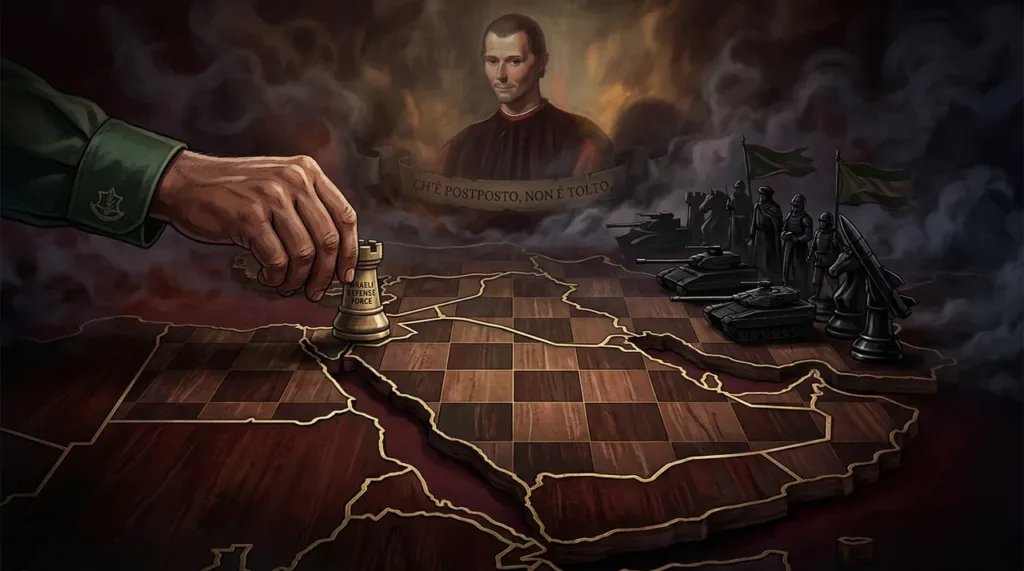
“The Romans never allowed a trouble spot to remain simply to avoid going to war over it, because they knew that wars do not go away; they are only postponed to the advantage of others.”
— Niccolò Machiavelli
Five centuries ago, the Florentine political thinker Niccolò Machiavelli observed something fundamental about power and conflict. In his reflections on Roman strategy in Discourses on Livy, he noted that the Roman Republic refused to ignore emerging threats merely to avoid immediate confrontation. The Romans understood that problems left unresolved do not disappear; they simply return under circumstances more favorable to the enemy.
The insight remains strikingly relevant today. Modern debates over territorial concessions—particularly in volatile regions such as the Middle East—often rest on the assumption that relinquishing strategic ground will reduce tensions and create space for diplomacy. Yet history repeatedly suggests the opposite: when territory is surrendered before lasting security arrangements are proven, conflict is not eliminated. It is postponed.
At the heart of the issue lies a simple strategic truth: territory is not merely land. It is leverage. Throughout history, control of territory has determined whether states dictate events or react to them. Strategic ground shapes military positioning, political negotiations, and the psychological balance between adversaries. Once relinquished, that leverage is rarely regained without significant cost.
This is not merely the observation of Renaissance political theory. Modern strategists have echoed the same principle. In The 33 Strategies of War, author Robert Greene argues that position determines initiative in conflict. The side that holds advantageous ground controls the tempo of events, forcing its opponent to react rather than dictate terms. When strategic position is surrendered prematurely, the balance of initiative shifts. The history of the modern Middle East offers several examples of this dynamic.
In 2000, Israel withdrew from southern Lebanon after nearly two decades of maintaining a security zone designed to buffer its northern communities from attacks. The withdrawal was widely interpreted at the time as a step toward de-escalation. Instead, the vacuum created by the retreat allowed Hezbollah to consolidate its position along the border, significantly expanding its military capabilities over the following years. What was intended as a step toward stability ultimately produced a new and more dangerous strategic reality.
A similar logic appeared in the 2005 disengagement from Gaza. Israel dismantled settlements and withdrew its military presence from the territory in the hope that removing the occupation issue would reduce tensions and open the door to new political arrangements. Instead, the withdrawal created an environment in which Hamas rapidly established control and transformed Gaza into a heavily militarized enclave.
Over the past half-century, Israel has repeatedly found itself trapped in a cycle of victory followed by concession. Territory captured at considerable cost in war is returned in exchange for diplomatic assurances that later prove fragile or unenforceable. When hostilities inevitably resume, Israel must once again commit blood and treasure to retake ground it had previously secured. The pattern has repeated itself often enough that it can no longer be dismissed as an accident of circumstance. It reflects a deeper strategic dilemma: concessions made before lasting security conditions exist often recreate the very dangers they were intended to eliminate.
The pattern has become so familiar that it increasingly resembles what the philosopher Friedrich Nietzsche once called “eternal recurrence”—a cycle repeating itself endlessly because its underlying lesson has not been learned. Even now, Israel finds itself preparing once again to enter southern Lebanon to confront the same forces it fought only a year ago. Territory that had been secured through military effort was relinquished in the hope that diplomatic arrangements would restrain Hezbollah. Instead, the same strategic dilemma has returned almost immediately. What was presented as a step toward stability has instead produced another round in a conflict that seems condemned to repeat itself.
These outcomes do not necessarily mean that territorial concessions can never contribute to peace. But they illustrate a crucial point: diplomacy cannot substitute for durable security conditions. Agreements written on paper may promise stability, yet strategic realities on the ground often determine whether those promises hold.
This is precisely the dilemma Machiavelli identified when examining Roman expansion. Rome did not assume that potential adversaries would abandon their ambitions simply because diplomacy suggested they should. Instead, Roman leaders believed that maintaining strategic leverage was essential to preventing future conflict. From Machiavelli’s perspective, weakness invited pressure. Concessions made prematurely—before the balance of power had decisively shifted—encouraged adversaries to regroup and resume the contest under more favorable conditions.
Modern strategists have reached similar conclusions. In The 33 Strategies of War, Robert Greene argues that position is one of the most decisive elements in conflict. The side that holds advantageous ground controls the tempo of events, forcing its opponent to react rather than dictate terms. Strategic territory therefore functions not merely as geography but as leverage. When such leverage is surrendered prematurely, the initiative passes to the adversary, who can regroup, rearm, and eventually challenge the balance again. Greene’s synthesis of historical military campaigns emphasizes that the most successful commanders maintain positional advantage as long as possible. Position is power because it shapes the environment in which negotiations occur.
When a state retains strategic ground, it negotiates from strength. When that ground is surrendered prematurely, the negotiation itself changes character. What might have been leverage becomes a concession already granted. The concept applies far beyond any single conflict. From the Cold War to regional disputes across the globe, successful diplomacy has often depended on the maintenance of credible deterrence. Strategic leverage does not eliminate the need for negotiation; rather, it makes negotiation meaningful.
This lesson is particularly relevant in regions where conflicts are deeply embedded and long-standing. Agreements reached under conditions of temporary political optimism can quickly erode if the underlying balance of power shifts. When that happens, previously surrendered ground becomes difficult—if not impossible—to reclaim without renewed confrontation. In this sense, the debate over territorial concessions is not simply about geography. It is about timing and incentives.
If concessions are granted before adversaries demonstrate durable compliance with agreements, the incentive to honor those agreements may weaken. Conversely, when strategic leverage is maintained until commitments are clearly upheld, the incentives shift in favor of stability. This was the logic behind many of the Roman decisions Machiavelli admired. The Romans did not rush to resolve conflicts through concessions. Instead, they sought to shape the strategic environment so that peace, when it arrived, rested on durable foundations.
Modern statesmen face a far more complex world than the Roman Republic ever knew. Yet the underlying dynamics of power have changed remarkably little. Nations still negotiate, compete, and deter one another in ways that reflect the realities of strategic position. The lesson Machiavelli drew from Roman history therefore remains instructive. Wars postponed through concessions are not necessarily wars avoided. They are often conflicts deferred until conditions favor the adversary.
Territory, once relinquished, rarely returns without cost. Strategic ground surrendered today may have to be reclaimed tomorrow under far less favorable circumstances. The challenge for policymakers is not simply to pursue peace but to ensure that the conditions for peace are durable. Diplomacy without leverage may produce temporary calm, but history suggests that lasting stability usually rests on a balance of power that adversaries cannot easily overturn.
Machiavelli’s warning was not a call for endless war. It was a recognition that avoiding conflict by surrendering strategic advantage rarely produces the result its advocates hope for. More often, it shifts the timing of the confrontation while strengthening the position of the opponent. The tragedy is not simply that territory is surrendered, but that the same ground must later be reconquered at the cost of new lives to correct the consequences of earlier concessions.
Five hundred years later, the logic remains difficult to ignore. History suggests that wars postponed are rarely wars avoided; they are merely waiting, like Hamlet’s tragedy, for the final act. In war, there are no second chances.