Order Jamie Glazov’s new book, ‘United in Hate: The Left’s Romance with Tyranny, Terror, and Hamas’: HERE.
In February, members of the U.S. House of Representatives introduced H.Res. 866, drawing attention to the escalating persecution of Christians in Nigeria and calling for greater international response. The House Appropriations Committee has likewise issued statements highlighting religious violence and the killing of Christians in parts of sub-Saharan Africa. After years in which massacres were treated as regional instability or “banditry,” Congress has begun to name the pattern more directly. The pattern is not new. What is new is the willingness, however tentative, to recognize it as systematic.
Across Nigeria, Cameroon, Mozambique, and parts of the Sahel, armed Islamist jihadist organizations have targeted Christian communities with mass killings, kidnappings, village burnings, and church attacks. Groups such as Boko Haram and its splinter faction, Islamic State West Africa Province (ISWAP), explicitly proclaim jihad as their mandate. They frame their campaign in religious terms. They identify Christian communities as infidels or obstacles to their vision of governance.
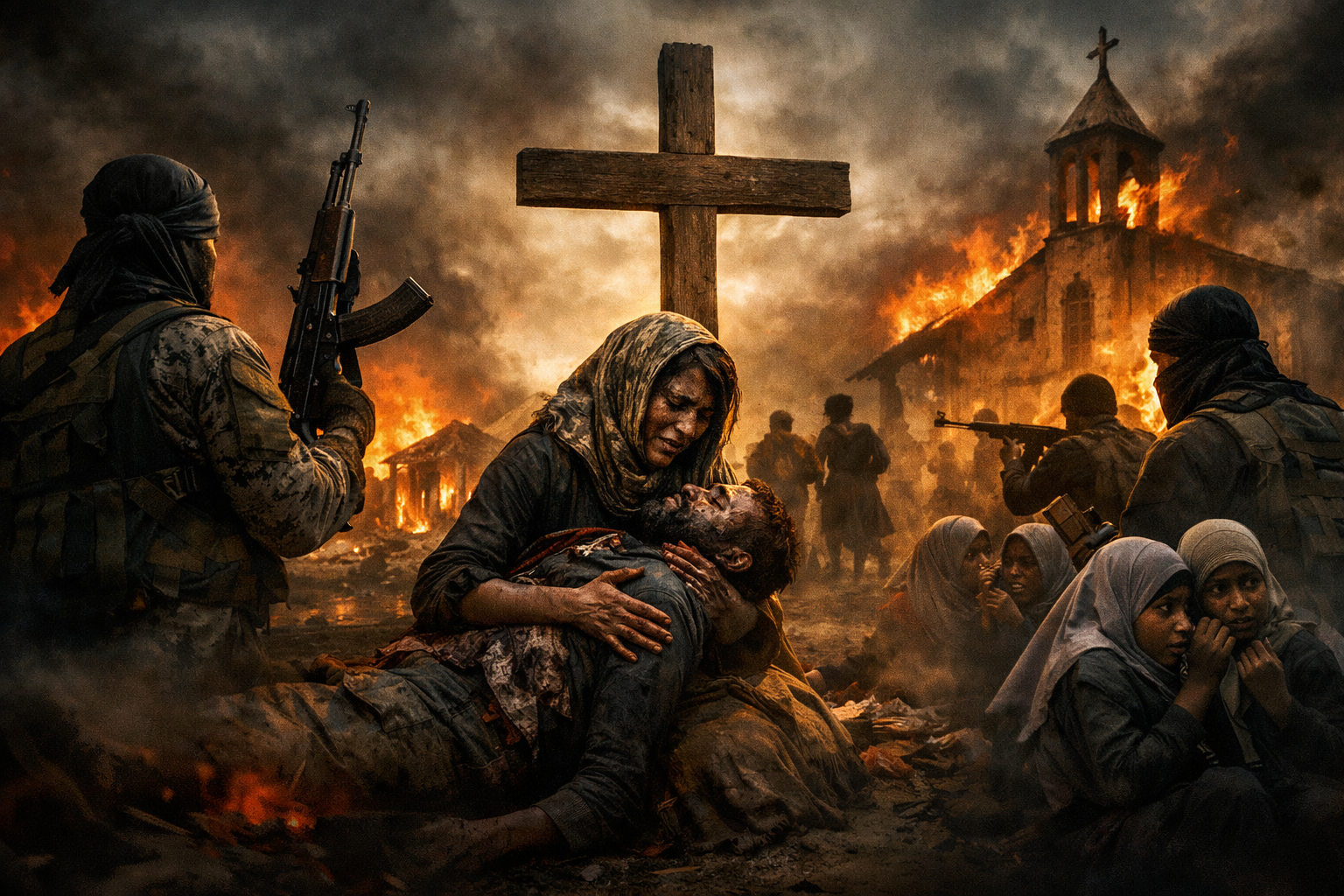
In Nigeria alone, tens of thousands of Christians have been killed over the past decade and a half, according to various advocacy and research organizations. Villages in Plateau, Kaduna, Niger, and Borno states have suffered repeated attacks. In Cameroon’s Far North region, Boko Haram-linked militants have raided communities, abducted civilians, and burned churches. In Mozambique’s Cabo Delgado province, Islamist insurgents aligned with Islamic State have attacked Christian villages and clergy. These are not isolated crimes of opportunity. They are ideological campaigns.
The perpetrators frequently declare their religious justification openly. Boko Haram’s founding rhetoric rejected Western education as forbidden and called for the establishment of an Islamic state governed by its interpretation of sharia. ISWAP pledges allegiance to the broader Islamic State network. In multiple attacks, militants have separated Christians from Muslims, killing the former and sparing the latter. Churches are burned. Pastors are executed. Schoolgirls are abducted.
The 2014 kidnapping of hundreds of Christian schoolgirls from Chibok by Boko Haram shocked the world briefly before fading from headlines. Many were held for years; some remain missing. More recent kidnappings and village massacres have generated far less attention. The pattern continues. This violence is frequently described in Western reporting as “communal clashes” or “ethnic conflict.” Such language obscures the ideological core. While land disputes and ethnic tensions can intersect with these attacks, the most lethal insurgent groups operating in these regions are Islamist organizations that explicitly frame their violence as jihad. History offers a parallel that should unsettle us.
In 1885, General Charles Gordon stood in Khartoum confronting an army led by Muhammad Ahmad, who had proclaimed himself the Mahdi. The Mahdi declared jihad against those he deemed infidels and corrupt rulers. His followers believed they were waging a divinely sanctioned Islamic holy war. When Khartoum fell, thousands were slaughtered. London debated strategy while fanaticism advanced.
The lesson was not that all Muslims were complicit; Sudan was and is a diverse society. The lesson was that when a militant movement cloaks violence in religious absolutism and meets hesitant opposition, devastation follows.
Today, in parts of Africa, Islamist extremist movements again proclaim religious mandate and wage armed campaigns against communities they identify as religious enemies. The scale differs by region, but the pattern is recognizable: ideological justification, civilian targeting, territorial ambition. The silence has been striking.
International media coverage spikes after particularly gruesome massacres and then recedes. Diplomatic statements condemn “violence” in general terms. The language often avoids naming the ideological drivers behind the attacks. Yet the militants themselves are unambiguous. They describe their campaign as jihad. They circulate propaganda videos celebrating attacks on Christians. They recruit fighters on explicitly religious grounds.
The reluctance to confront that reality directly may stem from understandable concerns about inflaming religious tensions. But evasion carries its own cost. When ideology is masked as generic instability, policy responses drift toward development aid and security assistance without addressing the theological and doctrinal narratives fueling recruitment.
None of this implies collective guilt. Africa is home to hundreds of millions of Muslims who reject violence and live peacefully alongside Christian neighbors. Indeed, many Muslims in these regions have themselves been victims of extremist groups. Distinguishing between peaceful adherents and armed Islamist insurgents is not a concession; it is a prerequisite for credibility. But clarity requires naming the ideology that animated these particular movements.
Boko Haram’s founding documents rejected Western education and democracy as incompatible with its vision of Islamic governance. ISWAP explicitly aligns itself with the global Islamic State project. In Mozambique, insurgents have pledged allegiance to Islamic State’s central leadership. These groups are not merely criminal gangs. They are ideological actors seeking to reshape territory through violence.
The consequences extend beyond immediate casualties. Entire Christian communities have been displaced. Agricultural regions are destabilized. Schools close. Local economies collapse. Over time, demographic shifts alter the social fabric of contested areas. When villages are repeatedly attacked and survivors flee, presence erodes quietly.
The strategic implications are significant. A persistent insurgency framed as religious war can entrench cycles of retaliation and mistrust. If unaddressed, it can harden sectarian lines across regions already strained by poverty and weak governance. The longer the violence continues with limited sustained international attention, the more normalized it becomes.
Congress’s recent resolution does not solve the problem. But it signals recognition that religious persecution in Nigeria and elsewhere is not incidental. It is systemic enough to warrant formal acknowledgment. Recognition is the first step toward sustained policy engagement — whether through diplomatic pressure, targeted sanctions, or support for local security reforms. There is also a moral dimension that transcends policy.
When Christian villagers are massacred and their churches burned, the language used to describe those events matters. When schoolgirls are abducted under the banner of religious extremism, candor matters. Sanitized phrasing may soothe diplomatic sensitivities, but it does little for those living under threat.
The fall of Khartoum became a symbol not merely of military defeat but of delayed resolve. The world today is not Victorian Britain, and Nigeria is not nineteenth-century Sudan. Yet the pattern of hesitant acknowledgment in the face of ideologically driven violence carries a familiar echo.
The men who attacked Gordon’s garrison proclaimed religious mandate. The militants who attack churches in parts of Nigeria and Mozambique proclaim religious mandate. In both cases, the ideology was not incidental. It was central. If the silent war is to end, it must first be named. Congress has begun to speak. Reports have been entered into the record. Hearings may follow. That is not yet decisive action, but it is no longer silence.
For years, the slaughter of Christians in parts of Africa has unfolded at the margins of global attention. Villages burned, clergy murdered, families displaced — and then the news cycle moved on. Now the silent war has been heard. Whether it will be answered remains the defining question.