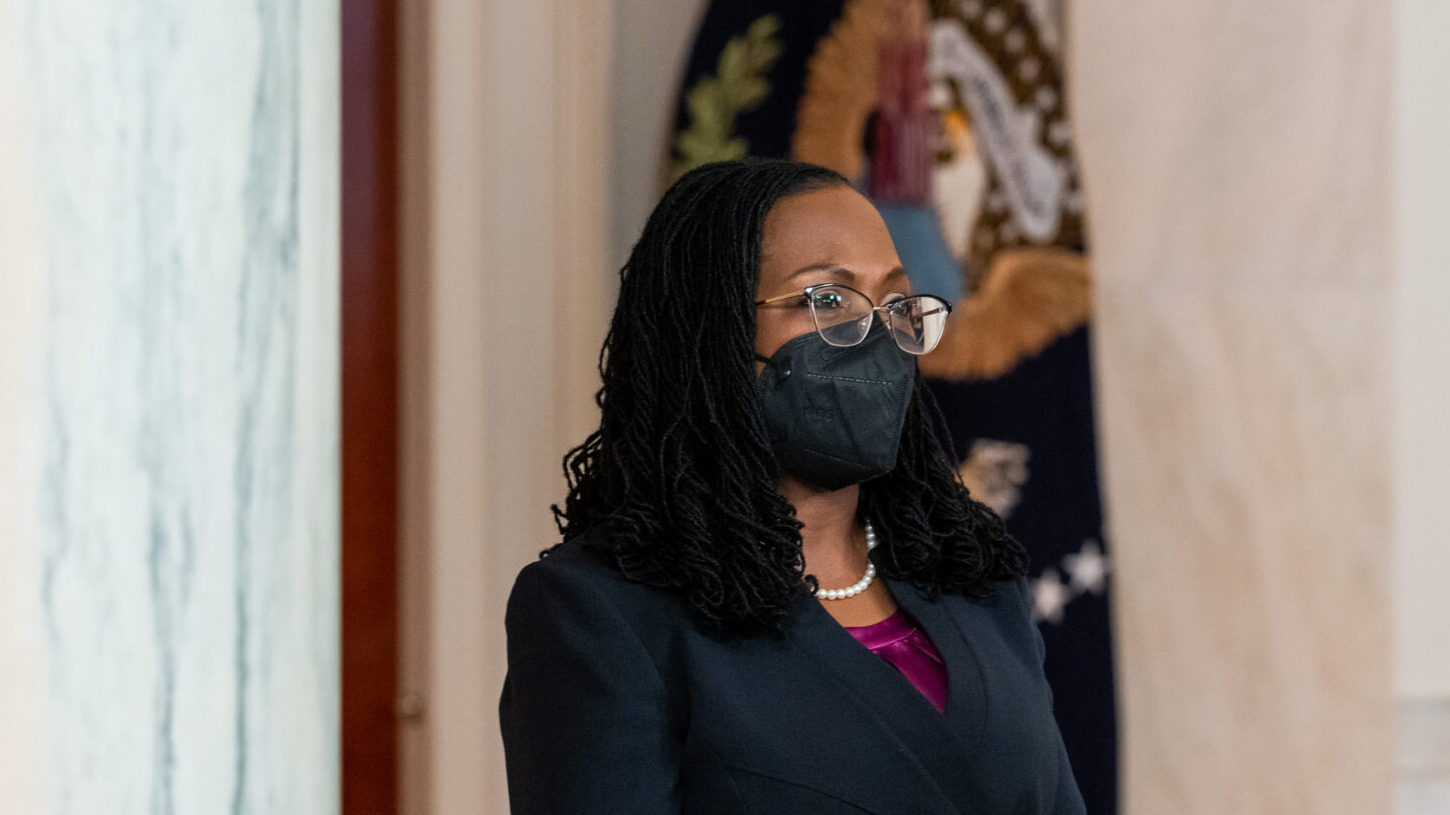
There are many things that D-list Broadway actress and Supreme Court Justice Ketanji Brown Jackson does not understand, as she will be the first to tell you. The latest item on that list, she revealed on Tuesday, is the First Amendment.
After her eight colleagues struck down Colorado’s ban on the use of talk therapy to help children overcome gender confusion, Jackson wrote a 35-page dissent — longer than the majority and concurring opinions combined — and reportedly forced everyone in the courtroom to listen as she read all 35 pages of it from the bench.
“To properly evaluate the First Amendment claim at issue in this case, one must first understand the impetus for Colorado’s regulation, what that law requires, and the nature of the speech it implicates,” she writes.
Jackson clearly does not.
Led by Justice Neil Gorsuch, the majority found that Colorado violated the speech rights of counselors like Kaley Chiles by banning them from providing talk therapy to patients who ask for help overcoming gender dysphoria and other sex-based confusion.
But Jackson insists speech codes targeting counselors’ ability to speak freely to clients about gender ideology are no different from standard medical regulations like prohibitions on doctors recommending suicide. (That’s an interesting example, given the support for state-sponsored suicide within the scientific establishment she reveres.)
For a counselor to tell a confused young girl she’s not a boy, and to help her make peace with that biological reality, is a “dangerous therapy modality,” in Jackson’s view. Banning such speech, she says, is just “garden-variety regulation.”
What she did not see as “garden-variety regulation,” however, was a Tennessee law banning care providers from performing amputation surgeries or prescribing puberty blockers and opposite-sex hormones to children. When the Supreme Court upheld that law in June, Jackson joined a dissent written by Justice Sonia Sotomayor. But don’t go looking for her to clear up that glaring contradiction in Tuesday’s dissent; her constitutional theory of interpretation is whatever allows states to ban therapists’ speech but doesn’t let them ban other medical professionals from chopping off the healthy body parts of 12-year-olds.
To get around the obvious First Amendment issue in Colorado’s law, Jackson insists a ban on therapists’ speech isn’t actually a speech ban at all.
“When a healthcare professional’s speech is not being targeted ‘as speech’ (because it conveys an idea) but is instead ‘incidentally’ restricted due to a State’s otherwise legitimate regulation of the medical treatments being offered to patients, heightened scrutiny is not warranted,” she writes. Of course, Colorado has no “otherwise legitimate” interest in banning Chiles’ speech. Restricting the “idea” that Chiles’ speech “conveys” — LGBT heterodoxy — is the entire reason the law exists.
To appreciate how ridiculous her argument is, try inserting the phrase “practicing religion,” another First Amendment freedom, in place of “conversion therapy” in this line from the dissent:
The [Colorado law] does not prevent Chiles from speaking out in favor of conversion therapy, promoting conversion therapy, or otherwise lending credence to efforts to validate that therapy. All this law does is prohibit Chiles from [actually doing it].
Undeterred, Jackson presses on, drawing a distinction between “the expression of ideas” and “professional medical speech.”
“[P]rofessional medical speech does not intersect with the marketplace of ideas,” she writes. And later in the same paragraph: “professional medical speech does not necessarily involve the expression of ideas or messages.”
Essentially, she argues that there is Very Serious Medical SpeechTM and then there are the unenlightened opinions of the rubes who think boys and girls are different.
“Medical standards are driven by science,” she informs us. In case that wasn’t clear, she explains that science is “objective facts and data.”
Miraculously, she seems to have regained her faith in those “objective facts” since her confirmation hearings, in which she told Sen. Marsha Blackburn she could not define a “woman.”
“I’m not a biologist,” but a mere judge, she explained at the time. Ironically, her take on Colorado’s law would allow judges more freedom to speak about the biological distinctions between the sexes than it would a medical professional.
States need to be able to enforce science, Jackson concludes, because it’s “for the protection of public health.” Where have we heard that one before?
The gist of Jackson’s dissent is that Kaley Chiles needs to shut up and trust the science. Transgender orthodoxy is just “facts and data,” dontcha know. Just like the “facts and data” that were used to bludgeon society with Covid vaccine mandates, mask orders, and stay-at-home edicts, transgender “science” may not be questioned.
Jackson employs another Faucian tactic in the final pages of her soliloquy.
“[T]o be completely frank, no one knows what will happen now,” she warns ominously. “The fallout” from the majority’s protection of Chiles’ speech “could be catastrophic.” To allow counselors to offer confused kids an alternative to elective mastectomies or penile amputation “ultimately risks grave harm to Americans’ health and wellbeing.”
What’s really at risk, of course, is the hegemony of the transgender-industrial complex — and the wellbeing of the children it dices up and spits out.
Elle Purnell is the assignment editor at The Federalist. She has appeared on Fox Business and Newsmax, and her work has been featured by RealClearPolitics, the Tampa Bay Times, and the Independent Women’s Forum. She received her B.A. in government with a minor in journalism. Follow her on Twitter @_ellepurnell.