Wisconsin Assistant Attorney General Adrienne Blais did little Monday to challenge the defense’s legal arguments that her agency’s politically motivated fraud case against two attorneys and an aide for the 2020 Trump campaign is built on a prosecution “error.”
Blais didn’t need to do much. Liberal Dane County Judge John Hyland, who refused to recuse himself from the case after explosive allegations that a retired judge was the ghostwriter of Hyland’s earlier order, ruled that prosecutors had provided enough evidence to take the phony “false electors” case to trial.
During a long preliminary hearing in Madison, attorneys for Jim Troupis and Michael Roman argued that the 11 fraud and forgery counts filed against them are themselves a fraud.
“We did not hear a single word saying that something was said by the defendants that was deceitful, nothing that established a conspiracy,” Troupis’ Madison attorney Joe Bugni said in summing up the state Department of Justice’s case that aims to lock up for decades allies of President Donald Trump in a proxy trial.
Troupis, a former Dane County judge, answered the Trump campaign’s call for help following the rigged 2020 election and, along with attorney Ken Chesebro, served as legal counsel for the campaign’s legal challenges in Wisconsin. Chesebro will appear for his preliminary hearing at a later date, Hyland ordered on Monday. Democrat Attorney General Josh Kaul alleges the defendants drove a “false electors” scheme aimed at usurping the rightful slate of Democrat electors for Joe Biden, who claimed victory in the swing state by a hair’s width 20,000-plus votes.
But, as Bugni has argued since the highly partisan Kaul announced charges in June 2024, the case is built on a legal house of cards that cannot stand scrutiny. And Bugni brought serious scrutiny to court Monday.
‘Unconstitutional’
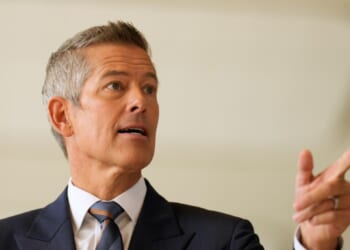
In testifying for the defense, Harvard law professor Lawrence Lessig basically argued what he wrote in a 2024 op-ed in the Wall Street Journal: The constitution protects alternate electors.
“Mr. Trump and his party’s lawyers encouraged [his electors] to meet and vote on the date set by Congress, Dec. 15. Because Joe Biden carried those states, Democrats and journalists call these Trump electors ‘fake.’ But the effort to prosecute them is unconstitutional, and the campaign to vilify them is stupid,” Lessig wrote.
The Harvard Law School professor is no red state conservative, and no fan of President Donald Trump. In 2016, he mulled a run for president as a Democrat, promising that, if he won, he would resign after passage of a bill that would bring liberal reforms to elections and do away with congressional district gerrymandering. His short list of running mates at the time included Neil deGrasse Tyson, Jon Stewart and Joe Biden, according to the Center for Public Integrity, a leftist investigative journalism group.
Lessig pointed to the 1960 presidential election when John F. Kennedy narrowly defeated Richard Nixon in Hawaii. While the results were being challenged, both campaigns did what Trump’s Wisconsin attorneys advised him to do: prepare a slate of electors — 10 in Wisconsin — to protect the president’s position while the legal challenges continued. Should Trump ultimately prevail in the courts, the Badger State’s electoral votes would go to him. They would not if he failed to secure them.
No one in 1960 thought the security plan was a “scheme” to try to overthrow an election, Lessig said. Nor did Democrats see a conspiracy in 2000 when Al Gore’s supporters begged George W. Bush electors to vote for the liberal candidate in the disputed 2000 presidential election. Or when Hillary Clinton backers appealed to Trump electors in 2016 to defy their commitment and vote for the Democrat.
‘Nothing Prohibits’
Prosecutors argue that the defendants didn’t include “contingent language” explaining their position and that they lied to the Republican alternate electors about the purpose of the legal strategy. Bugni said Troupis, Chesebro and Roman did no such thing and the evidence confirms at much. And Lessig said there’s no such requirement in federal law, particularly when litigation challenging the results is pending — as was the case in 2020.
“Everybody was representing this as a necessary contingent document to assure that if in fact the court goes the other way, there’s an opportunity to have the votes to be counted,” the legal expert said. “I can’t see that anyone could fairly conclude that that’s fraudulent. So in the context of how this played out, at least in the case of Wisconsin, I don’t think that it could deemed to be fraudulent.”
Neither did Kaul and his legal team while the Trump campaign was preparing to employ the alternate elector strategy — or after the fact.
A Kaul Department of Justice memo shot down a leftist lawfare organization’s contention that the alternate electors “met in a concerted effort to ensure that they would be mistaken, as a result of their deliberate forgery and fraud, for Wisconsin’s legitimate Presidential Electors.”
Nothing “prohibits or otherwise limits a party from meeting to cast electoral votes during a challenge to an election tabulation. [The statutes] say nothing about an alternative set of electors casting votes and do not expressly prohibit a slate of electors from casting votes to preserve their votes in case pending legal challenges prove successful,” the DOJ advised the Wisconsin Elections Commission.
Republicans notified the DOJ and the courts of their plan. It was publicly known. It was no secret.
‘Not Enough Evidence’
Bugni again argued that one of the biggest mistakes the prosecution is making — an “error that permeates the entire case” — is the idea that the defendants committed forgery. Forgery is a counterfeit. The alternate elector votes presented to congress were exactly what they purported to be. Nothing false or counterfeit about that.
The same for the fraud counts. Those involved knew that the strategy was being used to protect Trump’s position, Bugni argued. Prosecutors charge that the electors who signed the certificate had no idea that the end-game was to “falsely claim” Trump had won Wisconsin. That’s not what happened, Bugni argued.
“There is not enough evidence here to bind over” for trial, Bugni argued.
Hyland disagreed. Perhaps it came as no surprise.
‘External Influences’
The judge last week said he could be fair and impartial in the case even after Bugni presented expert testimony finding that it was “likely” retired Dane County Judge Frank Remington wrote Hyland’s order in August denying that the case be dismissed. Remington, Bugni argued, held a grudge against Troupis, his old legal colleague. The defense had requested Hyland remove himself from the case and that his order be vacated.
On Friday, Wisconsin Sen. Ron Johnson asked the U.S. Department of Justice to review the case and the allegations against Hyland “to determine whether any wrongdoing has occurred.”
On Monday, the Republican-controlled state Senate announced the formation of the Special Committee on Oversight of the Department of Justice. The committee will be charged with investigating the “operations, priorities, and external influences affecting the Wisconsin Department of Justice.”
Matt Kittle is a senior elections correspondent for The Federalist. An award-winning investigative reporter and 30-year veteran of print, broadcast, and online journalism, Kittle previously served as the executive director of Empower Wisconsin.