Order Michael Finch’s new book, A Time to Stand: HERE. Prof. Jason Hill calls it “an aesthetic and political tour de force.”
Suddenly, Pennsylvania Governor Josh Shapiro is in the national spotlight.
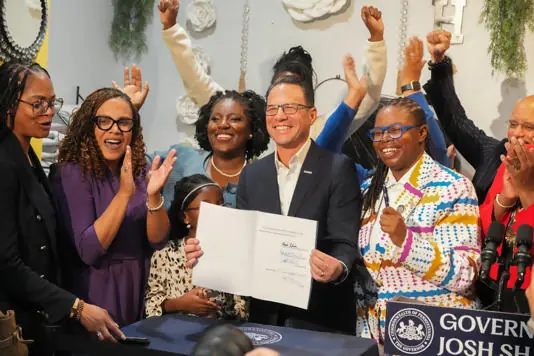
In November 2025, Shapiro signed into law the CROWN Act, a set of laws that prohibits racial discrimination based on hair texture and hairstyles in workplaces and schools.
Also known as Creating a Respectful and Open World for Natural Hair – a name that could have been lifted from a left-wing poetry reading – the signing of HB 439 garnered a lot of attention, with legacy media outlets like AOL and CNN praising its passage as if it was a truly historic piece of legislation.
Which it is not; HB 439 has the feel that it was written by the cosmetics section of a large department store.
“Real freedom means being respected for who you are – no matter what you look like, where you come from, who you love, or who you pray to,” Shapiro said when he signed the bill. “For too long, many Pennsylvanians have faced discrimination simply for hairstyles that reflect their identity and culture – that ends today.”
To bolster its hairstyle-as-discrimination case, the state cited 916 hair discrimination complaints filed in 2022 through the Pennsylvania Human Relations Commission (PHRC).
All along I thought that the ‘hair question’ in society was settled way back in 1967 after the Broadway debut of the musical HAIR:
A home for fleas (Yeah)
A hive for bees (Oh yeah)
A nest for birds
There ain’t no words
For the beauty, the splendor, the wonder of my
Hair, etcetera.
Pennsylvania is the 28th state to pass this hairy legislation. HB 439 received bipartisan support although the CROWN Act is the law in mostly blue states. HB 439 even lists the troublesome hairstyles that have resulted in discrimination: locs, braids, twists, coils, Bantic knots, afros, and extensions. Some of the hairstyles listed I’ve never heard of; most are so intricate they must take multiple hours to create.
I’ve no doubt most Americans associate dreadlocks with BLM activists and/or white lefty radicals who see hair as a romantic component to any socialist revolution. (A lock snipped from Che Guevara’s hair after his death in 1967 sold for $100,000 at a Houston auction in 2007.)
The historic stereotype of an angry radical black man in dreads raising his fists and shouting revolutionary slogans was not born out of thin air, despite the fact that times are different now.
Hakeem Jeffries (bald) and Cory Booker (balding) are two black Democrats who have opted for hair normalcy while maintaining a radical “dreadlock” state of mind.
Come to think of it, Hussein Barrack Obama (balding) might also be said to be a member of this radical dreadlock state of mind.
While reading about HB 439, it occurred to me that if one were to publish a history of radical-political Philadelphia hairstyles, there’d have to be a chapter about the back-to-nature group MOVE. This colony of dreadlock-wearing black revolutionaries harassed their West Philadelphia neighbors, both black and white, throughout the 1970s and ‘80s until the city’s exasperated black mayor, Wilson Goode (with short black hair), ordered police to drop a bomb on the MOVE compound.
While the mayor’s decision was a foolish one, the situation pointed to the power of a cult that came to believe American society was evil; to demonstrate this fact and show how much contempt the cult had for the country, its members all grew their hair in long unwashed dreadlocks.
Dreadlocks as a statement; political philosophy in a weave.
In Philadelphia at least, this is when dreadlocks became a symbol for anarchy, dirt, violence, and revolution. Newsflash: You’re not going to erase this association in the public mind by passing bills such as HB 439.
Regardless of what Governor Shapiro says, certain hairstyles can signal dangerous political proclivities.
Rainbow-colored hair signifies a white liberal female progressive who may have celebrated the death of Charlie Kirk. Nose rings also tend to symbolize membership in the leftist tribe. Call these the signs and symbols of the age. Employers, however, needn’t worry too much about the new hair law, mainly because if they don’t want a dreadlock-wearing man or women in their work- space, they’re still free to conjure any excuse why a person is not “hirable.”
The CROWN Act is a curious piece of legislation in that one of its unintended benefits is that it gives unattractive black women – who compensate for their plain looks by creating elaborate and outrageous hair styles – a measure of security.
As one quote goes: “Life isn’t perfect, but your hair can be.”
Experience tells me that classically beautiful black women are less likely to create elaborate, eye-popping (or even grotesque) hairstyles. After all, it’s all about deflection: outrageous hair redirects the viewer’s gaze away from the face to the hair; at that point the eye tends to rest on the hair – or the dreadlocks, which would then recall the grunge activism of an organization like MOVE.
As the Bible says, a woman’s glory is her hair, a fact that ironically has been lost on many contemporary (white) TDS feminists who mow their heads down to the roots in buzz cuts.
But there’s another story here. In many ways, the signing of HB 439 signals Governor Shapiro’s shift to the left. Or at least he is more vocal about it now.
In 2022, Muslim communities across the state signed an open letter addressed to Shapiro for not speaking out in support of Gazan civilians. A year later, The Philadelphia Inquirer reported that Shapiro’s views on the Middle East had changed, meaning he was less pro-Israel. In March 2025, came the shocking announcement that Shapiro had visited the Al-Aqsa lslamic Society to announce a $5 million grant (taxpayer money) to the community center there.
Josh Shapiro’s coat of many colors also includes his support of biological men in women’s sports. Although the Pennsylvania Senate approved a bill in May to keep biological males out of women’s and girl’s sports, the bill has been stalled in the Democrat-controlled House. Shapiro has said nothing about the bill and presumably wants to see it die on the vine although it has wide bipartisan support, just like HB 439.
Yet it’s much easier to pass bills about hair, especially when the hair in question involves race (and potential voters) then it is to get momentum around killing the holiest icon in the Democrat Party: the loving embrace of the transgender agenda, which includes the “rights” of biological men to compete in women’s and girl’s sports.
So, yes, ole Josh Shapiro is on a roll. He’s upped his ante. He’s being more vocal now because he is up for re-election next year and he is seen as one of several prominent Democrats eyeing the White House in 2028.
God help us.
He even commented on President Trump calling Tampon Tim Walz “retarded” without commenting on the reasons behind the name-calling, namely the Minnesota fraud scandal involving Somali immigrants charged with stealing from government programs during the pandemic.
With the Democrats, it’s all about using the correct terminology and making the surfaces of things seem polished while ignoring the greater rot underneath.