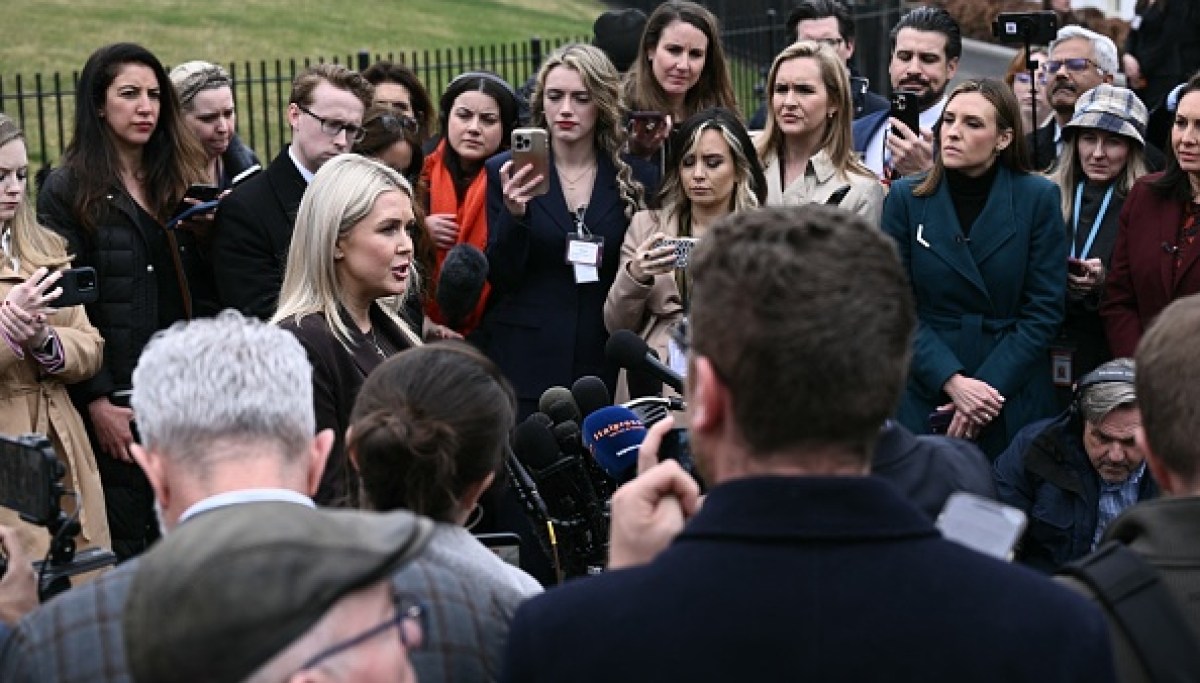
The White House on Friday downplayed the significance of reports that Russia is providing Iran with intelligence about the location of American forces in the Middle East that it is using to carry out retaliatory attacks.
It’s unclear the extent of Russia’s targeting assistance to Iran since the war began nearly a week ago, though it underscores the possible expansion of the conflict to include America’s chief nuclear weapons competitor.
“It clearly is not making a difference with respect to the military operations in Iran because we are completely decimating them,” top White House spokeswoman Karoline Leavitt said on Friday when asked about the story that originally appeared in the Washington Post. “As I said earlier, we’ve taken out nearly 30 of their ships. Their Navy has been deemed combat ineffective. 90% reduction in ballistic missile retaliatory strikes against the United States and our Gulf, Arab, and partners in the region.”
The United States and Israel have struck thousands of targets in Iran, including sinking or destroying more than 30 ships belonging to the Iranian navy. Tehran has retaliated by firing hundreds of ballistic missiles and thousands of drones targeting Israel and countries hosting U.S. bases and personnel, including Kuwait, Bahrain, Qatar, the United Arab Emirates, Saudi Arabia, Jordan, Iraq, and Oman.
“I think it’s really a low-risk, high-reward proposition for Russia,” Grant Rumley, a former Pentagon official, told the Washington Examiner. “A lot of what Iran wants are platforms that Russia would need in Ukraine. And so what they have been able, and what I think is easy for them to provide, is some of the high end boutique electronic warfare capabilities that Iran doesn’t have.”
Moscow’s “dream scenario” in aiding Iran, Rumley surmised, is for the U.S. to get “bogged down in Iran, much the same way Russia is bogged down in Ukraine right now.”
Six American service members were killed on Sunday, a day after the U.S. and Israel commenced their dual wars against Iran, by a one-way drone attack in Kuwait at the Port of Shuaiba.
The troops that were killed were: Capt. Cody A. Khork, 35; Sgt. 1st Class Noah L. Tietjens, 42; Sgt. 1st Class Nicole M. Amor, 39; Sgt. Declan J. Coady, 20. Maj. Jeffrey R. O’Brien, 45. Chief Warrant Officer 3 Robert Marzan, 54, is believed to be the other casualty, but a medical examiner has yet to confirm his identity.
“U.S. combat power is building as Iranian combat power declines,” Adm. Brad Cooper, the commander of U.S. Central Command, said during a press briefing on Thursday afternoon. “Our air dominance allows us to hit Iran’s center of gravity with overwhelming power and reach.”
Earlier this week, War Secretary Pete Hegseth was asked about what he would tell Russia and China, who are among Iran’s most powerful allies, and he said, “They’re not really a factor here.”
Russia and Iran’s defense partnership has expanded in recent years, largely coinciding with Russia’s full-scale war in Ukraine, which began in February 2022.
Tehran provided Russia with hundreds of drones that it has used to target Ukrainian civilian infrastructure and has helped it set up domestic factories to produce them more quickly in exchange for unprecedented defense cooperation on everything from missiles and electronics to air defense.
The U.S. was able to take a fallen Iranian drone and reconstruct its own models, which it used operationally for the first time this week.
“This was an original Iranian drone design. We captured it, pulled the guts out, sent it back to America, put a little made in America on it, brought it back here, and we’re shooting it at the Iranians,” Cooper said.
At the same time, the U.S. has had some issues defending against them. The U.S. is looking to learn from the Ukrainians, given Ukraine’s wartime experience in dealing with Iranian or Russian drones. The head of the Pentagon’s counterdrone task force, Brig. Gen. Matt Ross, was in Ukraine last week before the war in the Middle East began.