The killing of three Americans in Syria by an ISIS fighter over the weekend highlighted U.S. military presence in the Middle Eastern country, more than five years after the territorial defeat of the Islamic State.
There are roughly 1,000 American troops still in Syria, a U.S. defense official told the Washington Examiner on Monday, a reduction from where the tally had been when President Donald Trump returned to office last January.
They are in Syria and Iraq to ensure the lasting defeat of ISIS, and they work with local partners in both countries to help in that effort, but this weekend’s attack raises questions about their mission and whether the presence there is worth the risk.
“I think that it’s too easy for us to forget that having these troops deployed all over the world is costly and risky most of the time,” Rosemary Kelanic, the Middle East Director of Defense Priorities, a think tank that supports a more restrained U.S. foreign policy, told the Washington Examiner. “There aren’t American deaths in Syria. It doesn’t happen that often. And so I think we get lulled into a false sense of security and don’t necessarily realize that we’re taking risks by leaving U.S. forces there indefinitely.”
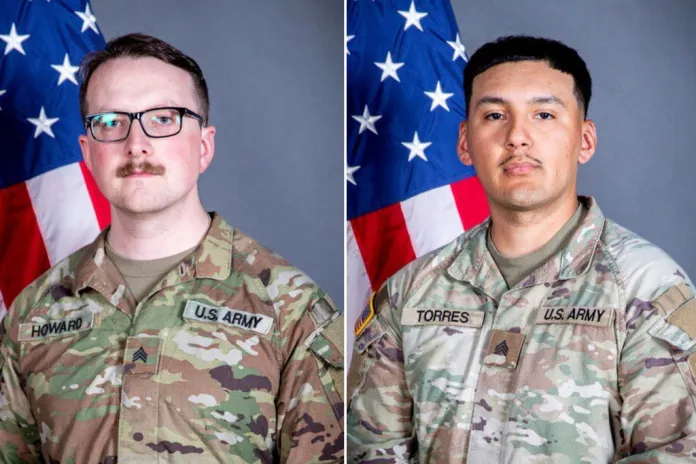
The ISIS fighter killed Sgt. Edgar Brian Torres Tovar, 25, and Sgt. William Nathaniel Howard, 29, as well as an American civilian contractor, whose identity has not yet been released. The ISIS attacker was killed shortly afterward.
The attacker had recently joined Syria’s internal security forces as a base security guard but had been reassigned amid suspicions that he might be affiliated with the Islamic State, according to the Associated Press. Other details about the perpetrator’s ties to ISIS remain unclear, and the attack is under investigation.
“I think it will likely catalyze a larger conversation about larger concerns about U.S. force posture and the security of the U.S. forces operating in Syria, because the advise, assist, enable approach that the U.S. has used for years now in the D-ISIS campaign, comes with the benefit of a smaller footprint, but it also means these troops can be at risk of being more isolated and potentially vulnerable,” Cameron McMillan, a senior research analyst at the Foundation for the Defense of Democracies, told the Washington Examiner.
The ambush, as U.S. Central Command described the attack, occurred in Palmyra, a city in central Syria, which is notable because that’s an area that former Syrian Dictator Bashar al-Assad had controlled.
Both President Donald Trump and Secretary of War Pete Hegseth have said the U.S. will carry out retaliation for the attack.
“He has been clear that there will be very serious retaliation,” a White House official told the Washington Examiner. “The United States will hold all who hurt and threaten Americans accountable.”
U.S. forces, along with their Syrian counterparts, routinely carry out missions targeting ISIS leaders, and have for years to ensure ISIS cannot reconstitute. The U.S. “advised, assisted and enabled more than 22 operations against ISIS with partners in Syria” resulting in the killing of five ISIS members and 19 more who were detained from Oct. 1 to Nov. 6, according to CENTCOM.
The Pentagon announced in April that it would consolidate U.S. forces, both in terms of numbers and bases, in Syria, but did not provide many specific details. Pentagon chief spokesman Sean Parnell said at the time that this would be a “deliberate and conditions-based process that will bring the U.S. footprint in Syria down to less than a thousand U.S. forces in the coming months.”
U.S. troops in Iraq and Syria have frequently come under attack in the last couple of years. Still, the perpetrators have largely been Iranian-aligned militias operating in Iraq and Syria, carrying out these attacks in the aftermath of Hamas’s Oct. 7, 2023, attack on Israel, and Israel’s subsequent wars in Gaza and Lebanon at that time.
The Trump administration has sought to shift the U.S.-Syria relationship following last year’s collapse of the Assad regime. The country’s new leader, Ahmed al Sharaa, was previously an al-Qaeda insurgent imprisoned in Iraq by U.S. forces.
al Sharaa has quietly been a partner for the U.S. in the “defeat ISIS” mission since coming to power, and last month, he signed a declaration of political cooperation to support the effort, but this weekend’s attack will be a major test for the nascent governing body.
There could be additional attacks on U.S. forces in Syria, Brian Carter, an expert with the American Enterprise Institute, told the Washington Examiner, arguing that ISIS could try more of these attacks to sour the U.S.-Syria relationship.
“I think ISIS would ideally like to conduct more of these insider attacks… to degrade the trust between Damascus and Washington, but also degrade the trust on the tactical level between American soldiers and their Syrian counterparts,” he said.
While ISIS no longer holds territory as it did a decade ago, the group has sought to inspire lone individuals all over the world to carry out attacks. The U.S. has been able to thwart some attacks by informing local officials prior to attacks, but has also failed to stop some.
In March 2024, ISIS took credit for carrying out a large terrorist attack on the outskirts of Moscow, Russia, in which four gunmen opened fire at the Crocus City Hall, a crowded concert venue, killing at least 137 people and injuring more. The U.S. warned Russia that ISIS-K, an affiliate of the group, was planning to carry out an attack. A couple of months later, the U.S. helped thwart an ISIS-inspired attack at a Taylor Swift concert in Austria.
On New Year’s last year, a lone man drove through a crowded street in New Orleans, killing 14 people. U.S. authorities found an ISIS flag in the perpetrator’s vehicle.