Order Jamie Glazov’s new book, ‘United in Hate: The Left’s Romance with Tyranny, Terror, and Hamas’: HERE.
The Islamic Republic of Iran is in full crisis mode with nationwide protests and teetering economy, so now the regime has issued a unilateral declaration that the “entire Islamic world” will respond with “an issuance of a ‘jihad ruling’ in the event of an attack on its supreme leader Ayatollah Khamenei”: “Iranian Lawmakers Warn Attack on Khamenei Would Mean War With ‘Entire Islamic World,” Al Arabiya, January 20, 2026:
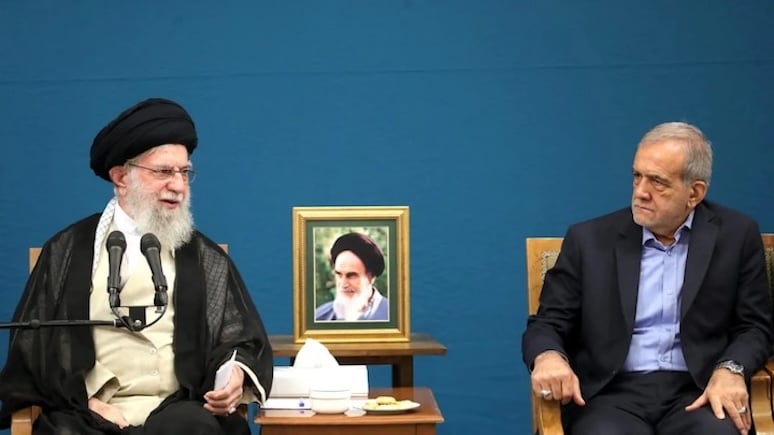
Iranian lawmakers warned on Tuesday that any attack on Supreme Leader Ali Khamenei would amount to a declaration of war “against the entire Islamic world” and would lead to the issuance of a “jihad ruling.”
Tensions between Iran and the United States have escalated following Tehran’s deadly crackdown on anti-government protests, which US President Donald Trump has warned could prompt Washington to intervene to aid protesters.
For all the latest headlines follow our Google News channel online or via the app.
Iran’s semi-official ISNA news agency quoted the parliamentary National Security Committee as saying that “any attack on the supreme leader means declaring war against the entire Islamic world,” adding that those responsible should expect a “jihad ruling from Islamic scholars” and a response from what it called “the soldiers of Islam” worldwide.
Iranian President Masoud Pezeshkian issued a similar warning on Sunday, saying that any attack on Khamenei would constitute a declaration of war.
“An attack on the great leader of our country is tantamount to a full-scale war with the Iranian nation,” Pezeshkian said in a post on X, in what appeared to be a response to Trump’s remarks calling for new leadership in Iran…
How seriously should the threats from the National Security Committee and Pezeshkian be taken? A point to remember: Pezeshkian signaled earlier in January “that the crisis maybe rapidly moving beyond officials’ control,” adding: “We should not expect the government to handle all of this alone… The government simply does not have that capacity.” It wasn’t clear at the time whom Pezeshkian might have had in mind about aiding Iran, and he was issuing what was obviously a desperate plea for help, but now it’s apparent that he is looking to the entire Islamic world to respond by issuing a jihad decree if Khamenei is attacked. How likely, however, is it that the “entire Islamic world” would respond to an attack on the Islamic Republic?
Robert Spencer observed: “Trump’s weakness and empty threats have emboldened the Islamic Republic, but they’re still wary, and figure he can be cowed into inaction with threats of their own. They’re probably right about that. Meanwhile, whether the Sunni world would really take up jihad for Shi’ite Iran is questionable, at best.”
Few things are more pathetic than being emboldened but also weak, which describes the current state of the Islamic Republic. And Iran is well aware that Trump’s threat still looms, even as protesters are expressing their deep sense of betrayal in light of Trump’s inaction. Trump recently seemed to keep the door open to action:
US President Donald Trump on Saturday called for an end to Ali Khamenei’s reign in Iran, responding to comments by the Supreme Leader who blamed Trump for the protest deaths in Iran.
“It’s time to look for new leadership in Iran,” Politico quoted Trump as saying.
He said Iran… pic.twitter.com/2cgodj0s34
— Iran International English (@IranIntl_En) January 17, 2026
Also, Iranian Crown Prince Reza Pahlavi is ready to head a caretaker government in Iran once the Islamic Republic falls:
The battle in Iran today is between occupation and liberation. The Iranian people have called for me to lead.
I will return to Iran. pic.twitter.com/V0JEVs55cw
— Reza Pahlavi (@PahlaviReza) January 18, 2026
The Islamic Republic of Iran is not only desperate; it’s isolated. The Sunni world is unlikely to take up jihad for Iran. Although Saudi Arabia, one of the world’s leading Sunni countries, has told Tehran that “it will not be part of any military action taken against it, and that its territory and airspace will not be used for that purpose,” the Saudis have opted to take a “very strategic and safe approach” to Iran. Likewise, Turkey has not endorsed the protesters, but neither has it backed Tehran’s brutal crackdown. Turkish President Recep Tayyip Erdogan has only warned ambiguously that “foreign intervention in Iran could spark wider turmoil in the region.”
And for the Shia world, it has always been unsettled toward Ayatollah Khamenei, who is a Marja, the highest religious authority in Shia Islam, providing authoritative interpretations of religious law for Shi’ites; however, longtime controversies haunt Khamenei. His appointment as Marja only came after a long, drawn-out debate, and before that, he had already earned the mocking titles of the “Overnight Ayatollah” and “Ayatollah in a Prance.” Khamenei’s religious credentials were widely deemed inferior
The enduring controversies and disapproval of Khamenei — from the beginning of his career up to now — somewhat mitigate the threat from the regime about the “entire Islamic world” coming to the regime’s rescue. Although the ayatollah holds significant authority as the supreme leader of Iran, he lacks unified allegiance and respect across the Shia world. Shortly after Khomeini’s death in 1989, Iran’s Assembly of Experts approved of Khamenei’s succession. The head of the Assembly of Experts, Akbar Hashemi Rafsanjani, sold acceptance of Khamenei as a matter of honoring the dying wish of Khomeini. By a vote of 60 to 14 Khamenei became supreme leader, while Rafsanjani became known as Khamenei’s “kingmaker.”
Khamenei’s rise to power “raised the ire of the country’s clerical elites in Qom.” It was the Islamic Republic’s political elites that rallied behind Khamenei. Eventually, even the Rafsanjani-Khamenei bond soured, as Khamenei grew increasingly hardline.
Khamenei has proven to be an utter failure. His hardline policies are a source of wide disagreement across the Shia world, along with Iran’s deplorable human rights record and the regime’s savage crackdown on internal protests; nonetheless, the regime clings to power at immense cost. Iran International now puts the death toll at over 16,000 murdered by the regime and at least 330,000 injured, according to reports compiled by doctors. This video gives insight into what is happening inside Iran:
A woman calls into the Persian Manoto News program, saying she is the daughter of a senior commander inside Iran.
Very disturbing conversation. pic.twitter.com/KmrPy9oLPd
— Open Source Intel (@Osint613) January 15, 2026
A recent viral video featured an Iranian Shia cleric denouncing the brutal regime as “criminal” and “murderous,” and calling on the people of Iran to “rise up against the system founded by Khomeini”:
Shia cleric speaking in Farsi, urging Iranians to rise up and actively fight against the current Islamic regime. He expresses strong support for the ongoing anti-regime protests and identifies Ayatollah Khomeini as the primary dictator responsible for initiating all of Iran’s… pic.twitter.com/IZOi26RNFx
— Open Source Intel (@Osint613) January 7, 2026
Over 90% of Iranians are Shia according to the US Department of State website as of 2022, and they are pleading for regime change. As one Iranian voice put it: “We are 90 million prisoners in Iran, and we need support.”
When Pezeshkian became president, I stated in a previous Jihad Watch post: “Many among wishful thinkers believe that the newly installed president of Iran, Masoud Pezeshkian, is a ‘moderate’ or ‘reformist.’ Like all of his predecessors, Pezeshkian is nothing more than a puppet of the Supreme Leader of the Islamic Republic of Iran, the Ayatollah Khamenei. Pezeshkian has virtually admitted this as he explains how he selected his cabinet, as the selections weren’t really his choice. The president of Iran is merely a functionary of the Supreme Leader.” See more here: “‘Don’t be fooled’ by Iran’s ‘bogus election of a puppet president.’”
In Iran’s current crisis, as the regime is showing the world its true self, Iranians are responding to Pezeshkian as the puppet president he always was, contrary to Western references to him as “reformist.” His warning that any attack on Khamenei would amount to “full-scale war” “prompted sharp criticism from Iranians who say the statement ignores the killing of protesters during recent nationwide unrest.” He also continues to face vilification from his own people on social media. Iran Wire reported:
Ali Sharifi Zarchi, a professor at Tehran’s Sharif University of Technology, wrote in response, “Curse the bloodthirsty regime that massacred thousands of Iranians. Curse the executioner Khamenei, whose only rival in killing Iranians in contemporary history is Saddam Hussein. Curse you and all the perpetrators of this massacre against the people.” Musician Arash Sobhani also addressed Pezeshkian directly, writing: “You have orchestrated the largest slaughter of Iranians in contemporary history.”
The Western world should not forget that the Islamic Revolutionary Guards Corps follows a Twelver Shia doomsday vision of an apocalypse. The hidden Twelfth Imam, Muhammad al-Mahdi, plays a dominant role in the official religion of Iran, Twelver Shi’ism. There is a messianic belief that at the end of days, al-Mahdi will appear in the midst of a violent apocalyptic scenario played out on a battleground stained with infidels’ blood. This messianic figure is believed to be the one to establish a global Islamic caliphate. The regime views its hostile policies, and its approach to America and the annihilation of Israel, as key in contributing to the conditions for the Mahdi’s reappearance.
How does one reconcile the crisis in Iran with the Twelver Doomsday belief? For one thing, it keeps the hardline Islamic regime emboldened and motivated; even if it falls short of its goal of galvanizing support across the Islamic world to wage jihad in its defense, it will certainly succeed in alerting the Islamic world to shore up defenses against the infidels. In the event of the regime’s fall, the global jihad must not be stymied in its relentless zeal for “martyrdom” and the expansion of the hegemony of Sharia
The Palestinian “resistance” (from the River to the Sea) remains the central cause to the Muslim ummah, as does Islamic supremacism and dedication to restoration of a global caliphate.
In October, Iran and Turkey discussed military cooperation, and signaled their intent to build a stronger regional security partnership. Let’s also not forget that Iran, Turkey, Qatar and even Saudi Arabia have been supporters of Hamas. The global Islamic jihad is alive and well, and schisms in Islam are as old as Islam itself; Muslims are well known to have murdered other Muslims by the droves in the name of their religion.
With respect to the Islamic Republic of Iran, it will not go down without a fight, backed by its religious zeal; nor will it discard its the Twelver doomsday beliefs; however, whether the Khamenei regime will survive is another question. It is now as fragile as it has ever been since the 1979 Revolution. It has never stood before the world as weak and humiliated as it is now. Its chances of ultimate survival look slim – and it remains uncertain whether the entire Islamic world will come to its defense.