Order Jamie Glazov’s new book, ‘United in Hate: The Left’s Romance with Tyranny, Terror, and Hamas‘: HERE.
With each ballistic missile or drone that Iran launches against the Arab states of the Gulf, those states draw closer to Israel. For it is Israel that in defending itself by bombing Iran’s ballistic missile arsenal, its ballistic missile production plants, its storehouses of drones and drone manufacturing plants, as well as the senior leadership of the Islamic Revolutionary Guard Corps and the Basij, is also protecting those Arab states from an aggressive Iran that has been attacking all of them — Qatar, the UAE, Saudi Arabia, Bahrain, Kuwait, and Oman — with great intensity.
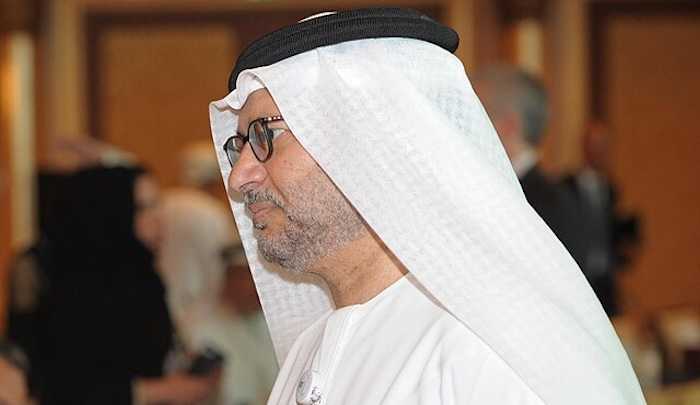
Anwar Gargash is a senior adviser to the UAE’s president who recently addressed the Council of Foreign Relations. He concludes, unsurprisingly, that Iran’s attacks on the Gulf states is pushing them closer to Israel. More on his address can be found here: “Senior UAE official says Iranian attacks will drive Gulf countries into Israeli arms,” by Lazar Berman, Times of Israel, March 18, 2026:
A top adviser to the United Arab Emirates’ president said on Tuesday that Iran’s attacks on Gulf states are pushing them closer to Israel and to the US.
“Iran’s full-throttle attack on the Gulf states will actually strengthen the Israeli role in the Gulf, will not diminish it,” Anwar Gargash said during a Council on Foreign Relations event.
“For countries that have relations with Israel, this is — you know, this relationship, in my opinion, will be even more strengthened,” he continued. “For countries that don’t have, I expect… that more channels will be open.”
Israel normalized relations with the UAE and Bahrain, another Gulf country, in 2020.
Since the US and Israel opened their aerial campaign against Iran on February 28, Tehran has attacked airports, ports, oil facilities and commercial hubs in the six Gulf states with missiles and drones while also attacking Israel and disrupting shipping through the Strait of Hormuz — the artery carrying about a fifth of global oil and underpinning Gulf economies.
The attacks have reinforced Gulf fears that leaving Iran with any significant offensive weaponry or arms manufacturing capacity could embolden it to hold the region’s energy lifeline hostage whenever tensions rise.
However, they have not joined any attacks themselves, as Gulf leaders remain deeply fearful of triggering a broader, uncontrollable conflagration.
Gargash said at Tuesday’s online event that his country could join an international effort led by the US to ensure the safety and security of the Strait of Hormuz.
The next day saw a major Israeli strike on the largest gas field in the world….
Just as the Gulf Arab states are drawing closer to Israel, so they have as well an enhanced appreciation for America’s ability to destroy Iran’s military infrastructure. Together, the “two best air forces in the world” — as Trump and Hegseth have called them — are wreaking havoc in Iran, with the Islamic Republic unable to mount anything more than the most minimal of air defenses. So far, not a single Israeli or American plane has been shot down, though one American Stealth fighter jet was hit and had to land quickly at a friendly airport.
Over the years, Iran and its regional allies have been accused of attacks on Gulf energy installations, not least a 2019 strike on Saudi Arabia’s Abqaiq and Khurais oil facilities — for which Iran denied responsibility — that halved Saudi output and rattled energy markets.
The Iranian strike in 2019 on Saudi Arabia’s oil production facilities at Abquaiq and Khurais showed Riyadh just how vulnerable Saudi oil fields are to Iranian attack; half of Saudi oil output was put offline, and it took two to three weeks for full production to be restored.
The six members of the Gulf Cooperation Council — Bahrain, Kuwait, Qatar, Saudi Arabia, Oman and the UAE — have held just one Zoom call, and no Arab summit has been convened to discuss coordinated action.
So far, there has indeed been no strictly Arab summit — a meeting of the Arab League — but on March 18, foreign ministers from both Arab and Muslim states met in Riyadh to collectively denounce Iran’s attacks on the energy sites (oil, natural gas) of Gulf Arab states. These countries included Saudi Arabia, Bahrain, Kuwait , Qatar, and the UAE, as well as Arab states outside the Gulf —Egypt, Jordan, and Lebanon — and three non-Arab states, Azerbaijan, Pakistan, and Turkey.
Now, with each new attack on their countries by Iran, Gulf Arab states have become ever more convinced of the mad malignity of Iran, and with each new IDF attack on Iran’s missiles and other weaponry, ever more certain that Israel is their surest protector. It’s quite a feat, in the annals of own-goal-making, to bring Israel and the Gulf Arab states closer together, but the Islamic Republic has shown itself equal to the task.
Photo credit: Nathalie Goulet, Creative Commons Attribution 2.0.