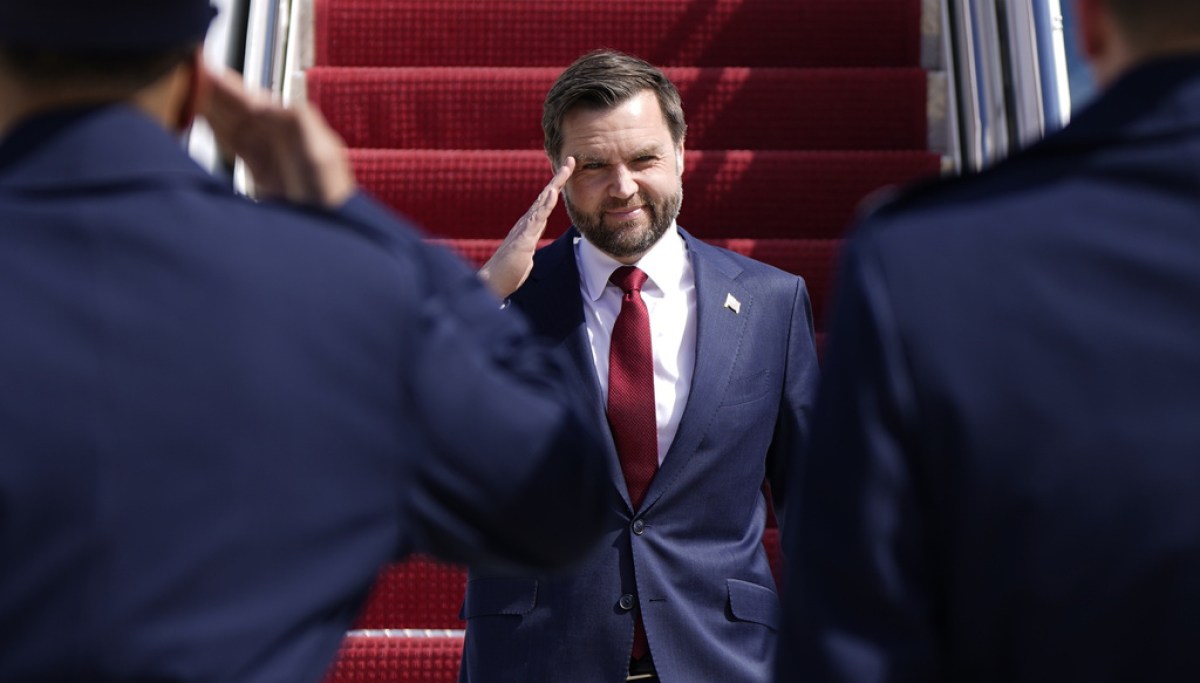
Vice President JD Vance is facing an early test of his 2028 bona fides thanks to the Iran war, attempting to navigate the need to defend an administration taking military action abroad while still appealing to a base long skeptical of foreign intervention.
Vance has moved quickly to project unity with President Donald Trump, stepping into a visible public role, carefully avoiding any hint of internal disagreement.
He has appeared in a steady drumbeat of public events, including a March 2 television interview, dignified transfers on March 8 and 9, and a series of speeches, visits, and press interactions in the days that followed. At each turn, Vance has defended the administration’s approach and forcefully pushed back against suggestions that his past skepticism of foreign intervention puts him at odds with the president.
“I know what you’re trying to do,” Vance said this week when pressed by reporters. “You’re trying to drive a wedge between members of the administration, between me and the president.”
Behind the scenes, the vice president was also deeply involved. According to a source familiar with the matter, Vance was fully integrated into the planning process and monitored the execution of the initial operation from the Situation Room, remaining in Washington due to security protocols designed to prevent both the president and vice president from being in the same location.
The approach reflects a deliberate strategy: stay visible, stay aligned, and shut down any narrative of division. But whether Vance is navigating a genuine political tightrope or a media-driven one is now a matter of dispute inside Trump’s orbit.
Long seen as a leading voice of the Republican Party’s more skeptical, non-interventionist wing, the Marine veteran is now defending an administration willing to use force abroad, a shift that carries political risk even as it reinforces his standing within the president’s inner circle.
The moment reflects a broader debate inside Trump’s political coalition. A defining theme of Trump’s rise was opposition to “endless wars” and a promise to avoid the kind of prolonged Middle East conflicts that shaped earlier Republican administrations.
That instinct has not disappeared. Some prominent voices aligned with the MAGA movement have raised concerns about the strikes, warning that deeper U.S. involvement risks drifting away from the “America First” approach that helped power Trump’s political rise.
A source close to the White House disputed that characterization, arguing that the idea of a “balancing act” is overstated and driven more by media narratives than voter sentiment. The source said Republican voters who make up the party’s core base broadly support the administration’s actions, and that criticism is largely coming from a small group of commentators rather than rank-and-file voters.
“I don’t think there is really a balancing act to play,” the source said. “He’s doing his job.”
The source also pushed back on how the “base” is often defined, arguing that reliable Republican voters, not political pundits, overwhelmingly back the administration’s approach.
Former Rep. Marjorie Taylor Greene (R-GA), who has broken with Trump over the past year, cautioned in an interview with CNN that the conflict could carry political risks if it drags on. “The longer it goes on, it definitely does hurt JD Vance,” she said.
Conservative commentator Tucker Carlson has also criticized the war, at one point describing it as “disgusting and evil,” reflecting a strain of skepticism that still runs through parts of the Republican base.
Vance’s own rhetoric in the past sounded similar. During the 2024 campaign, he warned against a broader conflict with Iran.
“Our interest, I think very much, is in not going to war with Iran,” Vance said on an October 2024 podcast, cautioning that such a conflict would be a costly distraction for the United States.
At the same time, he has consistently left the door open to military action under certain conditions. In a July 16, 2024, interview with Sean Hannity, Vance said that if the U.S. were to strike Iran, it should do so decisively, pointing to the Trump administration’s killing of Iranian Gen. Qassem Soleimani. And in a July 2024 interview with Morgan Ortagus, he warned that future leaders would face “very costly decisions” to prevent Iran from obtaining a nuclear weapon.
More recently, speaking at the Munich Leaders Conference last May, Vance emphasized that preventing Iran from acquiring a nuclear weapon remains a non-negotiable priority for the administration, even as military escalation remains an option of last resort.
“This definitely puts Vance in a corner,” a GOP strategist said, speaking on the condition of anonymity to reflect candidly on internal dynamics. “I think this only creates problems for Vance and helps to elevate Marco Rubio.”
The same strategist added that the moment is also shifting attention elsewhere. “It’s giving Rubio a platform,” the strategist said. “He’s getting more oxygen right now.”
Even so, most Republicans and strategists say the party’s broader shape remains largely intact, at least for now.
“I don’t see it affecting it at all on the current trajectory,” Republican strategist Ford O’Connell said. “This is the party of Donald J. Trump, and whoever he endorses will be the 2028 Republican presidential nominee.”
The White House dismissed the idea that the conflict has political implications for the next presidential race.
“The president has assembled an all-star team that has achieved unprecedented success in just over one year. No amount of crazed media speculation about 2028 will deter this Administration’s mission of fighting for the American people,” said Steven Cheung, assistant to the president and White House director of communications.
That reality has given Vance both a cushion and a constraint. On one hand, early polling continues to show him with a commanding lead over potential rivals. On the other, his role as vice president leaves little room to deviate publicly from the administration’s position.
A source close to the White House described that dynamic as straightforward: the president sets the course, and the vice president is expected to carry it out publicly, even while offering private counsel behind the scenes.
Outside the administration, Matthew Bartlett, a Republican strategist and former Trump administration official, described a similar reality.
“He has one job, and that is to follow the leader,” Bartlett said. “We have never had a schism between a vice president and president, much less publicly.”
“He has one job, and that is to follow the leader,” said Matthew Bartlett, a Republican strategist and former Trump administration official. “We have never had a schism between a vice president and president, much less publicly.”
Vance has leaned into that role in recent days, declining to discuss his private advice to Trump and emphasizing the administration’s consistent position that Iran must not obtain a nuclear weapon. At the same time, the conflict has resurfaced a familiar, yet unresolved, divide within the Republican coalition.
Bartlett described it as one of the more significant ideological splits inside the modern GOP, even if it has yet to translate into a political rupture.
“The winning MAGA coalition was diverse, not just demographically, but ideologically,” he said. “You had traditional foreign policy voices and more isolationist voices.”
That divide has yet to show up in a meaningful way among Republican voters.
“There’s a narrative in Washington that Republicans are dividing over foreign policy. That’s just not true,” GOP strategist Dennis Lennox said. “MAGA voters overwhelmingly support what President Trump is doing in Iran.”
Polling appears to back that up. A recent CNN survey found that 77% of Republicans approve of the strikes, with MAGA Republicans even more likely to strongly support the decision.
That support has helped insulate both Trump and, by extension, Vance in the early stages of the conflict, reinforcing the central role the president continues to play in shaping the party’s direction.
Even so, some Republicans say the political implications for Vance are ultimately tied less to positioning and more to the outcome of the conflict itself. As vice president, he is closely identified with the administration’s decisions, leaving little room to distance himself if the situation deteriorates, even as his past skepticism of foreign intervention lingers in the background.
For now, few see a clear opening for an outside contender to break through, particularly one running explicitly against U.S. involvement abroad.
O’Connell said there is not enough opposition within the party to reshape the field, particularly as long as Trump maintains strong support among Republican voters. “There isn’t enough non-interventionist [sentiment] to weed that out,” he said, noting that the dynamic would likely only change if the conflict “goes horribly sideways.”
RUBIO GAINS GROUND IN 2028 JOCKEYING AS IRAN WAR ELEVATES HIS PROFILE
Bartlett struck a similar note. “Possible, but not likely,” he said, pointing to Trump’s continued dominance within the party as a limiting factor for any outside candidate.
Instead, the moment is less about early positioning and more about how the conflict itself unfolds.
“If this gets longer or uglier, the divisions will deepen,” Bartlett said.