Order Jamie Glazov’s new book, ‘United in Hate: The Left’s Romance with Tyranny, Terror, and Hamas’: HERE.
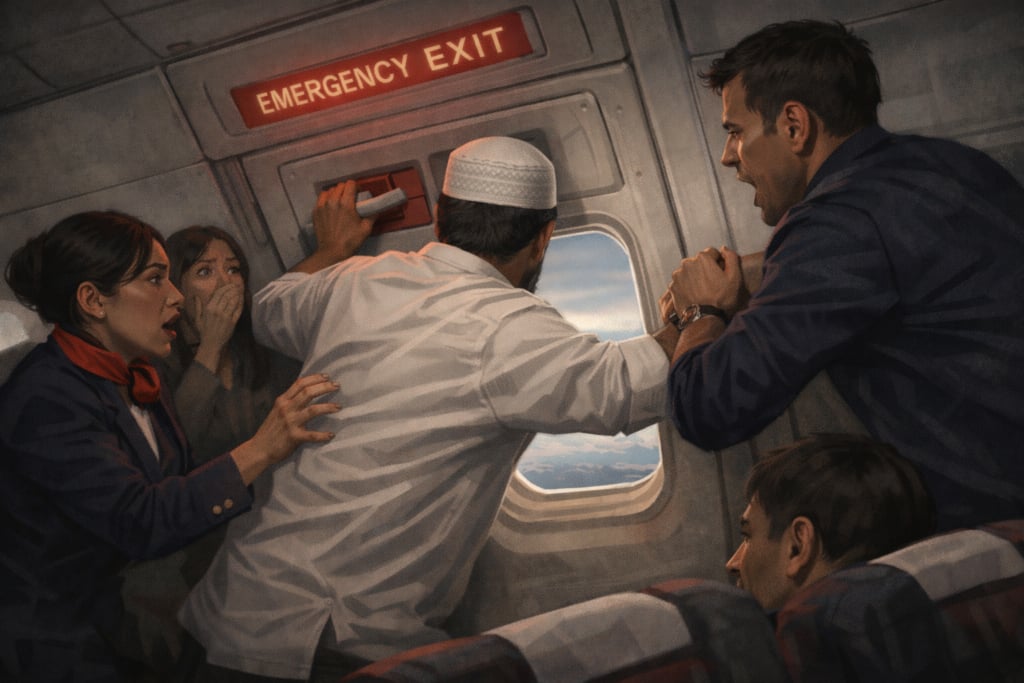
A routine domestic flight became tense after a Muslim passenger tried to open the emergency exit door twice, requiring crew intervention and an aborted landing on March 29, 2026. The incident on an IndiGo flight from Bengaluru to Varanasi shows the unpredictable nature of aviation threats, from disruptions by jihad-minded individuals to global attacks.
Mohammad Adnan from Uttar Pradesh’s Mau district was traveling for personal reasons and boarded the flight without any initial issue. The flight departed normally from Bengaluru, and was calm for the first several minutes. About 15 to 20 minutes in, the crew noticed strange movement near an emergency exit, as Adnan attempted to tamper with the door. Flight attendants intervened quickly, preventing further disruption. Passengers nearby grew anxious, but the crew calmly contained the situation. When questioned, Adnan claimed it was accidental or due to curiosity. He was warned and monitored for the rest of the flight.
The situation seemed stable for a while. The flight continued without incident until descent into Varanasi at about 500 feet. Adnan tried to open the emergency exit again. This time, the cabin crew alerted the cockpit, and pilots aborted the landing.
In aviation terms, the aircraft executed a “go-around,” which means the pilots aborted their initial landing approach and climbed back into the air to gain safe altitude before attempting another landing. These are standard safety procedures, typically carried out in response to technical issues or problems with the runway, and not usually because an Adnan chose to interfere with the flight’s mechanism. The decision underscored the seriousness of the threat that the crew perceived.
The flight, carrying over 100 passengers, experienced moments of panic as repeated attempts to tamper with the emergency exit unsettled those on board, leaving many shaken before the crew brought the situation under control.
The aircraft eventually landed safely at Lal Bahadur Shastri International Airport after the situation was brought under control. Adnan was immediately detained by security personnel and handed over to authorities for further questioning. During interrogation, he reportedly claimed that he had been “possessed by a ghost,” implying that the ghosts were trying to open the door. Though it may seem comical to many, it could equally be a calculated attempt to portray mental instability and thereby evade scrutiny or diminish the gravity of the incident, as has been seen in multiple cases where Muslims have resorted to such excuses after being caught engaging in violent, nefarious, and jihadist acts.
While the incident was serious, the likelihood of actually opening an aircraft door mid-flight is extremely low. Modern commercial aircraft are equipped with plug-type doors, which are fitted into the aircraft frame so that cabin air pressure pushes them tightly against their frames, making them impossible to open when the aircraft is pressurized and at cruising altitude. At those heights, the difference between internal and external pressure creates a force so strong that no human can physically open the door. Even during descent, multiple locking mechanisms and detailed safety protocols make accidental opening highly unlikely. Maybe curious Adnan wasn’t well versed with the physics involved here.
However, the danger lies not just in the act itself, but in the potential chain reaction it could trigger, and the intent. If a door were somehow compromised, it could lead to rapid decompression, a violent release of cabin pressure that can cause oxygen levels to drop instantly, disorient passengers, and potentially injure those seated nearby. Loose objects could be sucked toward the opening, and the aircraft would be forced into an emergency descent. Even an attempted breach, as seen in this case, can distract the crew during critical phases of flight, increasing overall risk.
The incident also brings to the fore the discussion that the aviation industry, even 25 years after the defining moment of September 11, remains vulnerable to jihadist attacks. Particularly after 2010, Islamic groups have increasingly targeted airports and aviation hubs. The Jinnah International Airport attack in 2014, the Metrojet Flight 9268 bombing in 2015, the Brussels Airport bombing, and the Istanbul Atatürk Airport attack in 2016 were all carried out by Islamic jihad terror organizations.
A growing number of incidents now involve disruptive individuals rather than organized groups. In one case, a London-based Muslim man of Pakistani origin threatened cabin crew mid-flight, while another incident near Kempegowda International Airport in Bangalore saw a Muslim man attempt a knife attack outside the premises.
The Bengaluru–Varanasi flight incident may not have been a coordinated attack, yet it triggered emergency procedures, endangered passengers, and tested airline preparedness, reminding us that aviation will remain a target for jihadis and fanatics, whether they come armed with explosives and firearms, or just with an ill intent to cause panic and harm.
Photo Credit: Wikimedia Commons.