Order Jamie Glazov’s new book, ‘United in Hate: The Left’s Romance with Tyranny, Terror, and Hamas’: HERE.
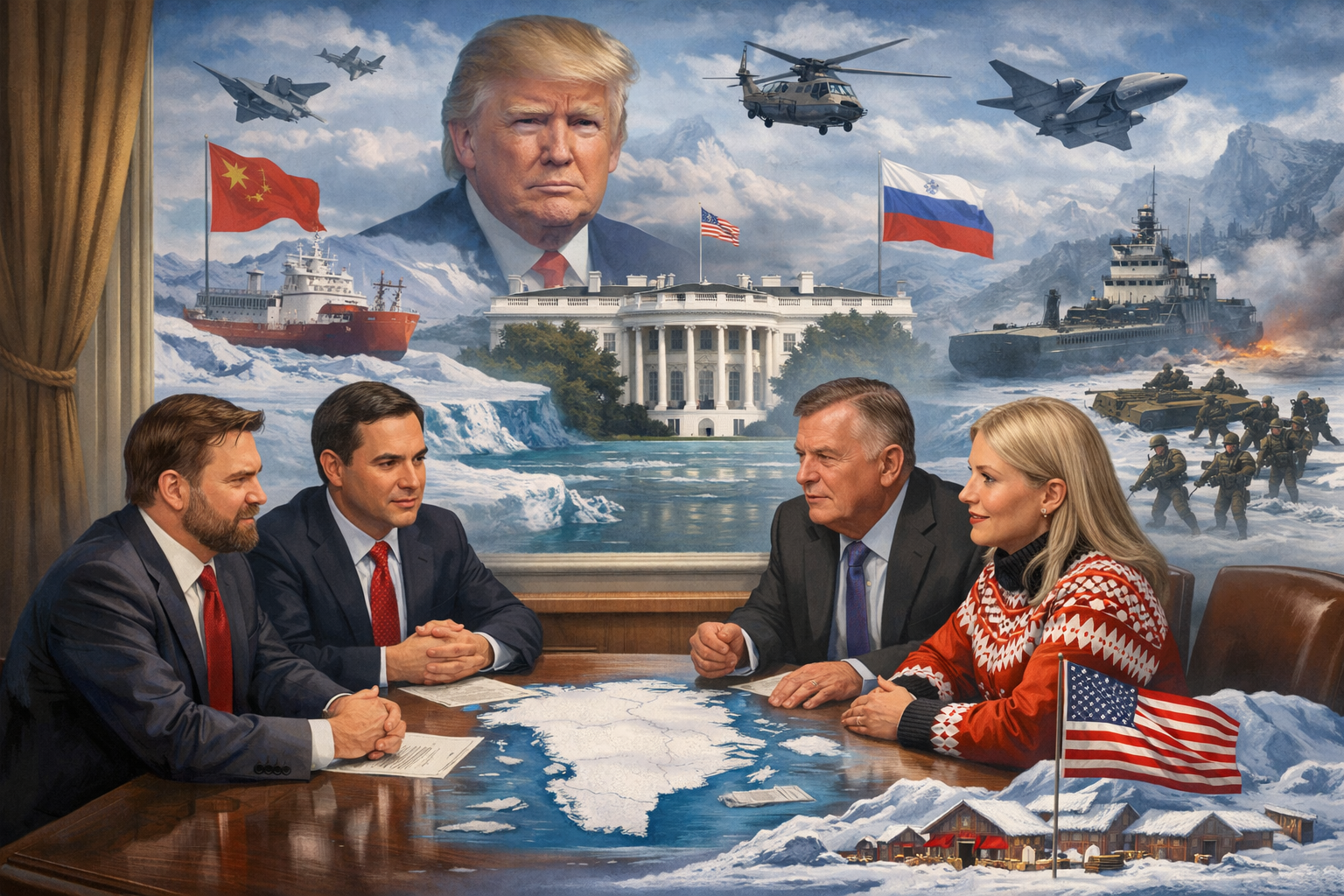
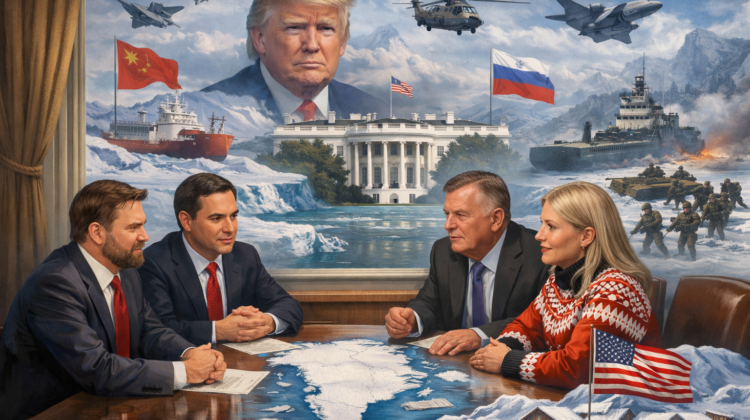
Today in Washington, J.D. Vance and Marco Rubio will meet with Denmark’s Foreign Minister, Lars Løkke Rasmussen, and Greenland’s Foreign Minister, Vivian Motzfeldt, to discuss an issue that hasn’t been on the front burner in the U.S. but that has pushed almost everything else out of the headlines in Denmark and, certainly, in Greenland.
That issue, of course, is the fate of Greenland, which Denmark owns and which Trump wants to annex so that America – rather than China or Russia – can dominate the Arctic. Will Denmark (which is roughly the size of Maryland) sell Greenland (which is bigger than Alaska) to the U.S.? Will Greenland be enticed by the U.S. to withdraw from the Kingdom of Denmark and become a U.S. territory? Or will Trump do the inconceivable and use the U.S. military to take Greenland by force, thereby exploding NATO to smithereens?
In the run-up to this showdown in D.C., it’s been entertaining to follow the deep thoughts of Danish journalists. Many of them, like their counterparts everywhere, have spent the last few years depicting Donald Trump as a monster, an autocrat, a Hitler. At first I don’t think they really believed it, but somewhere along the way they appear to have started believing their own hogwash – which is to say that they’re now acting as if Trump might really send in the Marines and take their icy island by force.
Some have responded to this fear by resorting to familiar tropes. On January 11, in the country’s largest newspaper, Politiken, journalist Ole Rasmussen served up the usual unimaginative name-calling: Trump is “King Carrot”; he’s “our old creepy uncle in America” and “the spray-painted tyrant”; he’s “the king of the Americans” (this from a subject of a real king!); and his favorite network newscasts end with “a weather forecast that predicts that the sun will shine out of the boss’s ass again tomorrow.”
Yes, this is the level of commentary about Trump and America in Denmark’s leading newspaper – and the level of gratitude that some Danes in positions of cultural influence have for eighty years of American military protection. Have so many of them forgotten that the Nazis conquered Denmark in under six hours?
The same day, Lars Henrik Aagaard, a “science journalist,” suggested in another major Danish paper, Berlingske Tidende, that perhaps Trump’s reason for wanting Greenland is that he’s weak in geography. Aagaard’s whole point was that the Mercator projection makes Greenland look a lot bigger than it is – just as it does Antarctica and everything else that’s far from the equator. Everybody who’s made it past fifth grade knows this. But Aagaard theorized that the Trump White House doesn’t.
How can serious Danish newspapers run such drivel?
Yet some commentators have been astonishingly reasonable – determined, it seems, to calm down hysterical politicians and give readers a reality check. For example, while the official leftist line is that Greenlanders don’t want to join the U.S., a January 10 Politiken article maintained otherwise. Yes, acknowledged the reporters Kristian Klarskov and Johan Blem Larsen, the government of Greenland insists that it’s “not for sale.” But among the island’s people, there’s a lot of “hidden…anger” toward Copenhagen, an anger that amounts to a “super trump card” for Donald Trump, and that emerged in all its surprising depth during a recent meeting between committees of the Danish and Greenlandic parliaments. Many Greenlanders feel patronized by Danes. They still remember how Danish doctors sterilized thousands of women in Greenland half a century ago, an action that many of them consider genocidal. Hence several of Greenland’s seven (yes, seven!) major political parties suggested establishing a dialogue with Washington from which Copenhagen was omitted completely – a proposal that “shocked” Danish legislators, who’d had no idea that they were on such rocky ground in Greenland.
In the same issue of Politiken, an extremely admirable dose of common sense was provided by commentator Noa Redington, who noted that the “spectacular” extraction of Maduro from Venezuela had led some overly imaginative Danes to believe that Trump’s next move would be to kidnap Frederiksen in similar style. It was, in fact, Frederiksen who drew Redington’s ire. The day after the Maduro capture, Frederiksen called on the U.S. to keep its hands off Greenland, and in the succeeding days she told any journalist who would listen that if the U.S. attacked Danish territory NATO would be finished. In doing so, she increased the focus on Greenland at a time when Trump was really giving more thought to Venezuela, Colombia, Cuba, and Iran and consequently forced Trump’s hand, causing him to request from his military leaders “an updated and expanded plan to take over Greenland.”
Meanwhile the head of Greenland’s government held a press conference at which, according to Redington, he “rather made it sound as if Greenland wanted to seek a negotiating path with the United States.” Redington further noted that Berlingske Tidende, which had never shown any interest in Greenland, was now saber-rattling. “Madness,” Redington called it. All because Frederiksen has needlessly ramped up tensions.
Makes sense. As did Nikolaj Arve’s January 12 piece for Weekendavisen, in which he spoke with former Trump official Alexander B. Gray, who suggested that the U.S. will probably come to some agreement with the people of Greenland. Gray’s summation of Denmark’s response to the situation echoed Redington’s: “hysteria.”
To be sure, added Gray, there is a long-term issue: someday, sooner or later, Greenland will gain its independence from Denmark, and the 1951 agreement giving the U.S. military carte blanche on the island will no longer apply, and China and Russia will swoop down. What to do? Gray suggested a Compact of Free Association with Greenland, such as the U.S. has with Palau, Micronesia and the Marshall Islands.
The same day that Weekendavisen ran Arve’s exchange with Gray, it ran Christian Foldager’s interview with British professor Helen Thompson. She provided a sensible primer on the Greenland situation, explaining that Trump’s fixation on the island is legitimate, security-wise. Most likely, said Thompson, Trump would go around Copenhagen and offer Greenland a purchase price that it couldn’t resist. Thompson pointed out that Frederiksen had promised years ago to strengthen Denmark’s military presence in the Arctic, but had never done so. In Thompson’s view, Denmark has never taken this issue seriously – perhaps understandably, given that Greenland is far too large for Denmark to defend.
Marc Jacobson, an Arctic expert at the Royal Danish Defence College, made the same argument in the January 12 issue of Politiken, explaining that even if Denmark spent its entire defense budget on Greenland, it couldn’t police the island properly.
The next day, Lars Aksel Bisgaard, an emeritus professor in history, urged a simple solution upon the Danish government: just sell Greenland to the U.S. already. Europe would remain secure, and the Atlantic alliance might even be strengthened. Yes, Greenlanders would ideally like to be on their own, but that’s simply not realistic. Who would defend them if the Russians or Chinese attacked? The U.S.? Besides, Bisgaard pointed out, giving up Greenland would save Denmark $600 million a year.
On Tuesday, the Prime Ministers of Denmark and Greenland held a joint press conference at which they sought to present a united front. The latter, Jens-Frederik Nielsen, stated: “If we have to choose between the United States and Denmark here and now, we choose Denmark. We choose NATO, the Kingdom of Denmark, and the EU.” Frederiksen added: “We want dialogue and cooperation. We are not seeking conflict. But our message is clear: Greenland is not for sale.”
To which one can only say to the Danish government and its media toadies: take all your misplaced hysteria about America – the country that has been protecting you for eight decades, while you’ve embraced the illusion that diplomacy and the UN and your own purported moral and intellectual virtue, in the face of overwhelming aggression, actually mean something – and apply that hysteria instead to China, to Russia, and (not least) to the terrifyingly fast growth of Islam in your country and throughout Western Europe.
Yes, your country is doing better at addressing Islam than most of its neighbors – but it needs to up its game even further if it wishes to survive as a liberal democracy. Whether the idea pleases you or not, Donald Trump is trying to show you the way in this regard, just as he seeks to defend you and the rest of Europe as best he knows how. No, he’s not saying that might makes right – he’s saying that in a world of calamitous threats from hostile powers, if you don’t have the might, it won’t really matter whether you’re right or not. Why is that simple truth so hard for you to grasp?