Forget conference rivalries: the Chicago Bears’ search for a new stadium has sparked a border battle between Illinois and Indiana, with lawmakers in both states — and in Washington — vying to land the “monsters of the Midway.”
The Bears have not committed to relocating yet, but Indiana is moving full steam ahead with legislation to create a stadium commission to finance and build a new NFL home for the team. If successful, Indiana would be home to both the Bears, the 2025-26 NFC division champions, and the Indianapolis Colts, who are in the AFC division.
The Indiana State Senate approved legislation, 46-2, on Wednesday to create the Northwest Indiana Stadium Commission, which would be tasked with locating, financing, and building a new stadium for the Bears. The bill now heads to the state House for a vote.
The fate of the Chicago Bears’ future home remains in limbo as Bears leadership and Illinois lawmakers continue to battle over a proposal to build a stadium in Arlington Heights, Illinois. While U.S. lawmakers have largely noted it is a state issue, Illinois members of Congress are still expressing their desire to keep the NFL team in the Land of Lincoln.

Rep. Jonathan Jackson (D-IL), who represents Illinois’s 1st District, told the Washington Examiner the Bears leaving Chicago would mean more than just a loss of a football team: it would have consequences for the state’s economy and small businesses.
He pointed to the roughly $245 million in revenue generated by the Chicago Bears each season, factoring in spending at home games by tourists on nearby restaurants and transportation.
“That activity supports thousands of jobs and provides steady income for workers and small business owners throughout Cook County,” Jackson said. “If the Bears move to Indiana, a large share of that economic activity moves with them.”
Rep. Brad Schneider (D-IL), whose 10th District is home to the Bears’ practice fields and many of the players, said the team only has “one home, and that’s in Illinois.”
“We can debate whether the games should be played in the city or a suburb, but there’s no question the Bears belong in Illinois,” he told the Washington Examiner.
But Indiana’s lawmakers in Washington are excited at the chance to see their state be home to another NFL team. Rep. Jim Baird (R-IN) pointed to Illinois’s high taxes, noting that Indiana is “one of the top states in the nation for businesses and affordability.”
“The Bears have already pledged that private investment will cover a significant portion of the cost to build the stadium,” Baird said in a statement. “Gov. [Mike Braun (R-IN)] has been supportive of this move, and I think it would be a win for Hoosiers and another example that Indiana is a state of great opportunity and economic success.”
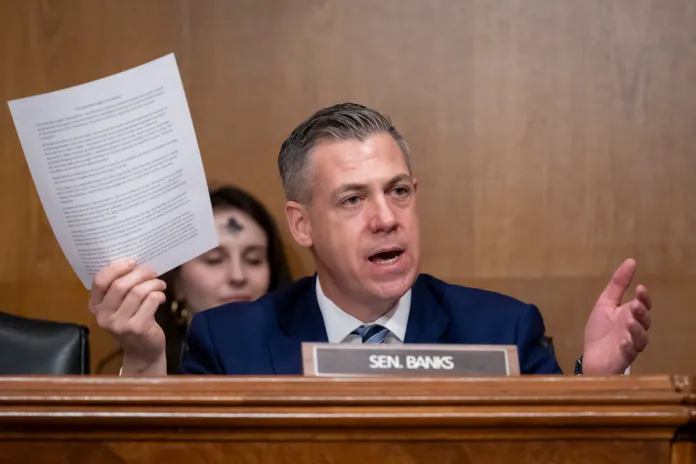
Sen. Jim Banks (R-IN) told the Washington Examiner he doesn’t plan on going to Indiana and placing his thumbs on the scale, but he thinks bringing the Bears across state lines would “be great.”
“If the Bears move to Indiana, I’ll become a Bears fan,” Banks said, adding that Braun and Indiana leaders have been working to secure a deal with the team’s ownership.
“Those discussions are very serious and ongoing, and I’ll do anything I can to help,” the senator said.
Bears wrestle with autonomy and location
The Bears have been eyeing a new stadium in Arlington Heights for decades. The team submitted a bid to purchase the 326-acre Arlington International Racecourse property in June 2021, the most recent serious push by the franchise to relocate.
But the Bears are facing numerous roadblocks as Illinois state lawmakers drag their feet on whether to advance a proposal to create a new stadium in Arlington Heights.
Illinois House Speaker Emanuel Welch (D) said earlier this month he thought it was “insensitive” for the legislature to focus on millions for a new stadium at the start of the legislative session.
“When folks say what’s your priority going into the legislative session, we’re trying to bring down the cost of living,” Welch said at the beginning of the year. “That’s insensitive to what real people are going through right now.”
Jackson said he agreed with Welch, adding that the situation should also be viewed through the lens of black communities, who often were “left out when major investments were made.”
“Large public projects moved forward, while neighborhoods on the South and West Sides were told to wait,” the congressman said. “That history is why I agree with Speaker Welch that lawmakers must be clear about priorities. Illinois has real needs right now. Housing, public transit, education, healthcare, and public safety matter deeply to the families I represent.”
“Public dollars should never be committed without clear benefits for working people,” he added.
Soldier Field, one of the NFL’s oldest venues, lacks the dome and modern amenities many newer stadiums offer.
The Bears currently pay zero property taxes on Soldier Field because the stadium is publicly owned. However, the team has asked the state to help fund infrastructure upgrades — including roads, rail, and utilities — estimated to cost roughly $855 million.
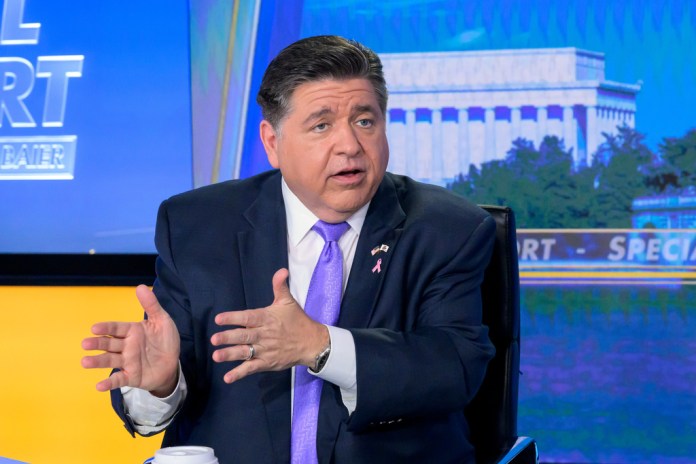
Gov. JB Pritzker (D-IL) has said he is open to allocating state funds for infrastructure upgrades near the site, but he has declined to support tax breaks or spend money to build a new facility despite most, if not all, NFL teams being exempt from property taxes on their stadiums.
“I just want to be clear that the actual fiscal responsibility, the financial responsibility, for that debt does not fall on the Bears,” Pritzker said on Jan. 16 at an event in Chicago. “Having said that, we do not want to leave the city of Chicago or the state of Illinois with enormous debt that goes unpaid, and so we have to figure out how that happens. That does not fall entirely on the Bears.”
Rep. Darin LaHood (R-IL), who represents Illinois’s 16th District, said the Bears are a “historic NFL franchise and a cornerstone of Illinois’ sports identity.”
“The organization supports thousands of jobs, boosts tourism, and provides millions of dollars in economic activity for communities in the Chicagoland area and across our state,” LaHood told the Washington Examiner. “I will continue to work with local leaders to find the best path forward to protect Illinois taxpayers and ensure the Bears remain in the great State of Illinois.”
Illinois village begs state to pump the gas on new stadium as Indiana’s bill advances
Arlington Heights officials are seeing the writing on the wall as Indiana is moving fast to try to approve the stadium commission. In mid-January, officials asked Illinois lawmakers to get moving on a proposal to build a stadium in their village.
Arlington Heights Mayor Jim Tinaglia warned that without legislation to let the Bears negotiate property taxes for the stadium, the team may move across the border.
“We cannot fumble this opportunity,” Tinaglia said in an open letter to the state, per the Chicago Tribune.
But Illinois’s legislative session doesn’t heat up until the spring, with only six legislative session days scheduled between now and mid-March. With that timeline, it would be very difficult, though not impossible, for the state legislature to move forward on a bill for the Arlington Heights stadium.
Meanwhile, Indiana lawmakers are eyeing a spot in Hammond — about 22 miles from downtown Chicago and near the state line. Indiana would own the stadium and lease it to the Bears for at least 35 years.
Hammond’s mayor told Fox 32 Chicago that Indiana was willing to offer more, while Illinois only appeared to be “digging in against the Bears.”
“The Bears’ fight song is ‘the pride of Illinois,’ and it doesn’t seem like they’re being treated like the pride of Illinois right now,” said McDermott.
Indiana officials have said the state would contribute $1 billion to build a new stadium. Rep. Marlin Stutzman (R-IN) told the Washington Examiner he isn’t concerned about the cost to the state, saying the Bears’ potential move to Indiana would have a “huge” economic impact on growing northwest Indiana.
MICHELE TAFOYA’S PAST TRUMP CRITICISM RESURFACES AS MINNESOTA SENATE RACE TAKES SHAPE
He said he trusts Braun and the Bears to create a “feasible, cost-effective deal that both sides will feel enthusiastic pursuing. He’s been engaging in conversations with state lawmakers, he said, many of whom he worked with when he served in the state House and Senate before coming to Congress.
“Should they need any assistance in getting the Bears to Indiana, I am working to help,” Stutzman said.