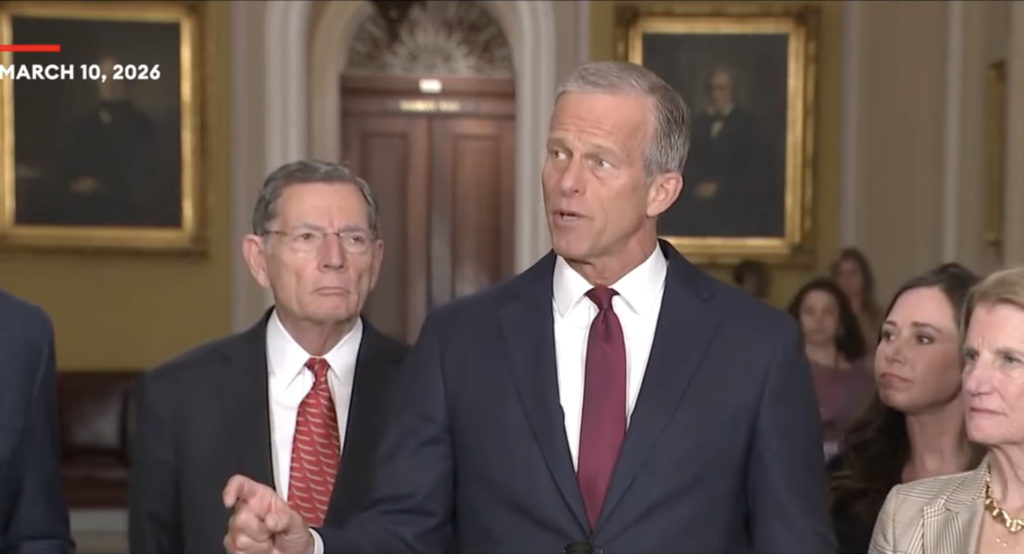
Senate Majority Leader John Thune is determined to continue missing opportunities, but wants you to know that it’s not his fault. In the latest scene of this farce, last week Thune swore that he would bring the SAVE Act to the Senate floor for a vote (like he already promised to do at the end of February) … but, since he doesn’t have 60 votes, he would be “very, very surprised” if it passed.
The word “saboteur” comes to mind.
The Republicans could easily end the “zombie” filibuster — a piece of Senate paraphernalia of no nostalgic or traditional importance — by lowering cloture (the procedure to end debate and actually vote on a bill) from 60 to a simple 51 majority with Vice President Vance ready to break any ties.
But it’s even easier than that. Several weeks ago, in Human Events, Connie Hair (Rep. Louie Gohmert’s chief of staff for more than ten years) wrote concerning the Senate misheva over SAVE:
The Senate’s Standing Rules have been dissected ad nauseam since the House took S.1383, a bill already passed by the Senate, gutted its text, replaced it entirely with the SAVE America Act, and returned it as a privileged message. That procedural posture matters. There is no need to “nuke” the filibuster lowering the cloture threshold from 60 votes to 51 to call up the bill (emphasis mine). Under the Senate’s existing rules, the message can be called up for debate. After the two-speech rule is exhausted or there is no one left wishing to speak, the bill is voted up or down by simple majority.
In other words, the Senate leadership could bring up and pass the SAVE Act whenever it wanted. Not doing that reveals much more than Thune wants to publicly admit. As Hair says, “If Sen. Thune files for cloture anyway to resurrect a 60-vote hurdle, he is conceding that the Senate doesn’t intend to consider this bill. It’s a facade to cloak killing the bill while claiming they held the promised vote.”
Why is this important, besides the fact that 84 percent of Americans — Republican, Democrat, white, black, Hispanic — want the same basic election integrity protections already in place in the UK, Mexico and Canada? Because Senate leadership wants us to repeat one of the greatest mistakes of ancient Rome.
In 212 AD, Emperor Caracalla changed the direction of the Roman Empire by declaring practically everyone living within the empire to be Roman citizens. “I grant, therefore, to all free persons throughout the Roman world the citizenship of the Romans,” the emperor decreed.
It was a cultural-political thunderbolt. Before this time, Roman citizenship had been a pearl of great price, jealously guarded. Being a Roman citizen set a man apart. Citizenship brought one fully into communion with the city via equality under the law and the right to vote. Citizenship meant that your family had been citizens since the founding of the city or, had earned the status through exceptional service or bravery. In fact, being a Roman went deeper than politics. Romanus sum — “I am a Roman” — preceded the legal category of citizen. In a real way, the citizen was part of the city and the city was part of the citizen, the two forming a whole.
Caracalla’s edict — whether a tactic to raise more tax money, a ploy to increase his troops (traditionally only citizens could be soldiers) or a bribe for the gods’ forgiveness after he murdered his brother, Geta — destroyed all that. Soldiers, who had before been united by the ties of citizenship and love of Rome, now had deeper loyalties to their local homes and tribes. Under the strain of incorporating millions of new citizens, the imperial government cracked even more. Bribery, corruption, and chaos spread and increased. Where before there had been unity, now the ground was more thickly sown with division and the potential for more.
Even worse than the political ramifications was the equal and opposite moral reaction: If everyone was a citizen, if the rights and privileges of citizenship were now just bureaucratic baubles for rulers to hand out for their own personal agenda, if Romanus sum was now just a box to be checked, what was the value of citizenship?
A similar question is before us now. With no way of telling if ballots are cast by living, breathing citizens, how can we tell if a certain election result is actually the will of the people? Once that question escapes the stable, the entire constitutional structure becomes suspect along with all forms of self-government. To paraphrase Confucius, every government depends on the loyalty and trust of its people. If that trust dies, nothing can hold them together except chains and whips.
This is the wildfire with which John Thune is playing. And it is a legitimate question, at this point, to ask why he is playing with it. What interests take precedence over 84 percent of Americans wanting U.S. elections reserved for U.S. citizens?
Whatever they are, they are powerful, taking precedence over even protecting one of the GOP’s own inner clubbers. Getting SAVE on the president’s desk could save Sen. John Cornyn’s (R-Texas) career by winning him a Trump endorsement. This is especially crucial to the senator since he only won 43 percent of the vote in his primary against Texas Attorney General Ken Paxton, who won 40 percent. They must now face off in a May runoff primary. And while Cornyn now writes New York Post op-eds declaring SAVE more important than the filibuster in an attempt to woo Texans, Thune seems more than content to let Cornyn sink.
Over this situation, President Trump wields much influence over GOP senators; endorsements, for example. But that does not mean we can just sit back and grill, waiting for Trump to do all the heavy lifting. Sen. Tim Scott, as chair of the National Republican Senatorial Committee, also wields considerable influence by determining which GOP Senate races receive what financial support. 10,000 citizens contacting his office, clearly expressing their anger at Thune’s ennui and their determination that the Senate not just vote on but pass SAVE, could cause a tectonic shift behind closed doors.
Changing government policy from the outside is always a tall order, but it is not without precedent. On Dec. 22, 1807, President Jefferson signed the Embargo Act which cut off all American trade with foreign nations. Opposition in New England was high and throughout 1808, the ordinary farmers, small merchants and sailors of New England fought back. Town hall meetings were organized. Speeches were given, articles written. Newburyport, Massachusetts gathered the signatures of 803 citizens on a petition requesting Congress repeal the Act. Other towns followed suit. The Congressional Massachusetts delegation acted as the bridge between their constituents and DC. The action of New Englanders paid off. Although James Madison won the presidential election of 1808, President Jefferson, as one of his last official acts, signed the repeal of the Embargo Act.
If we want to restore ourselves as independent, self-governing citizens, we must act as those New Englanders did. And we must act now, while GOP senators are reminded that tough tweets and promises are not enough anymore.
Strike while the iron is hot.