Republican senators have spoken with notable urgency and clarity about the war against Iran, saying the strikes are unavoidable, overdue, and necessary. This was the moment, delay was no longer an option, and decisive action was required, they argue — even though polling shows the strikes are unpopular, and they carry obvious military and economic risks.
That willingness to decisively support an unpopular, high-risk issue stands in stark contrast to how Republican senators have treated the SAVE America Act, a low-risk, broadly supported piece of legislation where GOP urgency has all but disappeared.
The Safeguard American Voter Eligibility (SAVE) America Act would require documentary proof of citizenship to register to vote and photo ID to cast a ballot in federal elections. It’s legislation that is overwhelmingly popular, with polling showing roughly 80 percent of Americans — including a large number of Democrats — support voter ID and citizenship requirements.
Despite that level of public support, and the backing of at least 50 Senators, the legislation has been treated as a matter requiring slow deliberation, careful consideration, and patience with Senate procedures — rather than an opportunity that must be seized before it slips away.
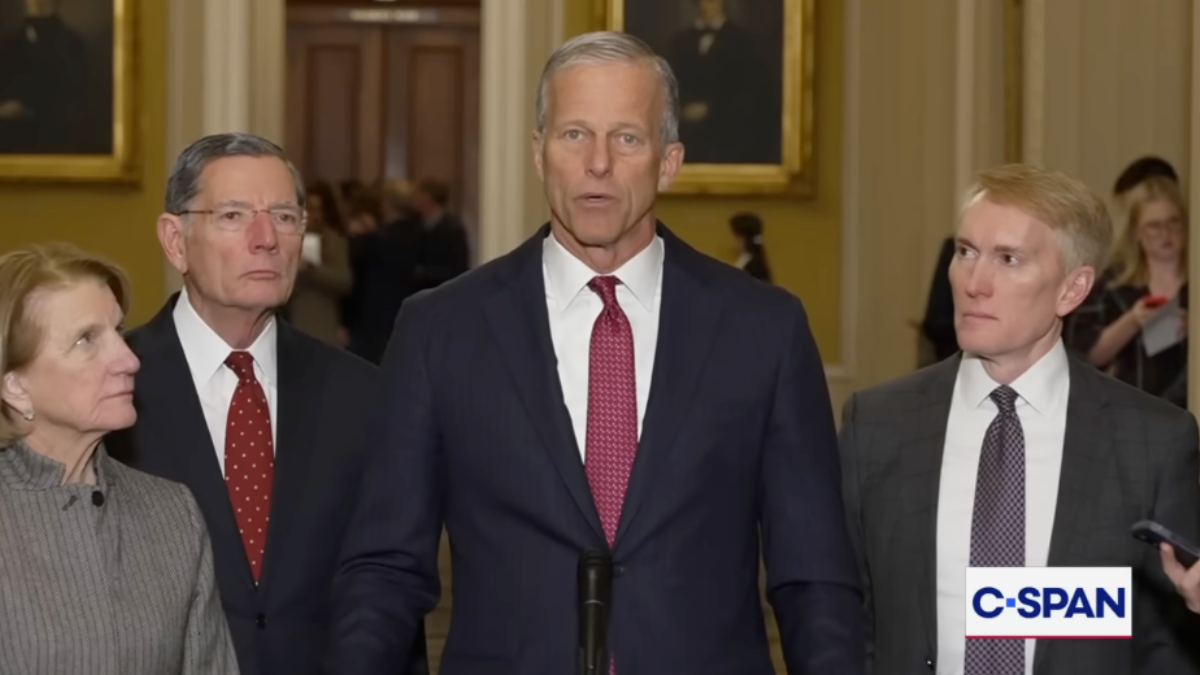
Senate Majority Leader John Thune has urged caution, saying that using a talking filibuster — which would allow the Republican-controlled Senate to force a simple-majority vote after Democrats fail to hold the floor continuously to stop it — to pass the SAVE America Act would make it “very hard to pivot and get back to open up the government.”
“If you go down that path, you’re talking about the need to table what are going to be numerous amendments and an ability to keep 50 Republicans unified pretty much on every single vote,” he continued. “There just isn’t the support for doing that at this point.”
Yet when it comes to Iran strikes, concerns about process or deliberation seem to disappear, despite polling showing the strikes are unpopular, opposed by nearly half of Americans, according to a three-poll average.
In justifying the strikes, Thune cited Iran’s “nuclear ambitions,” ballistic missile development, and sponsorship of terrorism. “Despite the dogged efforts of the president and his administration, the Iranian regime has refused the diplomatic off-ramps that would peacefully resolve these national security concerns. I commend President Trump for taking action to thwart these threats,” Thune said.
The message was clear: The risks of inaction outweighed the risks of acting now. That same logic, however, has not been applied to the SAVE America Act, legislation where the risks of not passing it are overwhelming.
Texas Sen. Ted Cruz expressed similar urgency for the Iran strikes on Meet the Press: “My counsel to [Trump] was that the Iranian regime has never been weaker, that it was teetering and now was the time. My advice was do not miss this opportunity.”
Sen. Lindsey Graham struck a similar tone on Iran, saying, “This is not Iraq. This is not Germany. This is not Japan. We’re going to free the people up from a terrorist regime.”
But when it comes to ensuring that Americans are “free” vis-à-vis free and fair elections, the urgency similarly vanishes. To be clear, these senators haven’t ignored the SAVE Act. They’ve all, in varying degrees, expressed support for the legislation. The issue, however, is prioritization.
Republicans currently hold a narrow but guaranteed Senate majority, and they have a limited window to act. The SAVE America Act is nationally popular and has the needed votes in the Senate to pass with the mobilization of the talking filibuster. It’s low-risk with high return. If there were ever a case for moving quickly, this would be it.
If GOP senators pushed the SAVE America Act with the same urgency and full-throated support with which they’ve backed the decision to strike Iran, it would already be law. Instead it remains stalled.
Brianna Lyman is an elections correspondent at The Federalist. Brianna graduated from Fordham University with a degree in International Political Economy. Her work has been featured on Newsmax, Fox News, Fox Business and RealClearPolitics. Follow Brianna on X: @briannalyman2